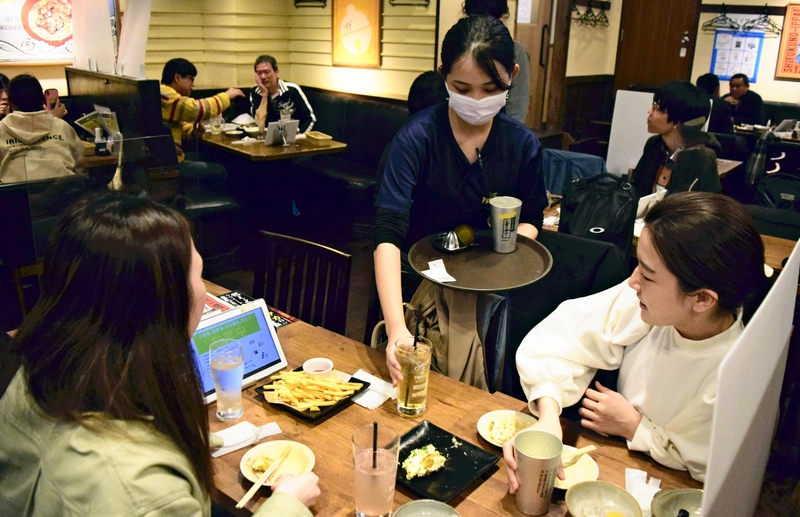
While Tokyo, Osaka and other prefectures have lifted their business hour restrictions on restaurants and bars, more than a few establishments are taking a cautious stance because of the difficulty of predicting a future outbreak of the coronavirus, or the uncertainty of whether customers will stay out late again.
An izakaya restaurant in Tokyo's Shinagawa Ward, sticking with the metropolitan guidelines, stopped serving alcohol by 8 p.m. and closed at 9 p.m. on Friday and has decided to serve alcohol and stay open until 11 p.m. from Monday. As the establishment is among those certified as having taken thorough infection prevention measures, all these restrictions ended on Monday.
"As this area has long had big demand for post-party drinking, the extension of opening hours will have a big impact on sales," said the manager of the izakaya, which is operated by Watami Co. "We will be finally able to respond to their expectations."
Watami will extend the hours of its outlets from Monday and reopen about 50 shops that were temporarily closed during the pandemic. However, the company will allow each outlet to decide how late they will remain open based on customer traffic. Watami does not intend to have a blanket restart of late-night operations.
-- Staff shortages
As the prolonged pandemic led to changes in social behavior, it has prompted questions in the industry over whether staying open until late at night will actually lead to increased sales.
Tsubohachi Co., a leading izakaya chain, will have its directly-operated outlets stay open no later than 11:30 p.m. In pre-pandemic times, they remained open until 2 a.m. on weekends, but the company is putting off resuming those hours.
"Many customers now tend to drink at only one place," a Tsubohachi official said. "It is difficult to see many customers coming late at night, and we can't find enough part-timers."
Major beer companies have seen a surge in shipments to restaurants and bars since the lifting of the state of emergency at the end of September. Suntory Beer Ltd. expects commercial shipments of beer products in October to be 2.4 times the volume of September. However, it also forecasts a November shipment volume 2.5 times that of September, an indication that the pace will not pick up.
There are many other companies besides the izakaya chains that are cautious about resuming late night services.
Family restaurant giant Skylark Holdings Co., which operates the Gusto chain, will have its outlets remain open until 10:30 p.m. during October, with an expected return to normal hours until 11:30 p.m. in November at the earliest.
Restaurant chain operator Saizeriya Co., citing that staying open late would be unprofitable because customers may not return, will have most of its restaurants close at 10 p.m. for the time being.
"Since it is also costly, we are leaning toward not having late night operations," said Saizeriya President Issei Horino, suggesting that the company will not return to its pre-coronavirus status.
-- Few company parties
In a survey conducted Oct. 1-11 by Tokyo Shoko Research, Ltd. and released Friday, 70% of about 8,200 companies across the nation said they would not hold year-end or New Year parties. While the figure is down compared to December last year when it was over 90%, it suggests that many companies still remain wary about a new surge in infections.
"As demand for parties will not recover and subsidies from municipalities will end, it will make it even harsher for some businesses," an official at Tokyo Shoko Research said.
An official at a major restaurant chain said, "We are entering a critical period. I hope the central and local governments can do something to encourage consumption."
Read more from The Japan News at https://japannews.yomiuri.co.jp/