Touchless services and devices that do not require human interaction are increasingly being used in restaurants as the novel coronavirus continues to spread and hygiene-conscious customers shun face-to-face contact.
-- From start to finish
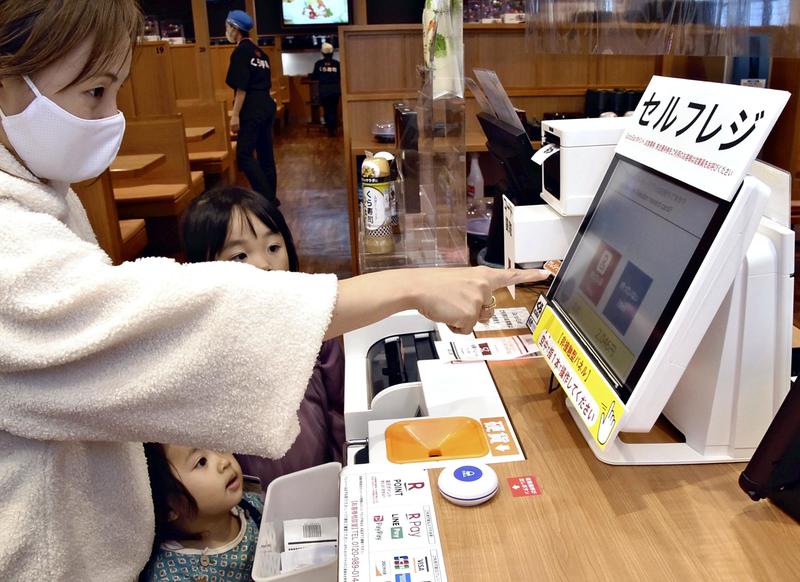
A new branch of the Kura Sushi conveyor belt sushi restaurant chain opened on Nov. 17 in Higashi-Murayama in western Tokyo that features a touchless device instead of wait staff for seating information. To enter the number of people in a party, customers point their finger close to the touch screen rather than contacting the device itself.
A ticket is printed that shows the seat number, and customers proceed to their table with no staff member guiding them. Customers order food using a sterilized tablet or by linking their smartphone to the store's website and placing orders there. Food is delivered via the conveyor belt, as usual. Payment is made using a self-service system that users need not touch.
Customers can enter the restaurant, sit, eat sushi and pay the bill without having any face-to-face contact with store personnel.
Such a system helps prevent the spread of the novel coronavirus and reduces waiting times as the shop's personnel can now rely on electronic devices to perform various services, which frees up the time of limited staff.
Kura Sushi Inc., a leading operator of conveyor belt sushi restaurants, had originally planned to introduce this convenience-enhancing system by 2025. However, the company bumped up the deadline because of the pandemic and now plans to have all of its 463 stores equipped with the system by the end of next year.
"I feel relieved because there's less contact with the shop's personnel," said Mari Suzuki, a 36-year-old homemaker from Tokorozawa, Saitama Prefecture, who went to the restaurant with her two daughters. "The staff still treated us politely, such as when they suggested using children's chairs for the kids."
-- The right robot in the right place
Monogatari Corp., the operator of a nationwide restaurant chain based in Aichi Prefecture, will introduce by next March robot servers dubbed Servi at 310 of its Yakiniku King and Sushi & Shabu-Shabu Yuzu-An eateries. Both chains are all-you-can-eat restaurants. The company carried out tests using Servi at four of its restaurants during which robots moved up to 8 kilometers a day with no apparent trouble.
"Having the robots deliver orders to customers and take away empty plates from tables means our staff can focus on other work, such as sterilization, which can also increase customer satisfaction," said Shoma Nagata, a 29-year-old store manager at Yakiniku King Itabashi Maeno-cho in Itabashi Ward, Tokyo. The restaurant introduced the robots ahead of other branches in early September. "Resources are better allocated this way," Nagata said.
-- Pedal power
DyDo Drinco, Inc., a leading manufacturer and seller of soft drinks based in Osaka Prefecture, has developed a foot-operated vending machine for soft drinks. Sales of soft drinks via vending machines account for more than 80% of its domestic sales of such products.
During the state of emergency in April and May, employees in DyDo's development division came up with the idea of creating a vending machine without push buttons.
In October, the company installed a trial machine for its employees to use within its Tokyo head office in Minato Ward.
Users select a beverage by pushing a foot pedal that corresponds to the number assigned to a drink. Another pedal opens the vending machine cover. This design means people no longer need to touch high-contact areas.
"As people's awareness of hygiene has been growing, we'd like our customers to use our vending machines with a greater sense of safety and reassurance," said Naoaki Morishita, 32, who is in charge of DyDo's public relations.
Nobuyuki Sekiya, 55, a business consultant specializing in restaurant management for small and midsize firms, said: "During the coronavirus pandemic, people's sense of reassurance is a top priority, and the increased use of contactless devices coupled with less face-to-face services will also help ensure worker safety. If more large companies implement such service systems, the cost of relevant devices will decline, thus leading to greater adoption among small and midsize businesses."
Read more from The Japan News at https://japannews.yomiuri.co.jp/