This is the third and final installment of a series on how local entities are proceeding with preparations and the implementation of their ideas.
Restaurants are exploring ways to cater to the international athletes and foreign visitors who are expected to arrive for the Tokyo Olympic and Paralympic Games.
-- Local products
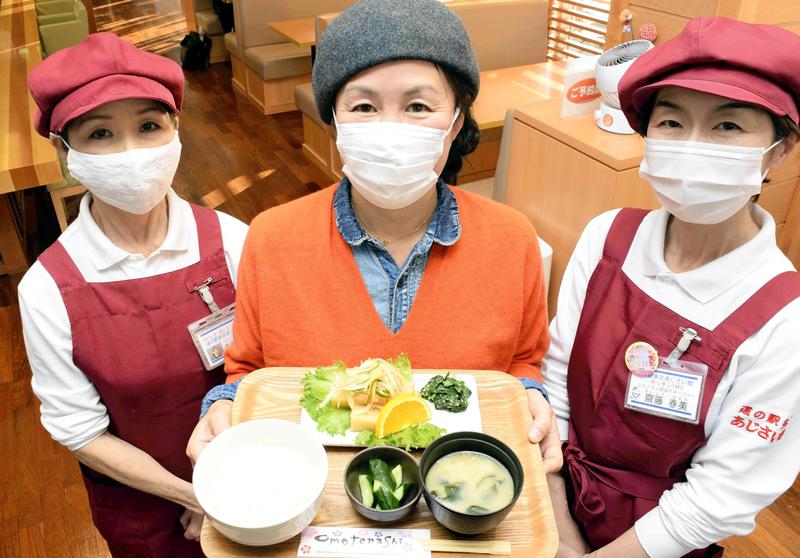
Kitchen TAKO, which is a part of the roadside rest area "Michi-no-eki Tako Ajisai-kan" located near Narita Airport in Tako, Chiba Prefecture, had to temporarily close its doors during the spring because of the novel coronavirus pandemic.
Since July, Kitchen TAKO has served a set meal using freeze-dried Koya tofu marinated in sweet vinegar sauce to attract vegan customers, many of whom are foreigners. The dish is prepared with vegetables that are mostly locally sourced, and the broth for the miso soup is made by boiling kombu, or dried kelp, and dried shiitake mushrooms.
The restaurant is working to expand its menu ahead of the Tokyo Games in an effort to have foreign visitors taste the agricultural products grown in the prefecture. The roadside rest facility is also considering putting stickers on its souvenirs to show that it is vegan friendly.
"Foreign customers have not come in because of the pandemic and the postponement of the Olympics, but people in Japan are becoming more aware of the vegan diet," said restaurant manager Harumi Saito. "Even non-vegans ordered the Koya tofu set meal and they said it was very satisfying."
Food coordinator Akemi Kawaguchi, who created the menu, said: "Many foreigners want to try dishes that are eaten by Japanese people. We'll keep working hard to make sure that more people eat at our restaurant by taking advantage of the Games."
-- Halal-friendly
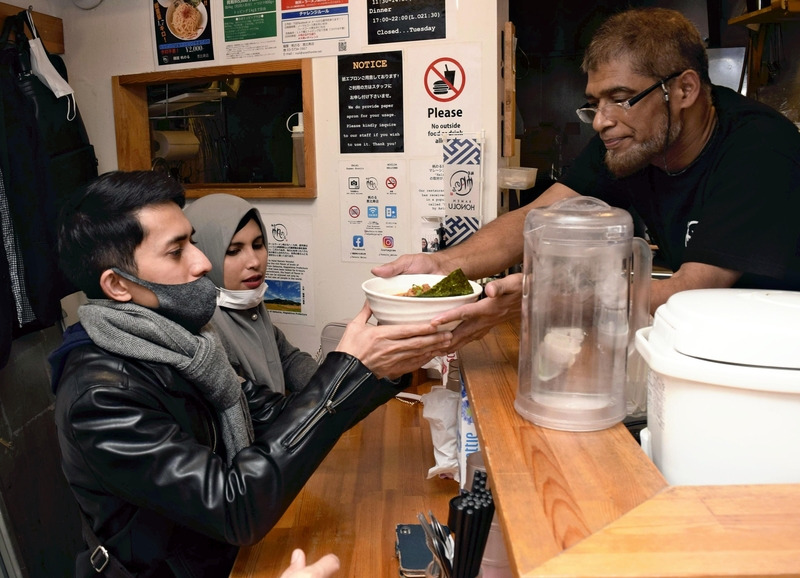
"Mettcha oishii!" (Incredibly delicious) exclaimed one of the Muslims who was eating ramen at Ramen Honolu in the Ebisu area of Tokyo.
The ramen shop serves dishes that meet halal requirements determined by Islamic dietary law, which also prohibits the consumption of pork and alcohol.
The shop's halal menu includes spicy fried chicken ramen and gyoza dumplings. The owner of Ramen Honolu Satoshi Shimasue, who opened the shop three years ago, said, "whenever I asked Muslims what they wanted to do in Japan, they would answer, 'I want to eat ramen,' but there are hardly any [halal] shops around."
Shimasue is trying to expand the availability of halal food by doing such things as developing halal instant ramen.
The number of customers at his shop is now at about half the number of its peak because of the pandemic. But he is highly motivated.
"There are not enough halal-friendly measures in place in Japan yet," Shimasue said. "With the Tokyo Games approaching, as well as the Osaka-Kansai Expo 2025, I'd like to think of ways to make [Muslims] feel more welcome."
-- Food safety on agenda
Ensuring food safety is also a challenge. Food poisoning is a matter of concern in summer when the Olympics are held. It was made mandatory in June this year that eateries meet the requirements of the Hazard Analysis and Critical Control Point (HACCP), the international standard of hygiene, within one year.
Of the about 30,000 members in the Tokyo Food Sanitation Association, most are small restaurants. Although they are also subject to HACCP requirements, it became impossible to hold all of the HACCP seminars scheduled for this year because of the pandemic.
"I feel like preparations have been delayed because coronavirus measures were prioritized," an official in charge said. "We'd like to boost the public's awareness [of HACCP]."
Prof. Shizunobu Igimi of the Tokyo University of Agriculture, who is familiar with food hygiene, said: "It is necessary to study what kind of dangers can arise when food is sold outside a shop and take necessary measures. It is essential to have HACCP understood by restaurant operators before the Olympics to ensure food safety."
Executive chef of Tokyo's Japanese restaurant Waketokuyama, Hiromitsu Nozaki, who advised the Olympic Organizing Committee on the menu at Olympic Village, said, "I hope the Tokyo Olympics provide a chance to demonstrate Japanese food culture to the world, while also making people feel that they are not fighting the coronavirus alone."
It will be a crucial eight months before the opening ceremony of the Tokyo Games.
Captions
Yomiuri Shimbun photos
Kitchen TAKO staff show a vegan set meal in Tako, Chiba Prefecture.
Ramen that has met halal requirements is being served at Ramen Honolu in Shibuya Ward, Tokyo.
Read more from The Japan News at https://japannews.yomiuri.co.jp/