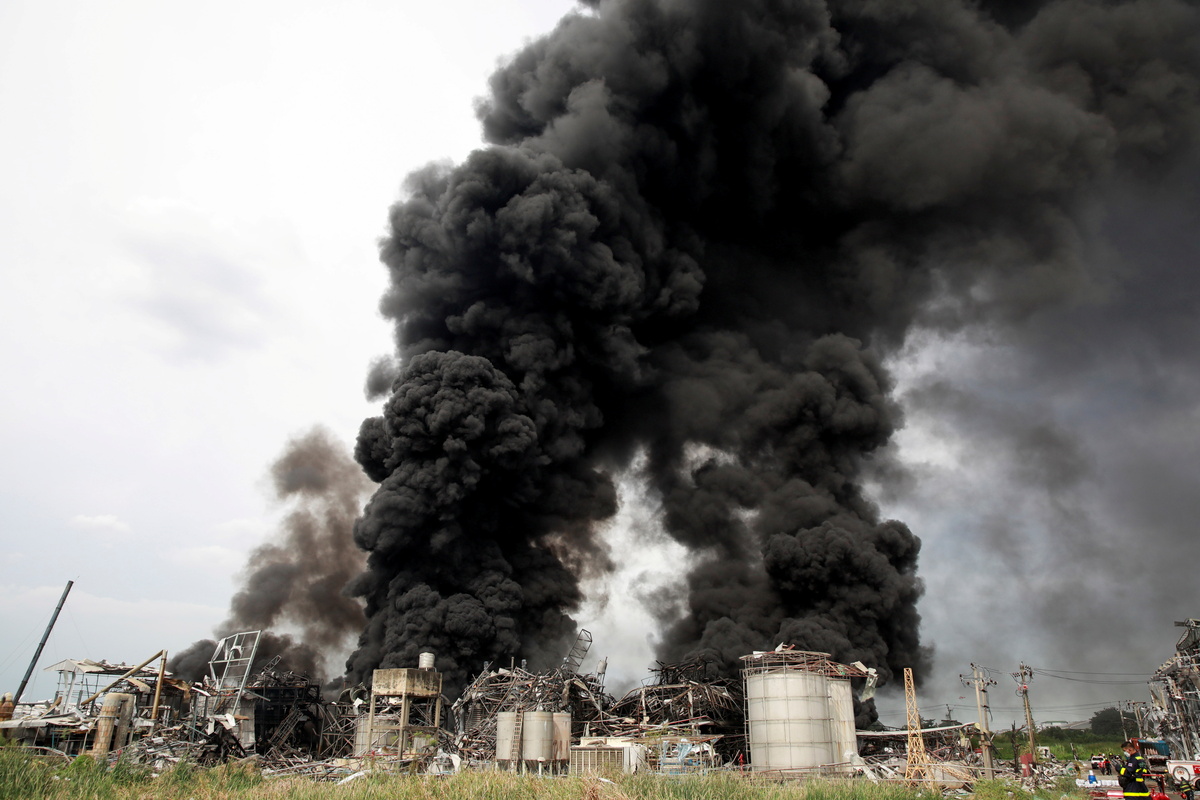
Evacuated residents warily began returning to their homes on Bangkok's outskirts on Thursday after a chemical factory went up in flames earlier this week, as experts called for air and water to be thoroughly tested for any lingering toxic chemicals.
One firefighter died and at least 33 people were injured in Monday's blaze at Ming Dih Chemical.
A storage tank containing styrene monomer, used to produce polystyrene foam, exploded and caused the fire. Styrene can be deadly if ignited and mixed into the air.
Last year, a leak of styrene gas at a factory in southern India killed 12 people, many as they slept, and sickened hundreds.
Thai authorities on Wednesday said residents living outside the immediate 1-kilometre (half-mile) radius could return home.
On Thursday, the Pollution Control Department told Reuters that air concentration of styrene was between 8 to 20 particles per million (ppm) within 1 km of the site, down from 1,035 ppm on Monday.
The safe level is up to 20 ppm, while exposure to 1,100ppm can have severe effects on human health.
"The air is now safe, because the pollutants have thinned out and risen up into the atmosphere," said Athapol Jaroenchansa, the department's director-general.
He said authorities are collecting water and soil samples every day, adding that any contamination was expected to dissolve within a week.
However, United Nations environmental expert Kakuko Nagatani-Yoshida said authorities should maintain long-term checks of aquifers and fish because styrene characteristically disperses into water.
She said the accident underscored a need for better safety regulations and urban planning in Thailand and across Asia.
"The pattern of industrial accidents is only becoming worse in Asia," said Nagatani-Yoshida, the U.N. Environmental Programme's Asia coordinator for chemicals, waste, and air quality.
One returning resident, Kanin, told Reuters the government's air quality report encouraged him to return to his house, just over 4 km (2.5 miles) from the factory.
"But that doesn't mean I'm not worried about future incidents, considering how lacklustre the government is at crisis management," said the resident, who asked to be identified only by his first name.
(Editing by Kay Johnson and Giles Elgood)