The decision now for the RBA board is whether to cut in May – a week before Joe Hockey hands down the budget – or to wait and see what the government has planned before cutting June.
The RBA’s statement concluded that “further easing of policy may be appropriate over the period ahead, in order to foster sustainable growth in demand and inflation consistent with the target”.
Such wording – the same as last month – ensures that the market will continue to expect the bank to cut in the next few months.
The RBA gave few new reasons for its decision. It essentially released the same statement as it did last month – when rates were also kept on hold.
It did note again note that “lending to businesses... has been strengthening recently”, and crucially with respect to house prices that “dwelling prices continue to rise strongly in Sydney, though trends have been more varied in a number of other cities”.
The RBA also said that the exchange rate, while lower than 12-18 months ago, is likely to fall further given the falls in commodity prices.
“A lower exchange rate is likely to be needed to achieve balanced growth in the economy”. This would indicate that the bank expects the dollar should fall below US$0.75, and perhaps if it does not, it will again look to cut rates as a means of causing the value of the dollar to fall.”
Updated
So the RBA has kept the cash rate on hold at 2.25%.
It is a decision that has surprised the market – which had priced in a 75% chance of a cut.
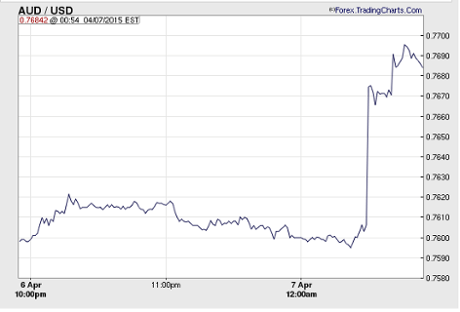
Here’s that spike in the dollar
Updated
The stock market has also dropped about 0.5%, but it remains ahead on where it started the day.
Not surprisingly, the value of the dollar jumped about 1% straight away, but it is now steady at around US$0.767
The media release is a virtual cut and paste of last month’s.
The bank sees the economy is growing weakly, and knows there is a lot of “spare capacity” (i.e. unemployed and idle machinery), but it seems it actually wants to wait to see if there is any impact from the last interest rate cut in February before moving again.
RBA keeps interest rates on hold!
Here’s the statement from the Reserve Bank (my summary to follow):
At its meeting today, the Board decided to leave the cash rate unchanged at 2.25 per cent.
Moderate growth in the global economy is expected in 2015, with the US economy continuing to strengthen, even as China’s growth slows a little from last year’s outcome.
Commodity prices have declined over the past year, in some cases sharply. The price of oil in particular is much lower than it was a year ago. These trends appear to reflect a combination of lower growth in demand and, more importantly, significant increases in supply. The much lower levels of energy prices will act to strengthen global output and temporarily to lower CPI inflation rates. Prices for key Australian exports have also been falling and therefore Australia’s terms of trade are continuing to decline.
Financial conditions are very accommodative globally, with long-term borrowing rates for several major sovereigns at all-time lows. Financing costs for creditworthy borrowers remain remarkably low.
In Australia the available information suggests that growth is continuing at a below-trend pace, with overall domestic demand growth quite weak as business capital expenditure falls. As a result, the unemployment rate has gradually moved higher over the past year. The economy is likely to be operating with a degree of spare capacity for some time yet. With growth in labour costs subdued, it appears likely that inflation will remain consistent with the target over the next one to two years, even with a lower exchange rate.
Credit is recording moderate growth overall. Growth in lending to investors in housing assets is stronger than to owner-occupiers, though neither appears to be picking up further at present. Lending to businesses, on the other hand, has been strengthening recently. Dwelling prices continue to rise strongly in Sydney, though trends have been more varied in a number of other cities. The Bank is working with other regulators to assess and contain risks that may arise from the housing market. In other asset markets, prices for equities and commercial property have risen, in part as a result of declining long-term interest rates.
The Australian dollar has declined noticeably against a rising US dollar over the past year, though less so against a basket of currencies. Further depreciation seems likely, particularly given the significant declines in key commodity prices. A lower exchange rate is likely to be needed to achieve balanced growth in the economy.
At today’s meeting the Board judged that it was appropriate to hold interest rates steady for the time being. Further easing of policy may be appropriate over the period ahead, in order to foster sustainable growth in demand and inflation consistent with the target. The Board will continue to assess the case for such action at forthcoming meetings
The arguments for and against a cut to interest rates
So with the decision about to occur lets have a recap:
For a cut:
The economy is not growing fast enough to get unemployment down
Mining investment is falling off a cliff - we need the non-mining sector to get in the game
The approvals of the building of houses seems to have hit a plateau
Job adverts have hit a plateau
The exchange rate is low, but perhaps should be lower.
The market expects a cut!
For a hold:
Only cut rates in February - let’s wait and see
Housing prices in Sydney are still pretty hot - and there are concerns of a glut in apartments in places like Melbourne
Rates are already at 2.25% - unheard of levels! - will a cut at this point actually change anyone’s behaviour?
We wait and see what the bank does…
Updated
So how low are home loan rates at the moment?
The RBA provides figures for the average standard variable rate, and the “discount” rate – which most banks offer, and which most people get at least for the first few years of their loan.
Currently the average standard variable loan is 5.65% , a 0.25% pts cut would take that to 5.4% - the last time rates were that low was 1968.
Yep, we’re at a point of seeing rates as low as a time when we had yet to put a man on the moon.
The average discount rate is currently 4.8%. The RBA only has figures for such rates back to 2002. But the lowest the standard variable rate has been since 1959 is 5.0%, so it is pretty clear we’re in very strange territory.
A cut today would mean any more cuts would have the cash rate starting with a “1”, and that is pretty amazing – and something I never thought I’d see.
Of course it is not just about home loans. The decision will affect savers as well – especially those self-funded retirees who gain income from interest on term deposits.
While the average six months term deposit rate is still a little bit lower than the level they reached during the GFC, they are still well below what savers would have been accustomed to over the past 15 years:
With inflation running at around 2.2%, the average term deposit rate of 2.35% is barely offering a real return. Even the “special” rate offered by banks of around 2.7% is providing a real return of only around 0.5% – well below the average real rate over the past 15 years of around 1.1%:
Another reason the RBA could consider cutting rates is our exchange rate. A lower value of our dollar assists our export industries – as it makes it cheaper to buy Australian goods and services (and more expensive to buy imports).
When the RBA began cutting rates in November 2011 the Australian dollar was worth around US$1.03. Now it is trading at around US0.76:
Some believe that given the falls in commodity prices like iron ore, the value of our dollar should be lower – nearer to US$0.70. One way to help that happen is to cut rates.
Given that the market expects the RBA to be more likely to cut rates than not, if the RBA does keep rates on hold, it will be interesting to see what happens to the value of the dollar.
Foreign exchange rate dealers are jittery folk who react to the slightest bit of news – even if it is expected news. But unexpected news can see big dives or falls.
While most expect a cut of 25 basis points (0.25 percentage points), the bank can cut by more if it chooses to. Given the market expect at least two more rate cuts this year, the bank could decide to make a bold statement and cut by 50 basis points.
Such a move might actually provide a bit of a shock to the economy – especially if there was the sense that that was as low as the bank was going to cut them. It might actually get those businesses who perhaps are waiting for lower rates to start investing.
Or it might just send the whole economy into a panic!
One other big issue for the RBA is the falling price of iron ore. It’s now down to around US$46.70 a tonne – well down on the $US136 a tonne price that was going less than 18 months ago.
That translates to mining industry investment falling much, much faster than either the bank or the government would like.
So how to get investment going in the non-mining sector? The RBA hopes lower interest rates.
But how much will it help is the big question. While small business lending rates are not at 40 year lows as is the case with mortgage rate, they are still as low as they have been in the past 10 years:
Will another rate cut see small businesses invest more than they currently are?
Those who oppose a cut argue it won’t, and all it will do is fuel investors to borrow money to buy houses rather than entice people to borrow to build a house
The problem for the RBA is that many believe a spark has already been set off in the housing market. House price rises in Sydney and Melbourne – driven by investors – have many worried that rates cuts are just fuelling a housing bubble.
However, last weeks housing data suggests that the level of building activity has come off the boil somewhat.
The building approvals data showed that dwelling unit approvals (which includes houses and dwelling apartments) has improved over the past year – and is growing strong than it was six months ago:
But one problem with that data is that figures for non-house dwelling units – apartment buildings and flats – can be a bit jumpy due to the local government approval process.
If we just look at the growth of private sector house building approvals, the picture is much less buoyant.
Every state saw weaker growth than 12 months ago, and across all there was in effect 0% growth in new houses approved to be built.
The RBA wants a strong construction sector to take up the big slack from the falling mining industry. These figures would have them wanting to cut rates.
There’s been a bit of economic news around today that could have an impact on the RBA’s decision.
The NAB job advertisement survey fell for the first time in 10 months. Fewer job adverts means less economic activity, and thus furthering the case for a rate cut.
Last week the ABS’s quarterly job vacancy data was released. It showed a very slight increase of 1.1% in job vacancies from November last year to February this year. Annual growth also remained weak:
The figures translate to little change in the fight for jobs. Across the country there are around 5.2 unemployed per job vacancy – a slight increase on this time last year:
South Australia remains the hardest state to find work – with around 7.3 unemployed per vacancy. Western Australia – despite a worsening jobs market, remains the best place with 4.4 unemployed per vacancy just ahead of NSW with 4.4 unemployed per vacancy.
Overall, however, the lack of improvement suggest an economy in need of some sort of a spark.
Updated
Since the last rate cut in February, the market has continued to predict further interest rate cuts:
Even if the RBA cuts rates today, the market expects more to follow – and has become more bullish about the likelihood of further cuts over time.
In February, the market believed 2.0% was about as low as the RBA would go. Now the market is even predicting a chance of rate being cut all the way to 1.50%.
As I noted yesterday, the market can often get it wrong, but it is rare that the RBA bucks the predictions of the market in the short term – so if it doesn’t cut rates today there is likely to be a lot of movement on the exchange rate and on the share market.
The case for an interest rate cut
The case for making the cut is however not clear cut. Many economists have in fact taken a contrary position to the market and believe the bank will keep rates on hold.
The economy is growing below trend and unemployment has been rising slowly, but steadily – which would suggest the need for a rate cut to help stimulate the economy. But with housing prices have been rising solidly over the past 12 to 18 months, economists believe another rate cut could help fuel a housing bubble.
Updated
Hello and welcome to our live blog on the Reserve Bank of Australia’s announcement on interest rates.
Just two months since it last cut interest rates, the Reserve Bank today is expected to announce at 2:30pm it has again lowered the cash rate – this time to a record low of 2.0%.
Currently the market believes there is a 75% chance that the bank will cut the cash rates. If it does, standard variable mortgage rate will fall to the lowest rates since 1968.