SUMMARY
- RBA keeps rates at 2% - as expected
- But policy will remain “accommodative”, says Glenn Stevens
- He cites weak investment and “spare capacity” in the economy
- Leaves the door open to possible further cuts later this year, most experts agree
- He reiterates concerns about Sydney house prices
- The dollar rises slightly to US76.85c
- ASX200 sold off a bit though - down 1.5% on the day
Thanks for being with us. We’ve just launched a news story here.
Another high-profile economist believes the easing bias remains with the path open to further cuts. This time Warren Hogan, chief economist at ANZ.
While the bank is worried about Sydney house prices, it hopes the efforts it and APRA are instituting with regards to credit growth will help keep a lid on things. And it remains of the view that Sydney is pretty much the only capital city where growth is approaching bubble like conditions (not that it uses the term “bubble”).
It pointedly noted that in a situation with spare capacity, low wages growth, low prices growth that “monetary policy needs to be accommodative”
And that suggests unless things start to improve “over the period ahead” then another cut will come.
Given the governor’s statement referred to the poor capital expenditure figures, I wouldn’t be surprised if the bank waits at least three more months until the next lot of those figures are released. If in three months time the outlook for investment for the rest of 2015-16 looks as bad as it does now, then I’d expect another cut to follow soon after.
But for now, at 2.0% remember we are still talking about mortgage rates that are as low as anything seen since Neil Armstrong put his foot on the moon.
So to sum up.
Today the RBA decided to the shock of absolutely no one to keep rates on hold at 2.0%
The bank however did nothing to change the current belief that further cuts could be coming. It continued to make note of the economy “operating with a degree of spare capacity for some time yet”. This spare capacity suggests low wages growth and low inflation.
That means plenty of room for another cut.
So much of the reaction has been around the housing bubble (or not) issue. Comments by Hockey and Abbott have given it a lot of legs.
Stephen Koukoulas poses a key question:
The non-decision by the RBA hasn’t had much of an impact on the market. The value of the dollar has gone from US$0.7660 to US$7675 – a 0.2% increase.
The stock market is not loving the RBA decision. The ASX200 was already down more than 50 points before 2.30, largely because of a weak overnight lead from the US.
Updated
The comments by Hockey and Abbott are in response to questions about a housing bubble. The problem of course with a bubble is that if it burst, houses will be very much more affordable very quickly – too quickly in fact.
Tony Abbott has also bought into the housing price debate. He told parliament just now that:
Millions of Australians have borrowed money to buy a house. Millions of Australians have mortgages and the last thing they want to see is the decline in the most important asset. The last thing Australians want to see is a decline in the value of their most important asset.
So it would appear that the government is concerned about housing affordability - so long as it means that houses don’t actually become more affordable.
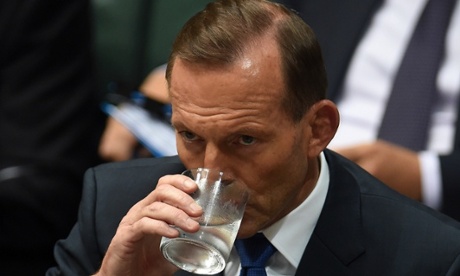
In Question Time just now, Joe Hockey has been asked about John Fraser’s housing bubble comments which we also touched on earlier.
He told parliament:
You know what? For anyone who has a loan out there, they would be wishing their home is worth more than their loan. That is what they would actually want. Actually, there are a lot of Australians out there with a mortgage that hope that the value of their home increases above that of their mortgage.
Leading economist Shane Oliver of AMP reckons there’s still a 50-50 chance of another cut this year. He’s basing that on the capex shocker we mentioned earlier.
Updated
Regarding the key issue of housing prices, the RBA states that:
Credit is recording moderate growth overall, with stronger lending to businesses and growth in lending to the housing market broadly steady over recent months.
So not a lot of panic there, but then it turns to Sydney:
Dwelling prices continue to rise strongly in Sydney, though trends have been more varied in a number of other cities. The Bank is working with other regulators to assess and contain risks that may arise from the housing market. In other asset markets, prices for equities and commercial property have been supported by lower long-term interest rates.
So it remains worried about risk, but also remains of the view that Sydney is a bit of an outlier.
More analysis on that statement.
It notes that while “household spending has improved, including a large rise in dwelling construction” and while “exports are rising”, there are still a few weaknesses – and the big one is that weak investment referred to earlier. The bank says that “a key drag on private demand is weakness in business capital expenditure in both the mining and non-mining sectors and this is likely to persist over the coming year”.
And with a small nod to the budget it notes as well that: “Public spending is also scheduled to be subdued.”
So weak private investment, and subdued public spending, does not add up to an economy with a lot of heat in it.
Last month the RBA referred to “stronger growth in employment”, this month that is dropped and in place it notes that “Overall, the economy is likely to be operating with a degree of spare capacity for some time yet. With very slow growth in labour costs, inflation is forecast to remain consistent with the target over the next one to two years, even with a lower exchange rate.
Updated
Dollar spikes
The dollar has perked up on the news.
But worth noting that the reaction might be in the opposite direction once everyone has digested the news.
The statement also notes that the “Federal Reserve is expected to start increasing its policy rate later this year”.
But when it looks to the domestic economy it notes that “the available information suggests the economy has continued to grow, but at a rate somewhat below its longer-term average”.
The statement has a great deal of “we need to wait and see” about it.
It mentions with respect to the exchange rate that:
The Australian dollar has declined noticeably against a rising US dollar over the past year, though less so against a basket of currencies. Further depreciation seems both likely and necessary, particularly given the significant declines in key commodity prices.
Governor's statement
The statement from governor Glenn Stevens concluded that:
Having eased monetary policy last month, the Board today judged that leaving the cash rate unchanged was appropriate at this meeting. Information on economic and financial conditions to be received over the period ahead will inform the Board’s assessment of the outlook and hence whether the current stance of policy will most effectively foster sustainable growth and inflation consistent with the target..
Updated
No change
And not surprisingly the RBA today has decided to keep rates on hold at the record low of 2.0%
Ok, we’re just a few minutes away from the RBA’s decision (or lack thereof).
Once it come out we’ll do a thorough reading of the announcement - to see what the tea leaves reveal, and we’ll keep an eye on the markets to see what they think is going to happen.
But before we get there some breaking news:
Australia’s 1.86 million lowest paid workers will get a $16 a week pay rise after the minimum wage was raised 2.5% today by the Fair Work Commission.
The impact of rate on the value of the dollar is most important with respect to our exports.
A lower dollar makes our exports more competitive on international markets.
And our exporters need all the help they can get.
The latest balance of payments figures released today showed that the terms of trade for our goods and services fell another 1.9% in trend terms in the March quarter and are now over 12% below what they were a year ago:
Falling prices, with a non-falling dollar does not make for a happy exporter.
Tomorrow’s GDP figures are always presaged with some small pieces of the GDP data. On Tuesday the “business indicators” tranche of data was released.
This covers aspects such as profits, wages and inventories.
The build-up of inventories in the March quarter will assist overall GDP growth, and while the 0.2% quarterly growth in company profits was a touch better than was expected it does not scream “strong economy”
When you consider the company profits are actually down 5.5% in the past year, it’s pretty clear that business has not been booming.
One other thing that is not booming is wages.
In seasonally adjusted terms the total amount of wages in the economy fell 0.1% in the March quarter. Falling wages id the type of situation usually associated with recessions, so that is not a great bit of news. Over the past year, in trend terms, wages rose just 1.4% 0 the lowest rise since during the GFC (when they fell)
So while the RBA might think housing prices are a bit of concern, the reality is the broader Australian economy – at least in the first quarter of this year – was pretty dismal.
Our friends at Business Insider, meanwhile, believe that the RBA statement could send the dollar downwards if it hints at another cut to come.
John Fraser’s comments yesterday about a housing bubble made a “no-change” outcome today more likely than it already was. So interest today might focus on what observers like to call the “easing bias”, or in other words, what the direction of travel might be for interest rates in the coming months.
As CMC Markets chief market analyst Ric Spooner told Australian Associated Press today:
I think people are more or less content to sit on their hands at this stage, waiting for the RBA decision. The key part that people are going to be watching with the RBA decision is what they have to say in terms of any easing bias or not.
The big data release of the past week was the private new capital expenditure figures.
The RBA has been desperately hoping for investment in the non-mining sector to pick up. And alas the figures for the first quarter of this year were not good.
The seasonally adjusted estimate for other selected industries (which includes all industries not in mining or manufacturing) fell 4.2% in the March quarter. In trend terms it was just a 0.1% fall, but even still it showed a decline in the level of annual growth observed in the sector:
And worse was that the mining sector saw investment fall 4.1% as well, and thus overall new capital expenditure was 4.4% below what it was in the December 2014 quarter, and 5.3% below where it was 12 months ago.
Worst of all was that expectations for the coming financial year are pretty dire.
Last week’s figures contained the second estimate for investment for 2015-16. It showed a 10.4% fall in expected investment in the non-mining sector from 12 months ago.
And the mining sector? It’s second estimate was down 35%
That is a serious slap to the economy should it occur.
Joe Hockey and Tony Abbott will be hoping their small business tax write off improves things somewhat (actually a whole lot!).
While housing prices are always on the RBA’s watch list, so too is economic activity in the housing market. Yesterday the latest building approvals figures were released by the ABS:
It showed a 15% fall in non-housing dwellings approvals (seasonally adjusted). Such approvals are often quite erratic so that didn’t tell us a lot. However, there was an increase in the approvals of private sector houses.
In trend terms there was a 4% annual growth of private sector housing approvals – up from 1.6% in the 12 months to February.
That certainly would add to the likelihood of the RBA not cutting rates today – especially as those figures do not include May and any pick up that may have occured due to the last rate cut.
The recent rate cuts and their impact has taken on more of a political flavour of late due to comments made in Senate estimates yesterday by the Treasury Secretary John Fraser.
Fraser told the committee that “It does worry me that the historically low level of interest rates are encouraging people to perhaps overinvest in housing.”
And he further suggested that “When you look at the housing price bubble evidence, it’s unequivocally the case in Sydney.”
With respect to other capital cities Fraser suggested that a housing bubble was “certainly the case in higher priced areas in Melbourne.” Elsewhere however he suggested the evidence was “less compelling”.
Yesterday also came reports that monthly housing prices had fallen in Sydney for the first time in 6 months. But with a 15% annual rise in prices in Sydney, there is little suggestion that things are cooling down.
All this of course impacts on housing affordability.
The prime minister was asked yesterday about John Fraser’s comments.
Abbott told parliament in Question Time that “As someone who, along with a bank, owns a house in Sydney, I do hope that our housing prices are increasing”. He then clarified by saying “I do want housing to be affordable, but nevertheless I also want house prices to be modestly increasing”.
What is modestly increasing however? If that modest increase is faster than incomes then housing will not become more affordable.
In 2003 former Prime Minister, John Howard addressed the same issue in a very similar manner. He said at the time “For people who are already in the housing market, the increase in the value of their homes has been welcome. I don’t get people stopping me in the street and saying, ‘John you’re outrageous, under your government the value of my house has increased’.”
The then PM concluded, “In fact, most people feel more secure and feel better off because the value of their homes has gone up.”
It would appear that Tony Abbott like John Howard is definitely more concerned about home owners than those who would be thus.
The minutes of last month meeting not only saw expectations of a rate cut return, it also saw the value of our currency fall.
After rates were cut last month, the dollar bizarrely went up. Most of the reason was due to the weakening of the US dollar.
By 14 May the value of Australia’s dollar had gone from US$0.784 prior to the RBA’s decision to cut rates, to US$0.812 – a 3.5% rise.
But with the belief that rates cuts are still being considered, plus some pretty poor economic news, and the suggestion that rate rises in the US are closer than might have been thought has seen the dollar fall back to just above US$0.76.
The market expectations for rate cuts has changed a fair bit in the past two months.
After the RBA failed to cut rates in April, the market still saw a lot of movement ahead – to the point it was pricing in a full rate cut to 1.75% by October.
After the May meeting which saw rates cut to 2.0%, but which also saw the bank remove its “easing bias” in its statement, the market became a bit more conservative about rates.
But since then thing have returned to the previous position somewhat.
On 19 May, the RBA released the minutes of its monthly meeting. The minutes concluded by stating:
“Members agreed that, as at the time of the reduction in the cash rate in February, the statement communicating the decision would not contain any guidance on the future path of monetary policy. Members did not see this as limiting the Board’s scope for any action that might be appropriate at future meetings”.
That last sentence was taken by the market to mean rate cuts were back on the agenda. Currently a cut to 1.75% is price in to occur by February next year.
Hello and welcome to our live blog on today’s interest rate decision. Last month the Reserve Bank cut the cash rate to a record low of 2.0%. While some economists had thought the RBA might have waited to see what was in the Budget, the RBA thought the slowly growing economy couldn’t wait another month.
Today most economists agree with the market pricing that suggests a very small chance of a rate cut. The market currently is pricing in just a 4% chance of a rate cut.
Recent poor data regarding business investment, wages and company profits however, suggests tomorrow’s GDP growth figures will be rather weak.
And thus while the low chance of a rate cut implies today will be much ado about nothing, economist and traders will be looking for signs from the RBA to see if it believes the economy will later need another push via a rate cut, or will it seem as if the bank is content to put its feet up.
Updated