
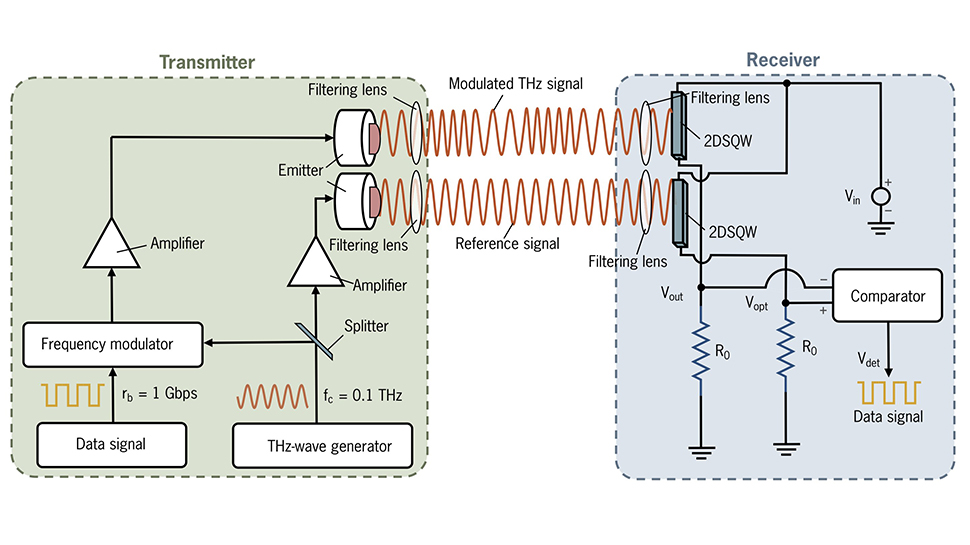
As computing shifts from single-chip processors to multi-chip systems, traditional communication methods, such as Network-on-Chip (NoC) and Network-in-Package (NiP), are becoming less efficient. To address these limitations, scientists are exploring terahertz frequencies for high-speed data transfer, despite the challenge of noise interference, which complicates data decoding.
A research team from universities in Australia and the US has been studying wireless communication at the chip level and looking at ways to reduce noise. By applying Floquet engineering, a quantum technique that manipulates electron behavior, they found they were able to improve terahertz signal detection.
When implemented in a two-dimensional semiconductor quantum well (2DSQW), the approach successfully mitigated noise and boosted signal clarity. The team’s findings suggest that this method could pave the way for more effective and reliable wireless communication between chiplets, offering a potential solution for the efficiency challenges faced in multi-chip systems.
Wide-ranging applications
The team also developed a dual-signaling system that uses two receivers to monitor noise levels and adjust signals in real-time, further reducing error rates.
Writing forTech Xplore, researchers Kosala Herath and Malin Premaratne explained, “By overcoming the challenges of noise and signal degradation, our dual-signaling technique marks a key advancement in developing high-speed, noise-resistant wireless communication for chiplets. This innovation brings us closer to creating more efficient, scalable, and adaptable computing systems for the technologies of tomorrow.”
Their findings were published in the IEEE Journal on Selected Areas in Communications.
As we previously reported, universities are also looking at ways of boosting the potential of terahertz technology in order to unlock bandwidth for future telecommunications.
The University of Adelaide has developed a polarization multiplexer that doubles data transmission capacity at terahertz frequencies, while researchers at the University of Notre Dame showcased a silicon topological beamformer chip capable of splitting a single terahertz signal into 54 smaller beams.