Researchers have uncovered the class of meteorite that killed the dinosaurs 66 million years ago — and it’s one not commonly seen on Earth.
While an asteroid was the responsible party for ending the age of the dinosaurs, meteorites are what we call parts of asteroids that have survived their trip to Earth’s surface.
When the six-mile-wide “Chicxulub” asteroid hit the planet, it disintegrated, leaving a major crater and shards thousands of miles away.
Using traces of Chicxulub, scientists found that the world-shattering chondrite – a term for the oldest known rocks – was made of carbon monoxide.
These types of meteorites make up only five percent of meteorites sampled on Earth and are some of the most primitive materials in our solar system, according to new research published Friday by scientists at the University of British Columbia.
“Being impacted by such a rare, distant projectile really underscores how unlucky the dinosaurs were,” Dr. Philippe Claeys, a visiting professor at the school, explained in a statement.
The findings don’t change the theory of what happened when Chicxulub struck Earth at what is now the Yucatán Peninsula in Mexico, he noted.
But it does make it less likely that sulfur in the meteorite – an element that can be combustible – is responsible for wiping out 75 percent of living species.
“The fine debris thrown into the atmosphere would have been the primary factor,” said Claeys.
Claeys partnered with other researchers in Europe, including some at the Parisian Institut de Physique du Globe and Université de Paris.
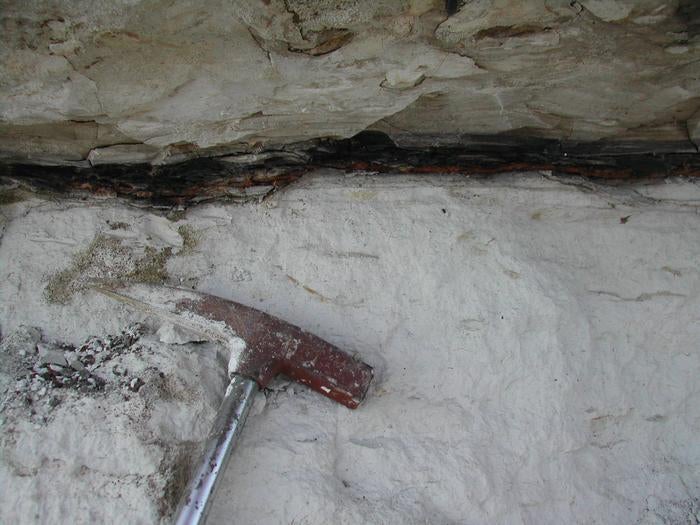
These researchers measured trace elements in samples collected from a thin layer of clay created by the meteorite.
Chicxulub may have been coming from the outer area of the asteroid belt near Jupiter, or the distant reaches of the solar system, the team said.
Many questions remain about the asteroid and its impact, and what wiped out life on Earth is still being studied.
Some researchers have suggested that climate change may have played a role long before the impact and others point to volcanoes.
Either way, what could have happened sounds bad.
In a vivid account published in The Conversation, English professors Monica Grady and Michael Benton describe a harrowing scene of indiscriminate death.
“Whether a dinosaur or a dung beetle, if you were near the transient cavity you would have been incinerated instantly by the blast,” they wrote.
“But even if you were up to 2,000 kilometers from the epicenter, you’d likely have been killed quickly by the thermal radiation and supersonic winds now spreading out from the impact site,” the professors said.