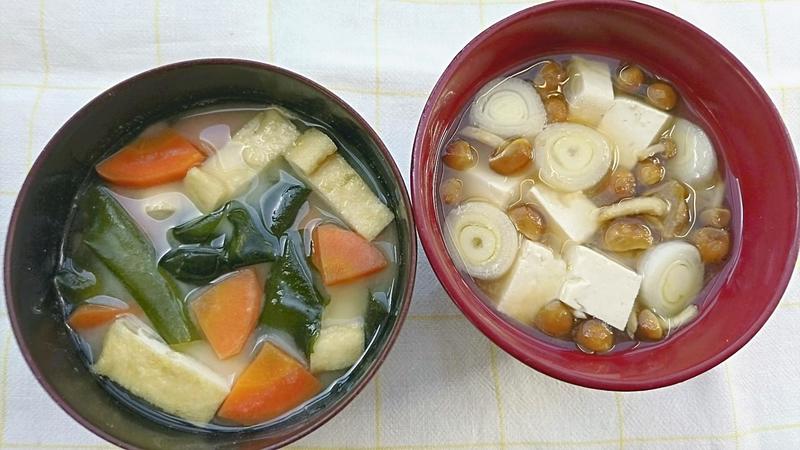
Miso soup has been a crucial part of the Japanese dietary concept that a meal should consist of a soup and three other dishes. Some people now avoid it because of fears that too much salt is bad for the blood pressure, but scientists are finding that miso soup might actually prevent blood pressure from rising.
"When I talk about miso soup to the elderly in dietary classes, they say, 'I like it but I'm worried about blood pressure,'" said Minami Yamada, who is part of the research and development division at Marukome Co., a miso maker headquartered in Nagano City.
Cerebrovascular disease was the leading cause of death among Japanese people from 1951 to 1980, which led to close scrutiny of excess salt intake as a cause of hypertension. Since the 1970s there have been widespread efforts to curb salt intake and this has reduced consumption of miso soup and tsukemono pickles, both high in salt.

"As our research progressed, it became clear that it was safe to have two bowls of miso soup a day. When we explain that, people are reassured," Yamada said.
In 2019, Marukome conducted a clinical study with Yoshio Uehara, a former professor at Kyoritsu Women's University with a PhD in medicine. People with stage 1 hypertension or slightly elevated blood pressure ate a soup made from soybean and rice powder with no salt added, or miso soup made from awase mixed miso that had 3.8 grams of salt, twice a day for a set period.
The study found that daytime blood pressure did not increase with either soup, while blood pressure during sleep at night was much lower in the miso soup group.
Normally, blood pressure rises during the day and falls during sleep. These findings indicate that miso soup has effects that include suppressing increases in blood pressure or lowering blood pressure.
Uehara also conducted an experiment in which rats were fed miso dissolved in water or a saline solution with the same salt concentration. The rats that had miso water exhibited blood pressure levels equivalent to the saline solution with 30 percent less salt.
Based on his research, Uehara has found there are two main mechanisms for controlling blood pressure.
The first is through the excretion of salt in the urine. In experiments on rats and other subjects, the salt in miso was found to be easily excreted by the kidneys as urine.
The other mechanism is to have blood vessels expand so blood pressure does not rise. When rats received subcutaneous injections of a miso extract, their blood pressure declined.
"The components of miso cause the release of large quantities of nitric oxide, which dilates blood vessels," Uehara speculated.
Marukome is also focusing on miso's ability to inhibit vasoconstriction, developing a miso that enhances this effect. Multiple components are thought to be involved, and research to identify them is ongoing.
Recent research on miso has examined its ability to prevent diabetes and arteriosclerosis, and to whiten the skin.
Miso soup tastes and smells good, and the nutrition of the ingredients dissolved in the soup should not be missed. People can add whatever ingredients they want. Add enough and it becomes a meal in itself.
Hiroyuki Kobayashi, a professor at Juntendo University's faculty of medicine, has proposed making "miso balls" in advance in books and other places.
This involves combining red miso, white miso, grated onion and apple cider vinegar into balls, which are put in ice cube trays and frozen. Just add whatever ingredients are available for an easy bowl of miso soup.
"The appeal of miso soup is that you can eat it every day without getting tired of it. I want it to be the entryway to thinking about a balanced diet," he said.
Miso purchases halve in 30 years
The Health, Labor and Welfare Ministry's recommended daily salt intake for adults is less than 7.5 grams for men and less than 6.5 grams for women.
One 150-milliliter bowl of miso soup contains about 1.5 grams of salt. Many low-salt varieties of miso are now available.
Miso consumption has declined as diets have diversified.
According to the Internal Affairs and Communications Ministry's Family Income and Expenditure Surveys, households of two or more people bought 11.1 kilograms of miso in 1985, but only 5.1 kilograms in 2017, a decline of more than half. The surveys did not include agriculture, forestry and fishery households.
Read more from The Japan News at https://japannews.yomiuri.co.jp/