A research team appears to be closing in on the answer to one of the mysteries of the universe – why did antimatter disappear but matter remained?
It is believed that when the universe was created, equal amounts of matter and antimatter were generated. Matter and antimatter share the same mass but bear the opposite charge. However, antimatter has disappeared and now the universe is composed of ordinary matter. The research team from the High Energy Accelerator Research Organization (KEK) and other institutes has been conducting an experiment to untangle this mystery with the help of mysterious particles called neutrinos (see below).
Everything around us is made of matter. It is thought that a collision between matter and antimatter can lead to their mutual annihilation, but due to subtle differences in their properties, only matter has remained.
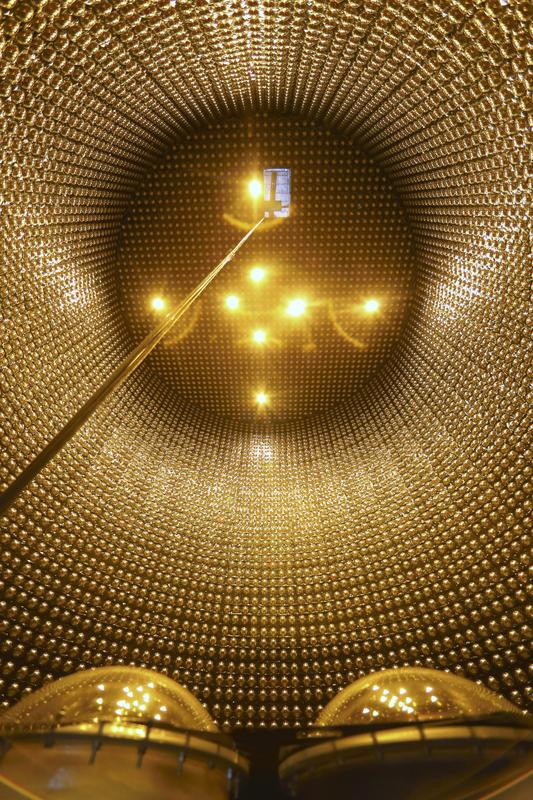
The research team has conducted an experiment using the unique properties of neutrinos, which come in three types – electron, muon and tau. As a neutrino travels through the air, it can change into another type. In the experiment, researchers created and fired a beam of muon neutrinos and muon antineutrinos from the Japan Proton Accelerator Research Complex (J-PARC) in Tokaimura, Ibaraki Prefecture. The Super-Kamiokande underground neutrino detector, which is 295 kilometers away in Hida, Gifu Prefecture, detected the number of muon neutrinos that changed into electron neutrinos.
During research conducted over the past decade, the team had observed 90 electron neutrinos but only 15 electron antineutrinos. The findings of the latest research project apparently show with a 95% confidence level that neutrinos and antineutrinos behave differently. The experiment's results were published in the April edition of the British scientific journal Nature.
"We want to keep gathering data and get that confidence level up to 99.7%," said Kyoto University Associate Prof. Atsuko Ichikawa, spokesperson of the research team. Ichikawa is an expert in particle physics and this year received the Saruhashi Prize awarded to outstanding female scientists.
Kunio Inoue, director of Tohoku University's Research Center for Neutrino Science, said, "Research verifying the qualities of neutrinos is progressing faster than I imagined. We're getting closer to solving the mystery of why matter remained in the universe."
--Neutrinos
Neutrinos are particles found in abundance in the universe, but they can pass through any object. Detecting them requires equipment including a huge water tank equipped with multiple extremely sensitive light detectors.
Read more from The Japan News at https://japannews.yomiuri.co.jp/