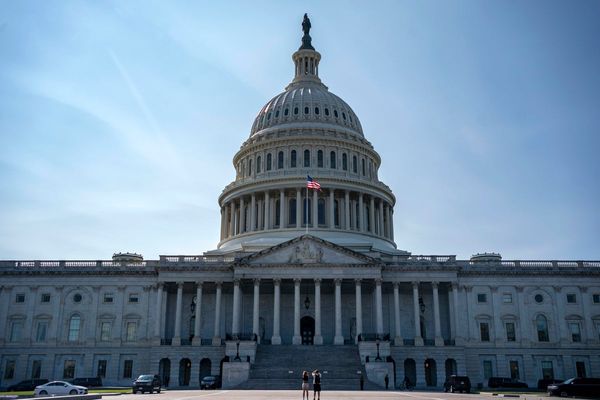
WASHINGTON — Within 24 hours, Congress will have almost certainly counted and accepted President-elect Joe Biden’s victory in the Electoral College, a formality required by the Constitution.
But unlike past years when the process was purely perfunctory, lawmakers Wednesday will embark down a long and winding road to get there in an unprecedented effort to undo Biden’s win.
Republicans in both the House and Senate intend to object to the certified electoral vote tallies in at least three states, using the process to express their loyalty to President Trump, who is urging them to protest in support of his baseless claims of voter fraud in the 2020 election.
There is no chance that the effort to block Biden from the presidency will succeed. With a Democratic majority in the House and upwards of two dozen Republicans prepared to vote down the effort in the Senate, all objections will fail.
The challenge was well in the works even before Tuesday’s Senate runoff election in Georgia, where Democrats won one seat and are ahead in the other race. If they win both races, Democrats will seize the Senate majority from Republicans.
Wednesday’s Electoral College challenge will lay bare the internal divisions within the GOP. Though some high-profile conservatives are lining up to support Trump, others in the GOP are bitterly opposed to the last-ditch effort, highlighting the deep fractures opened in the Republican Party by the Trump presidency.
The objections will force Vice President Mike Pence into perhaps the most uncomfortable position of all. While seen as one of Trump’s most loyal allies, the vice president is responsible for overseeing the process on Capitol Hill as president of the Senate. Trump falsely said Tuesday that Pence can single-handedly “reject” the victory, but Pence and others have noted he has no power to change the outcome.
On Twitter, Trump called his followers to come to Washington for the proceedings. Many of them did, filling a plaza near the White House on Tuesday evening.
The process was set to get underway at 1 p.m. Eastern as a joint session of Congress meets to go through each state in alphabetical order. Republicans plan to object to the results in at least three states: Arizona, Georgia and Pennsylvania. The first expected objection, Arizona, would come within minutes of the start of vote counting.
For each objection, the House and Senate will separate into their respective chambers for up to two hours of debate on the objection, followed by a vote on whether to uphold it. Those votes are expected to fail. The process could last well into Wednesday evening, if not Thursday morning, particularly if Republicans object to more than the three states.
In the House, Speaker Nancy Pelosi, D-Calif., tapped California Democratic Reps. Adam B. Schiff and Zoe Lofgren, Maryland Democratic Rep. Jamie Raskin and Colorado Democratic Rep. Joe Neguse to lead the House Democratic response to the objections.
Democrats universally reject the GOP claims and have expressed concern that the objections will have long-term consequences.
“These actions have eroded the American people’s faith in the integrity of our elections and the institutions that stand at the core of our democracy,” said Sen. Chris Coons, D-Del.
Republicans who object to the vote say they’re following through on the objections and concerns of their constituents. Rep. Doug LaMalfa, R-Calif., said he would have preferred courts to review claims of fraud.
“Because the courts at all levels have sidestepped their duty to the republic, there is no other alternative than to use the power of Congress to investigate and hopefully get to the truth,” LaMalfa said.
Numerous courts nationwide received and reviewed challenges pertaining to the vote — including the Supreme Court. All of them dismissed the claims.
Republicans who plan to object to the process include conservatives such as Sens. Josh Hawley of Missouri and Ted Cruz of Texas, and California Rep. Mike Garcia, who was recently elected to his first full term.
Other Republicans say they have seen no evidence of fraud and cannot object, pointing to the states’ right to certify their own elections without interference from the federal government or other states.
Sen. Kevin Cramer, R-N.D., one of Trump’s most loyal allies in the Senate, said he has concerns about the widespread use of mail-in voting, but would prefer an independent commission to review the voting process — not to overturn the election.
“While I share the concerns of those who plan to object, the Founding Fathers did not design a system where the federal legislative branch could reject a state’s certified choice for president in favor of their own,” Cramer said.
Objections can only advance if they are supported by at least one House member and one senator. The most recent such objection was raised in 2005 upon the reelection of President George W. Bush, with the support of then-Sen. Barbara Boxer, D-Calif. The objection was heard, briefly debated and voted down.