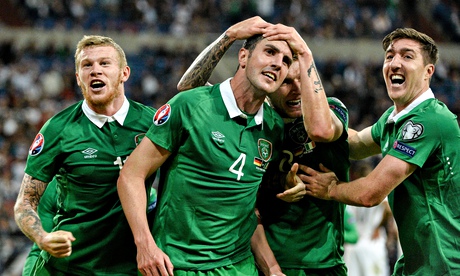
There was some debate over whether John O’Shea was earning his 100th cap for the Republic of Ireland on Tuesday night, because of a friendly against Hungary in 2012 being struck off because of an unregistered linesman. The FAI recognised the Germany game as his century but Fifa is adamant it was his 99th. No matter, his last-ditch goal made it one of the most memorable nights of his career whether he reached the milestone or not, and perhaps signified a dramatic change in fortunes for the Republic of Ireland.
It was only an equaliser but this was still Ireland’s first significant result against one of the major nations since they drew with Italy in the 2010 World Cup qualifiers. The point could prove precious in a group which defies the theory that qualification has become less competitive.
There was a sense in Gelsenkirchen that Ireland’s rehabilitation has been completed. Twelve months ago, when Martin O’Neill took charge of a team deflated by the pitiful mess created by Giovanni Trapattoni, the players were bereft of self-belief. Last October they were beaten 3-0 in Cologne; this performance was a world away from those gloomy days.
This is a squad which still has its limitations and a lack of depth is evident but that familiar refrain of “You’ll never beat the Irish” has been resurrected. Such positivity has not been witnessed since qualification for Euro 2012 was secured three years ago. O’Shea’s ability to get in front of Mats Hummels with 94 minutes on the clock and direct home Jeff Hendrick’s neat flick may well be a major turning point.
It still did not stop O’Neill from joking about the defender’s poor goal return, though: “You couldn’t write that script for him. It’s his 100th game and that’s, what, his third goal? That’s pretty appalling. When you look at the amount of set-pieces he goes up for, it really is appalling. I must tell him that.
“I saw the one against Kazakhstan where Richard Dunne knocked it back to him – I’d have scored that. But, joking aside, he had the captain’s armband at the same time, so for him it was really delightful. It worked out brilliantly for him. It’s fantastic.”
Amid much laughter, O’Neill had a point: O’Shea should have scored a few more. Then again, that added another layer to the 33-year-old’s fairytale. Ireland have plenty of momentum now but thoughts immediately turn to next month’s trip to Scotland. Germany should still win the group, making the game in Glasgow vital in the battle for the other qualification place.
O’Neill is expecting a different challenge at Celtic Park, where he was manager from 2000 to 2005, but they will take on Gordon Strachan’s team with plenty of confidence. “We’ll face a different set of circumstances there but the greatest thing for us is getting that late goal, the exhilaration was so apparent. For us to carry that confidence into Scotland is very important,” he said.
“Scotland are doing really well at the moment and Gordon has got them playing. He’s been involved with them for a couple of seasons now and has got things going again. I don’t know what their reaction will be to our late goal but it keeps our momentum growing.”
O’Neill claimed Ireland’s injury problems had more of an effect on his side than Germany’s woes because of the depth of Die Mannschaft’s playing pool but Joachim Löw’s decision not to bring reinforcements in – instead choosing to name only four outfield players on the bench – may have been construed as arrogance from the Germany manager.
“We’ve just played against the team that won the World Cup, and I think injuries caused us more problems than it did to the Germans – we had the best right-back in England missing and had to replace him [Séamus Coleman] with a midfielder. Germany are top quality and they can bring people in at their will if they want. For us to get something speaks volumes.
“If we’d lost the game 1-0 I’d have been really irritated. I felt the players never lost heart even if it’s easy for me to say that after getting a late equaliser. To get a draw against the world champions on their own pitch is remarkable.”