On the afternoon of March 21, I was in Zhenjiang, a city in Jiangsu province, working on a story. As my interview wrapped up, I looked at my phone — an explosion had happened in Xiangshui, only 333 kilometers (207 miles) away. As night fell and I approached my destination, the highway was filled with fire trucks and ambulances going from Yancheng and nearby Sheyang county to the site. The sheer number of rescue vehicles on the road gave me the feeling that the scene I was approaching would be very different from anything I had seen before. The silence of slow-moving traffic along the dark highway was broken by wailing sirens.
Those in Xiangshui that had experienced the 2011 gas explosion clearly remember the scenes from eight years ago — but this blast was incomparable.
Over the past decade, as Xiangshui’s chemical industrial parks have grown bit by bit, fear has wound like a thin thread around the hearts of the residents of nearby villages, tightened by successive gas leaks, explosions, and smuggling incidents. But unlike the gas leak seven or eight years ago, residents had under a second to react to this explosion.

When I arrived in the early morning, I found a hotel to take a nap, and then quickly began work. Arriving at the local hospital, I met Li Sheng (pseudonym), whose face needed multiple stitches. It will take longer still for his perforated eardrum to heal. He is now completely deaf in one ear.
The day of the blast, Li was working only 300 meters (990 feet) from the plant where the explosion occurred. He had just finished two days of safety training and was getting ready to formally start work. While he was in a meeting room sipping a cup of water, he noticed a fire outside, not far away, and pulled out his phone to notify his boss. As he put the phone to his ear, the shockwaves from the first explosion hit him, knocking him over.
“When I was taken to the hospital, I didn’t look like this — my clothes had been singed off and only my belt was left,” Li recalled. He has a broken rib and a large, shallow scrape on the back of his thigh, meaning he can only lay down or stand. “I was covered by a reactor cauldron, it was dark all around me. I used my hands to lift it up and crawled out.” He used his hands to mimic the action in the air, with mud and chemical residue from the reactor still on his fingers.

Two other workers were sharing the room with Li. They had been resting in the plant dormitories when the explosion occurred. Like many of the injured their wounds came mostly from glass that shattered with the blast.
Of course, many were not so lucky. By March 27, the death toll had risen to 78.


On March 23, three days after the explosion, the Xiangshui County People’s Hospital was filled with families searching for those who remained unaccounted for. They filled both ambulance lanes, desperately looking into each arriving vehicle to see if it carried their loved one. In the corners of the hospital, women gathered, wailing and weeping, holding each other. A pale-faced man stood just beyond the crowd, trembling violently, his hollow gaze focused ahead. A tear slid slowly down his face, falling to the earth.
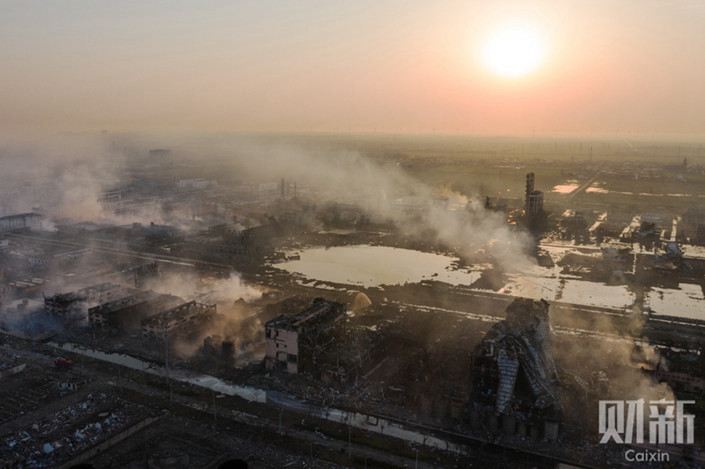
The fire at the chemical plant raged until the next morning, when it was finally extinguished. Smoke continued to billow from the site — white, gray, blue, yellow, and black — that was carried more than 10 kilometers (6.2 miles) by a northeastern wind.
Three villages, each incrementally further away from the blast’s center, suffered different degrees of damage. Walking along the villages was like walking on the set of a disaster film. In Wangshang village, closest to the explosion, the roads looked as if they were paved with broken glass. Sofas and beds were scattered as though they had fallen from the sky. In one house where the owners had fled, the day’s meals were still on the table, and bits of the ceiling had fallen down around them.
Some elderly people still in the village, facing the debris of their houses, could only hobble around on shaky legs and clean up. One older woman grabbed me and frantically asked: “Will it explode again? Will there be another one?”
No one can answer this question. Jiangsu’s northern plains have been besieged by chemical plants for many years.


On March 25, the fourth day after the explosion, Jiangsu’s environmental monitoring center said that concentrations of benzene, toluene, sulfur dioxide and nitrogen oxide in the air around the Jinlong Hotel, 3.5 kilometers from the explosion site, were below China’s air quality standards. Ten schools around Xiangshui county resumed classes, which had been suspended due to the blast. Twisted building debris and warped vehicles were removed piece by piece. The devastation left by the explosion is being cleaned up, leaving only the lives lost and families irrevocably changed.
Contact reporter Ren Qiuyu (qiuyuren@caixin.com)