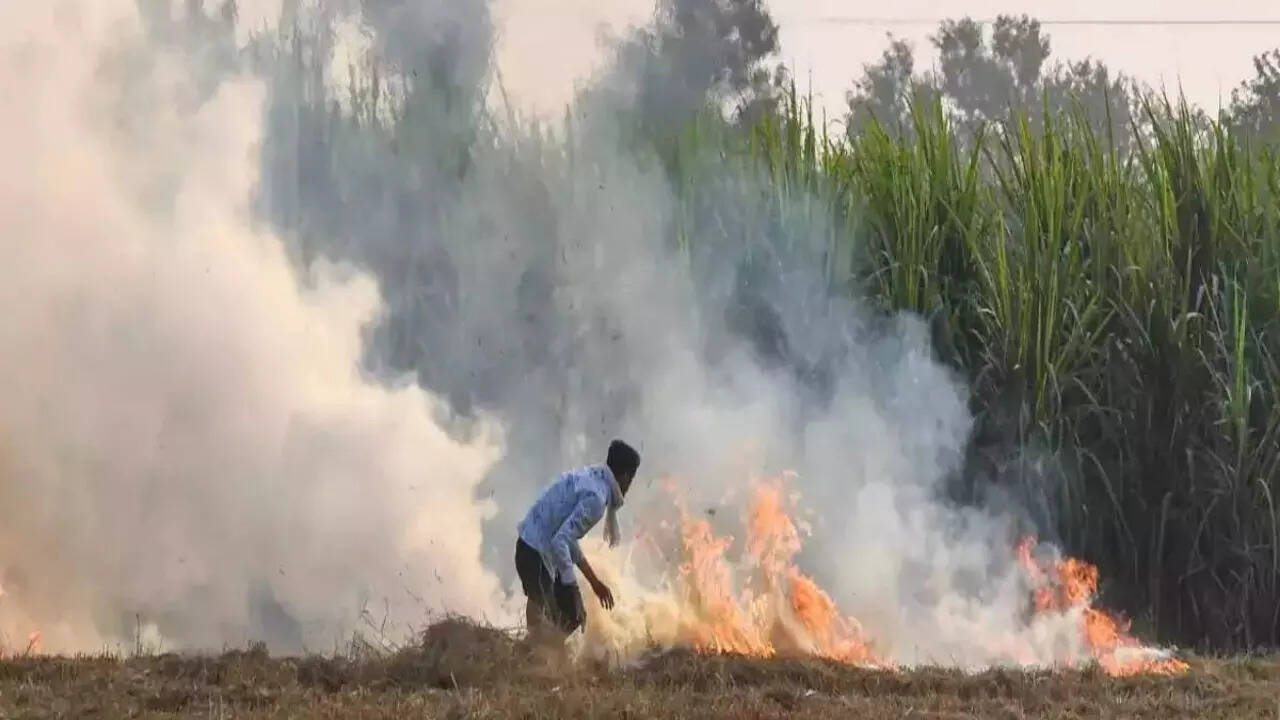
NEW DELHI: Paddy residue burning events have got reduced by 69.49% in Punjab, 18.28% in Haryana and 47.61% in the eight National Capital Region (NCR) districts of Uttar Pradesh during the one-month period since September 15 compared to the same period last year, according to a report based on the protocol framed by Isro for Commission for Air Quality Management in NCR and Adjoining Areas.
The commission has been actively monitoring such occurrences from September 15 to curb air pollution during the ongoing harvest season.
It said on Friday that in the past one month, the total reported residue burning events in Punjab are 1,286 as against 4,216 for the same period in 2020. Similarly, the reported fire incidents are 487 as against 596 in Haryana and 22 as compared to 42 in the eight UP districts.
However, no fire count has been reported from Delhi and two NCR districts of Rajasthan, the commission stated.
The first paddy residue burning was reported on September 16 in Punjab, September 28 in Haryana and September 18 in the NCR area of UP.
In Punjab, the major hotspots are Amritsar, Tarn Taran, Patiala and Ludhiana districts, accounting for 72% of stubble burning events in the state.
Similarly, the major hotspots in Haryana are Karnal, Kaithal and Kurukshetra districts that account for 80% of the state’s share.
The commission said it “is taking up (the issue) with the state governments of Punjab, Haryana and UP on a daily basis to ensure strict implementation of the action plan and the framework to curb paddy residue burning events”.
It has also held a series of meetings with state government officials.
“Harvesting will be at its peak in the next few weeks and the state governments are taking steps as per the plan of action to improve the efficacy of enforcement and implementation to effectively tackle the problem of stubble burning,” the commission added.
Of the total 1,795 sites where burning has been reported till October 14, 663 fields have been inspected by the enforcement agencies and environmental compensation has been imposed in 252 cases.
However, experts said the fire counts were likely to rise from October-end.
“We are already in mid-October, only a week away from the peak stubble burning window (late October to early November), during which the count may go up to 3,000-4,000 fires a day,” said L S Kurinji, programme associate at Council on Energy, Environment and Water.
He added, “The Punjab government should ensure the financial viability of — and timely access to — crop residue management options, as well as initiate targeted outreach to trigger behaviour change among farmers.”