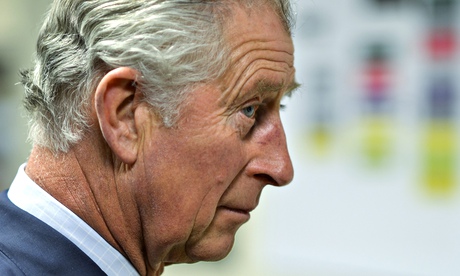
In a country where thousands of people can be coerced into believing that they have a real emotional connection to some old bones in a box (From car park to cathedral: thousands line the route as Richard III comes home at last, 23 March), and where to be a leftist politician is implicitly illegal, for it appears automatically to invite the attentions of the police (Revealed: special branch targeting of Labour MPs, 26 March), the Guardian’s success in achieving the release of some of the letters with which Charles Windsor appears relentlessly to pepper ministers is as surprising as it is wonderful (Guardian wins 10-year legal battle over Charles letters, 27 March).
In a rational nation it should lead to serious discussions about the institution of the monarchy, and our great nonexistent (for it is unwritten) constitution more generally. It won’t. The establishment, weakened during the 1950s and 60s, has been clawing back power, and, after a Conservative election victory, George Osborne will be chief among those gleefully hammering the last nails into the coffin of the postwar settlement, thus to signal its final triumph. Only heaven can help the rest of us, for I don’t notice the Labour party taking them on.
Michael Rosenthal
Banbury, Oxfordshire
• I realise it is tiresome to be told that things are different in Scotland, but when it comes to freedom of information and royal correspondence that is the case. You are right to say that a legal amendment passed at Westminster means that such information is now absolutely exempt from disclosure. However, the Scottish government was persuaded not to follow suit, which means that information relating to royal correspondence held by Scottish public authorities may still be disclosed, if it is in the public interest to do so.
Can I also add that the distinction being drawn between advocacy and personal correspondence from Prince Charles has already formed the basis of a decision which I made, as the first Scottish information commissioner, more than four years ago, in relation to a request by another journalist? In that instance I ordered disclosure, and the Scottish government did not veto my decision or appeal it to our courts.
Professor Kevin Dunion
Centre for Freedom of Information, University of Dundee
• One irony of the judicial decision that Prince Charles’s letters should be released is that judges themselves are not subject to the Freedom of Information Act. This means requests for information from the judicial office can be and are turned down. My charity was researching magistrates’ training and asked to see the standard training materials for new magistrates (detail of what the course covers) and a report on magistrates’ training that by law is presented to the lord chief justice annually. We were denied access to these documents on the basis that the judiciary is not subject to FoI and they were for judges’ eyes only. If we are to have open justice, should documents produced by the judiciary not be subject to FoI too?
Penelope Gibbs (@PenelopeGibbs2)
Director, Transform Justice
• In the debate on the “black spider memos”, the role and usefulness of the monarchy in 21st-century Great Britain has had little attention. The political neutrality of the monarchy means that it confers a degree of continuity in our system that transcends politics. If that continuity goes hand in hand with a concern for the long-term fabric of our country, stewardship in short, that is a useful counterbalance to rapacious short-term exploitation. Prince Charles’s explicit concern for the agricultural and built environments (as well as our marine resources) can therefore be seen as wholly consistent with his present and future roles. Though we may not applaud all his ideas, if his letters to ministers reflect that concern we can applaud the action. I look forward to reading them.
Peter Lewis
Burley in Wharfedale, West Yorkshire
• I dare say you are thrilled that private letters from Prince Charles written 10 years ago to government ministers should now be in the public domain. Currently Prince Charles is heir to the throne, not king. As such, he would have been pilloried for not taking an active part in matters that affect the UK. In theory, yes, he will be king, but even that is not guaranteed. In these circumstances, your achievement is a violation of privacy.
Claire Colton
Cottesmore, Rutland
• I eagerly await your black spider wallchart. This will need to show clear cause and effect lines between initial royal memos, ministerial replies and subsequent actions including the likely editing of policy and even legislation.
Sue Carmichael
Liverpool
• I just let out a cheer on hearing the news of the supreme court ruling that Prince Charles’s spidery letters should be made public. Thank you, Guardian, for your 10-year campaign – you nailed it!
David Prothero
Harpenden, Hertfordshire