Working from the comforts of home in non-urban areas, far away from company headquarters in Tokyo, is an increasingly popular option to take advantage of the telecommuting wave, which many countries have adopted.
If people are able to live and work in their hometowns or nature-rich areas, lifestyle choices are likely to expand.
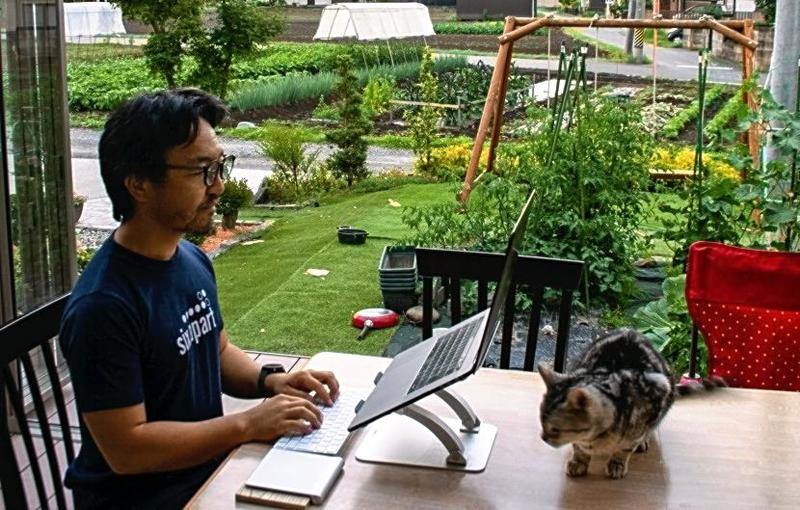
Taku Amano, 41, sits at a table and takes part in a videoconference with colleagues, developing a system for the making of websites.
It's almost no different than working at an IT company office in central Tokyo, except a swing sways in the yard right outside the window of his residence. Rice paddies and mountains fill out the area beyond his yard.
Such is the landscape surrounding his work environment in Saku, Nagano Prefecture. Amano is an employee at Six Apart Ltd. in Chiyoda Ward, Tokyo, a firm that develops website-building systems. But he works remotely from his hometown of Saku.
Amano, who previously had a job at a local company, wanted to continue working in Saku when he made a career change in 2017. That's why he decided to work at Six Apart, because the company allowed him to make the most of telework and perform his duties from home as a full-time employee.
No commute has freed up his personal time. He can also map out his own work schedule so he can now even serve as an assistant for extracurricular activities at the elementary school his children attend.
"This is the style of work that suits me best," he said, a smile covering his face.
According to the company, this work-from-home system has been mutually beneficial, in terms a personnel acquisition. One example is the fact that the company has employed several IT engineers who have remained in rural areas and are allowed to telework.
--Growth of telecommuting
Central and local governments as well as companies have high expectations for remote work as a means of revitalizing regional communities and leading to more fulfilling lives for employees.
The central government has been promoting "furusato telework," or remote hometown work, since fiscal 2016. If a company in an urban area sets up a satellite office or similar facilities in a regional location where employees can move to and telecommute, the government will shoulder a portion of the expenses.
This work method is aimed at not only avoiding concentration of manpower in and around large cities and spreading them to other regions, but also facilitating a strong work-life balance among employees.
Telecommuting did not catch on in Japan in the past, mainly because employees feared they might appear to be slacking off, and that it would be detrimental to the communication process.
It finally started to become more common as a measure to help prevent the spread infections of the novel coronavirus. According to an April Tokyo metropolitan government survey, 63% of companies with at least 30 employees in Tokyo introduced remote working, 2.6 times more than in March.
Now that telecommuting know-how has grown widely enough and people are more accustomed to the procedures, work methods that take advantage of telecommuting will be even more diversified.
--Managing from a distance
Even among those in management are adopting a lifestyle built around making their homes away from big cities and maintaining positions at companies in urban areas.
Kyoko Kawa, a co-chairman and executive officer at the temp agency Waris Co. in Chiyoda Ward, Tokyo, lives in Fukuoka.
Kawa, 35, thought she would be able to live in a city surrounded by nature if she made the most of the telework system the company introduced when it was founded in 2013.
Although Fukuoka is not her hometown, she moved to the city in 2016. Since then, she has never felt inconvenienced, being able to hold online meetings with the other two copresidents and employees.
"My quality of life has improved a great deal," she said. "I take a mental break by walking down to the beach. I can also work at places like a cafe in a park."
Shuta Shibuya, the president of the software development company Fuller, Inc. in Chiba Prefecture, returned to his hometown in Niigata Prefecture because of the pandemic. Shibuya, 31, started telecommuting in April.
Realizing there were no issues, he moved to the prefecture with his family, leaving the headquarters in Chiba Prefecture.
"I'm determined to make Niigata my final home," Shibuya said.
He also makes contributions to local communities by dispatching one of his employees to a technical college as a lecturer. He plans to get involved himself by giving lectures on starting a business at local junior high schools.
"More and more companies now take into consideration employees' wishes when deciding where they should be transferred," said University of Toyama Prof. Sachiko Yanagihara, who is well-versed in remote work.
"More companies will allow employees working remotely to live where they want to live," Yanagihara asserts, also noting, "It is also necessary to understand that remote work has its downside, for instance, it's not possible to immediately get to the office when there are sudden problems."
Read more from The Japan News at https://japannews.yomiuri.co.jp/