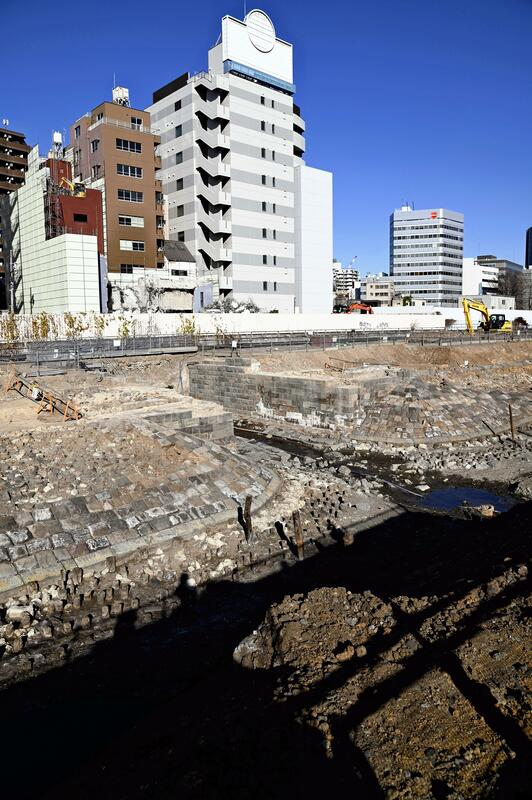
The archeological remains of Japan's first railroad embankment have been found in an area near Takanawa Gateway Station in Minato Ward, Tokyo, that is currently being developed by East Japan Railway Co.
The discovery, called the Takanawa embankment, was a dike in the shallow waters of Tokyo Bay that served as the foundation of the railway.
"Locomotives on the shore" was a common description of the steam locomotives using the railway. JR East plans to preserve the discovery as valuable railway heritage and use it to display the civil engineering technology of that time to future generations.
Japan's first railway, which opened in 1872, was a line about 29 kilometers long between Yokohama and Tokyo's Shimbashi.
According to JR East and the Minato Ward board of education, the Takanawa embankment, about 2.7 kilometers long, was part of the Shimbashi-Yokohama line, in an area between what is now JR Tamachi and Shinagawa stations. At the time, the embankment stood in the waters of Tokyo Bay.
The embankment measured about 6.4 meters wide and 3 to 4 meters high. It had an opening to allow boats to pass through. Its slopes were apparently reinforced with rockwork.
The recently unearthed embankment is about 1 kilometer long and no railroad track remnants have been found on it. But its location is consistent with tracks that appear on an 1887 government map.
The Takanawa embankment commonly shows up in nishiki-e woodblock prints from those days. Among them is "Steam Locomotive Train Running near the Sea at Shinagawa, Tokyo," created early in the Meiji era (1868-1912). It depicts a smoke-billowing steam locomotive traveling along the area of the embankment.
According to the board of education, the embankment might have been constructed above water to avoid the nearby site of the former ministry in charge of military affairs.
"The rockwork may have incorporated a Western style," an official at the Minato City Local History Museum said. "The archeological remains are valuable as they tell us of the technology in those days and the history, so I hope they will be preserved at the site."
JR East said it had planned to erect buildings and other structures in the area of the embankment.
"We are currently considering preserving a part of the area on the site or relocating it and preserving it to make it available to the public. We will continue to discuss the matter with the board of education," an official at the railway company said.
Read more from The Japan News at https://japannews.yomiuri.co.jp/