Christmas 1982. Liverpool lead the First Division by five points from Manchester United. Renée & Renato’s Save Your Love, a 3min 6sec-sized cruise missile of an earworm – which still burrows into many worst-song-of-all-time lists – tops the charts. And, like many seven-year-old boys, almost everything I covet is in Shoot! magazine.
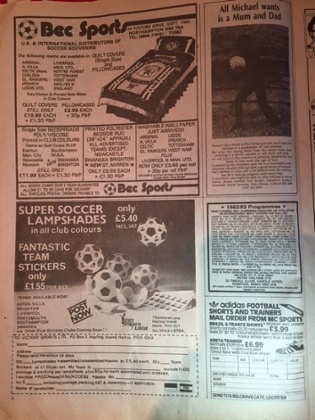
The Subbuteo Fifa World Cup Edition. A replica kit. Even, in weaker moments, the 100% cotton towelling robes in team colours – which, the advert promised, “makes a superb gift for all the family”.
Saturday’s Guardian, in which my colleague Hilary Osborne unearthed a Boots catalogue from 1982 showing that a Ferguson video recorder cost £599 – or £1,863 at 2014 prices – brought memories scampering back. It also provided an excuse to crawl into the mustiest corners of my attic and dig through yellowing magazines to see how the price of football, from ticket prices to tat, has changed.
That Subbuteo edition, with Brazil’s brooding Nelinho on the box lid, £28.95. Which, given the Office for National Statistics confirms that prices are 3.11 times higher now than in Christmas 1982 (when adjusted for inflation as measured by the retail prices index) equates to £90 today.
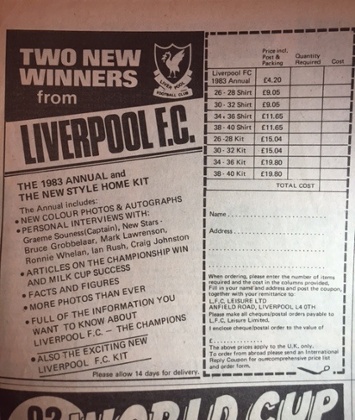
Those 100% cotton towelling robes? £20 after postage – or £62 in 2014 prices. Meanwhile, team quilt covers and pillowcases, beloved of many an 80s’ pre-teen, were the equivalent of £67 today.
Football books were far from cheap, too. The Hamlyn Book of Football Techniques and Tactics by Richard Widdows “with 192 fully illustrated pages with approximately 200 colour illustrations” was £6.95 (£22). Yet videos were even pricier. A 60-minute film of España 82 cost £33.60 (£104) – extortionate given the average weekly wage in 1982 was £136.50 before tax.
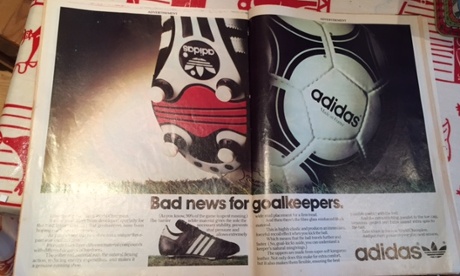
But the biggest surprise was the cost of a football kit. I had assumed that prices went into overdrive during English football’s post-Euro 96 gentrification period. Not so. One advert in Shoot! promising “top team replica strips” offered adult Manchester United home and away Adidas kits for £17.80 (£55), while Umbro’s Arsenal, Liverpool and Brazil kits cost £18.95 (£59).
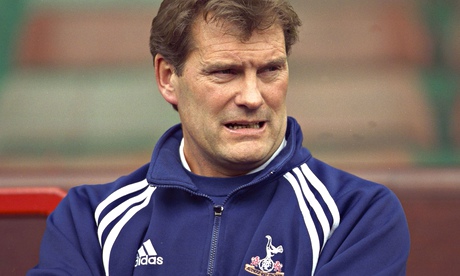
And Spurs’ Le Coq Sportif kit, which Glenn Hoddle insisted was “just the thing to get me through a tough season – with all the style and staying power you’d expect from the foremost fashion sports company in the world”, cost a staggering £20.75, equivalent to £64 today.
True, in 1982 that bought shorts, socks and an official jersey. But the prices have not risen as much as I expected. A full Spurs kit in 2014, for instance, costs £78 - although Manchester United’s is more at £82. An aside: in 1982 the biggest size was XL. Nowadays clubs offer 2XL and 3XL as standard.
I had also expected children’s kits in 2014 to be comparatively more expensive than in 1982. In fact in some cases they are less. A Manchester United boys’ kit in 1982 cost £13.50 (£42). In 2014 it is £38. Arsenal’s strip, meanwhile, was £14.50 (£45) in 1982, while a mini-kit in 2014 will set parents back £40.
Yet when it came to ticket prices every hardened prejudice was confirmed. In The Economics of Football, the academics Stephen Dobson and John Goddard record the average cost to watch First Division football (the equivalent of today’s Premier League) in 1982-83 as £2.55 – the equivalent of £7 in 2014 prices. No wonder, then, that there was outrage in December 1982 when the top-priced seat for England’s match against Luxembourg was £13 (£40), with the cheapest at £7 (£22).
As a Shoot! editorial put it: “For the same price you could catch a return ferry from Folkestone to Boulogne, twice in a day. Or, if you’re on a health kick, you could stock up the fridge with 65 pints of milk. The £13 would also buy two LPs with plenty of change, 81 Mars bars – or 18 pints of bitter.”
Still, tickets were still comparatively cheaper than the £25-£55 they were for adults at England’s game against San Marino in October. Meanwhile in the Premier League, the cheapest Chelsea ticket is now £50. And while Hull, Leicester and West Ham do charge under £20 for some fixtures, simple supply and demand dictates that prices are likely to keep rising.
In the early 80s, the economics worked very differently. Football was broke. And with unemployment figures well above three million, many fans were too. A festering miasma of decrepit grounds and hooliganism hardly helped. Too often fans were treated like animals. Too often they behaved like them.
To raise money, some clubs delved outside the penalty box. Watford offered a special deal for overseas tourists – bed and breakfast and a ticket at £17 all-in. Torquay United made £1,000 from a target golf competition on their Plainmoor pitch and, as the Guardian reported, further boosted their bank balance by organising wrestling bouts and an antique fair.
Meanwhile, on Christmas Day 1982 I became one of football’s new romantics when I was given my own kit. It was far from official: my parents bought a generic strip and stuck a badge on it. It was all they could afford, but I couldn’t have cared less. There is a still a latent pride when I look at photos of me wearing it. Pride I doubt I’d feel if I had been given a cotton-towelling robe instead.