Rembrandt (1936)
Director: Alexander Korda
Entertainment grade: B
History grade: C
Rembrandt van Rijn was a Dutch artist, generally considered to be among the greatest painters of all time.

Love
Rembrandt (Charles Laughton, brilliant) struts around a pigment shop, splurging 5,000 florins on a necklace from a merchant for his beloved wife Saskia, before rolling off home to paint her. Alas! She’s dead. He throws himself into art, drink and melancholy. His son Titus’s nurse Geertje Dircx (Gertrude Lawrence) snuggles up to him. “What I need is a woman I can call my wife!” he bellows, and off they pop to his chamber. Later, Geertje is supplanted in his affections by a maid, Hendrickje Stoffels (played by Laughton’s wife, Elsa Lanchester). The film shows the situation as awkward. In real life, it was soap operatic. Geertje sued Rembrandt for breach of promise when he went off with Hendrickje. He accused her of pawning Saskia’s jewellery, and had her imprisoned in a house of correction for five years. She then sued him for wrongful imprisonment. It’s not often that a historical movie plays down a scandal, but biographies of Rembrandt tended to skip over his more hair-raising exploits until the 1960s.
Painting
Rembrandt doesn’t enjoy churning out lucrative portraits of the local bourgeoisie, but he needs the cash. He agrees to paint Militia Company of District II under the Command of Captain Frans Banninck Cocq. The painting is better known as The Night Watch – but that name was given to it in the 18th century, because it had become so encrusted with grime that people thought it was set at night. It was cleaned in 1946 – ten years after this film was made – and revealed to be a daylight scene. When it is unveiled in the movie, people burst out laughing. The men in it refuse to pay Rembrandt, because it’s so dark, and what little can be seen of them doesn’t look handsome enough. Rembrandt goes bananas. “Your nose is painted with bad liquor!” he yells at them. “Your mouth is reeking with bawdy kisses! Vanity and stupidity are written all over your face! The only pretty things about you are your ruffs and your breastplates! And the only distinguished things about you are your hats!”

It’s a terrific scene, but fictional. The story that the sitters themselves disliked the painting was sometimes still believed when Alexander Korda made this film, but has now been comprehensively debunked. You have been able to see the faces perfectly well since the Rijksmuseum curators scrubbed the dirt off, and it is on record that all the men in it paid up. As Simon Schama wrote in his biography of Rembrandt: “There is no sign that … any of the … depicted figures were anything but happy with the painting. Bannink Cocq was sufficiently satisfied that he had two copies made for himself, one by the artist Gerrit Lundens and another as a watercolor in a two-volume family album.”
Talent
The film portrays Rembrandt as partial to pleasures of the flesh. In the centuries after his death, Rembrandt’s critics were often vile about his portraiture, complaining that he painted ordinary women – yuck! – rather than aspiring to the Greek goddess ideal. Rembrandt’s “notions of the delicate forms of women would have frightened an arctic bear”, snarked a much less distinguished painter, Benjamin Robert Haydon (1786-1846). Kenneth Clark snottily dismissed one of Rembrandt’s charmingly intimate female nudes in the British Museum as depicting a “fat, flaccid creature” with “the most deplorable body imaginable”. Rembrandt himself showed no such contempt for the women he drew and painted, and thankfully nor does this film. In real life, Saskia, Geertje and Hendrickje all sat for him. Hendrickje is thought to have been the model for one of his most sensuous and famous portraits, A Woman Bathing in a Stream (1654).
Age
Director Alexander Korda and his star, Laughton, find kindness and warmth in Rembrandt’s character – helped, perhaps, by leaving out the bit where he forced his jilted lover into prison. As he gets older and poorer, with Laughton’s look modelled splendidly on Rembrandt’s last self-portrait, you feel real sympathy for a man of such enormous talent who died in poverty and relative obscurity. Since this film was made, some critics have assessed Rembrandt’s later years as producing some of the most powerful art of his career.
Verdict
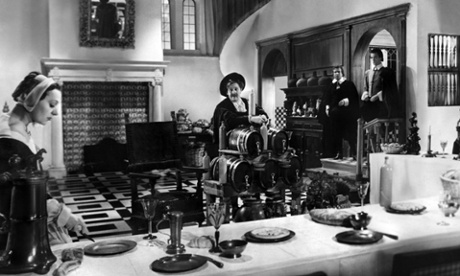
This riches-to-rags story softens some of Rembrandt’s rough edges, but it’s redeemed by a terrific central performance – and by Georges Périnal’s cinematography, which pays elegant tribute to the real Rembrandt’s chiaroscuro technique.