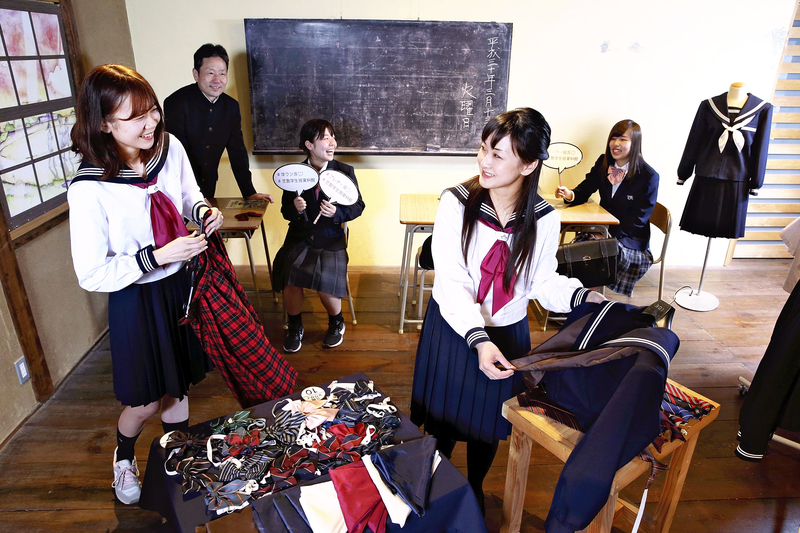
KURASHIKI, Okayama -- "There are so many kinds of school uniforms, I can't choose what to put on!" a visitor exclaimed at a museum.
Kojima Gakuseifuku Shiryokan (Kojima school uniform museum) is a popular sightseeing spot in Kurashiki, Okayama Prefecture, mainly for women in their 20s and 30s. Visitors can try on as many as about 200 uniforms for free.
The clothing has gained popularity recently, as girls in pop groups dance in costumes resembling school uniforms. Uniform manufacturer Nippon Hifuku Co. established the museum in 2010 at a company property to show the history of the local area, which is known for producing school uniforms.
About 70 percent of school uniforms in Japan are made in Okayama Prefecture. Why does the area produce so many of them?
Many factories are concentrated in the Kojima district in the city. Kojima was originally an island before a land reclamation project in the Edo period.
"Residents planted cotton that can grow in salty land instead of rice and made traditional strings using tough cotton threads," museum director Satoru Araki said. "In the Meiji era, the textile industry prospered and they produced numerous traditional tabi footwear. The technique of making tabi has been carried over to produce school uniforms these days."
As demand for tabi decreased because people were wearing western clothing, Shukichi Sunami saw affluent children in school uniforms in Tokyo. A maker of cotton puttees, strips of cloth that were wrapped around the leg from ankle to knee, Sunami reportedly saw a boy's jacket with a stand-up collar and girls' uniforms that resembled sailors' clothing.
He took some uniforms back to Okayama and started producing them in 1918, in the middle of the Taisho era.
After the Taisho era, school uniforms spread to even rural areas and more than 100 companies were established in Okayama Prefecture, mainly in the Kojima district. In the peak year of 1963, 10.06 million school uniforms were produced. About 40 companies remain there, such as Kanko Gakuseifuku Co., which is famous for the Kanko brand, and Tombow Co.
Working by hand
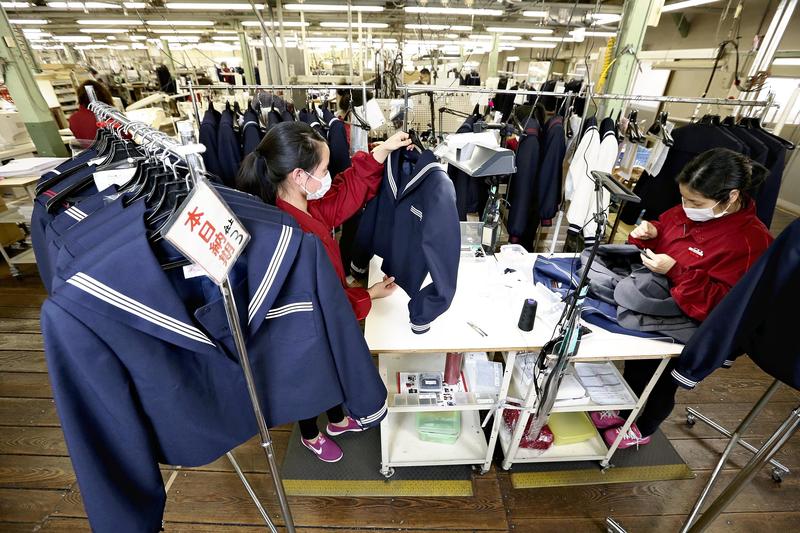
The Kurashiki factory of Kanko Gakuseifuku makes girl's school uniforms, including designs with a sailor collar, pinafores and pleated skirts. Entering the factory, people can hear the sound of pedal sewing machines.
The design of a school uniform is an important factor in attracting students -- a growing number of high schools cannot meet their admission quotas due to the declining number of children. Requests from schools have increased, and the company has as many as 5,000 kinds of material and 700 kinds of pleated skirt patterns.
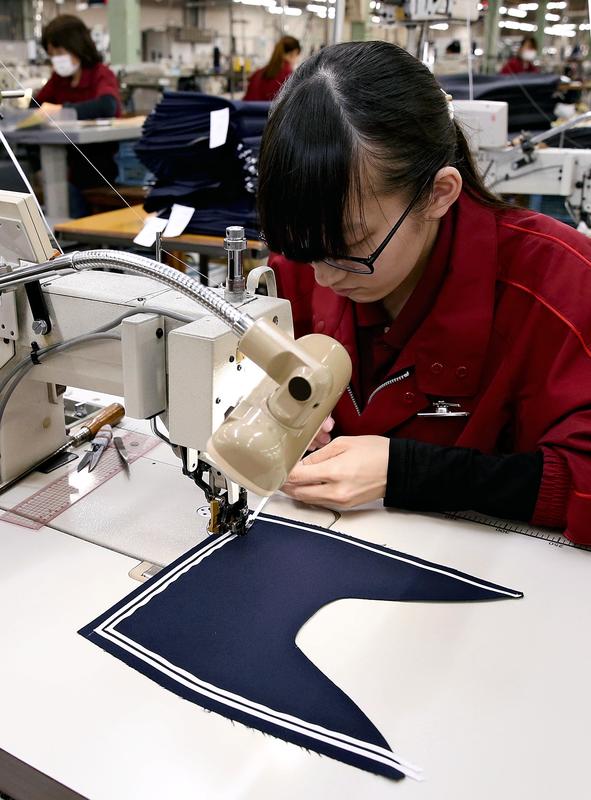
Each person on the assembly line has a specific job when producing uniforms. Only a few procedures are automated, such as cutting plain material and pressing pleats on skirts. The rest is done manually -- it takes two workers, for example, to cut checkered material. The checks on the hem and in the center of a skirt are predetermined, and deviations are not allowed.
Workers also stitch snaps onto uniforms and manually sew decorative lines on the collars of sailor uniforms. Based on the specifications that schools make for designs and the types of material, highly skilled workers make a uniform to fit the student comfortably.
"Making uniforms by hand is faster than developing special devices because the operations are complicated. You must've been surprised that we do it manually," said factory director Mikiaki Fuji, expressing a commitment to quality. "A school uniform is there for the good and bad times of adolescence. We can't sell an imperfect product."
The company also has an "ergonomics laboratory" that analyzes changes in the bodies, minds and tastes of junior high and high school students. Based on data that students wear school uniforms for as long as one-third of the day, it created a blazer that had more stitching on the back and arms so students can move around easily.
More comfortable, more fashionable
School uniforms have become more about comfort and fashion. Denim material has been introduced, for example, and students can wear polo shirts as a summer uniform. Uniforms have also diversified, with girls allowed to choose between a skirt or pants.
People are unaware of where uniforms are made and by who, even though they wear, or used to wear, one every day. Adults work earnestly in the production areas to make students smile.
Read more from The Japan News at https://japannews.yomiuri.co.jp/