Closing summary
No point staying up until 3am with this blog, I think. Let’s have a closing summary.
Greece took a step closer to a third bailout early this morning, after MP voted to accept legal and banking sector reforms at a late-night session in Athens.
A request for fresh help could be sent to the IMF as early as Friday.
The country is likely to suffer a deep recession this year, according to a new report from influential thinktank IOBE. It believes GDP could fall by 2.5% this year, due to the impact of capital controls on the economy.
The turmoil over Greece has been blamed for a drop in consumer confidence across the eurozone.
Howard Archer of IHS Global Insight explains:
While there is no breakdown available yet of Eurozone consumer confidence in July, it looks highly probable that the heightened crisis in Greece contributed to reduced perceptions of the economic outlook.
This was certainly true of both Belgium (especially) and the Netherlands, where confidence weakened.
Divisions appear to be deepening in the Syriza party, after prime minister Alexis Tsipras accused speaker Zoe Konstantopoulou of creating “institutional discord”.
Last night saw 36 Syriza MPs defy Tsipras - this list shows all the details.
Athens stock market traders must wait until next week to discover when they can return to work.
And there has been a protest at the Acropolis today, by contract workers seeking back pay from the government.

I’ll be back tomorrow to do it all again. Thanks for reading and commenting, as ever. Goodnight! GW
Greece’s largest opposition party, New Democracy, has decided to keep its current interim leader, Evangelos Meimarakis, in place until next spring.
New Democracy decides Meimarakis will remain as leader until spring 2016, reports @geoterzis. 62 of 76 ND MPs had asked for this #Greece
— Nick Malkoutzis (@NickMalkoutzis) July 23, 2015
That means ND won’t be caught up in a leadership fight if snap elections were called this autumn.
The Kathimerini newspaper reports that eight suspected members of the anarchist group Rouvikonas were detained for questioning on Thursday, after a group of protesters gathered outside the Greek PM’s residence.
They released leaflets calling for a debt writedown, and for Greece to leave the EU.
Eight arrested during protest outside PM's office http://t.co/iu5YJTsXYa pic.twitter.com/C5Mj3joxix
— Kathimerini English (@ekathimerini) July 23, 2015
Greece could make its formal request to the International Monetary Fund for fresh financing on Friday, as part of its third bailout, reports the Ethnos newspaper tonight.
#Greece expected to make official bailout request to the #IMF tomorrow http://t.co/PS986yHRIj /via @ethnosgr
— Yannis Koutsomitis (@YanniKouts) July 23, 2015
Earlier today, IMF spokesman Gerry Rice confirmed that a request hasn’t been made yet. He also warned that the Fund would need to assess Greece’s financial situation before negotiations could start.
And, as Christine Lagarde has made clear several times, Europe needs to make a promise on debt sustainability.
As Rice put it:
“On the debt relief, there would need to be a specific, concrete commitment.”
The morning rally in Europe’s stock markets fizzled out by the close.
Jasper Lawler of CMC Markets explains:
Early gains in Europe slipped away with the open of US markets which are still plagued by disappointment over Apple’s quarterly earnings update.
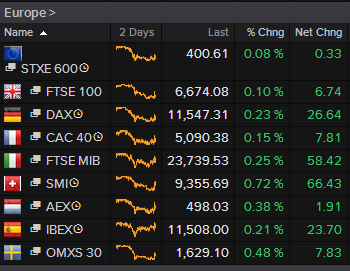
Tony Cross of Trustnet Direct has run through the main movers in London:
ARM Holdings is finishing the day at the top of the board after yesterday’s rout inspired by those rotten Apple results on Tuesday. Given ARM’s diverse customer base the sell-off has been seen to have little merit, so whether the rally has further to run here remains to be seen. Pearson is also up around 2% on the back of news that it has finally sold The Financial Times although there are suggestions that given both the London premises and the 50% stake in The Economist have been retained, this price achieved was more than fair. Once the numbers have been dissected there could be further reaction seen here, too.
Scottish and Southern is lagging both off the back of having gone ex-div and some disappointing sales figures, but it’s Aberdeen Asset Management that’s at the foot of the index, down 7% after a notable fall in AUM was reported with volatility in emerging markets being seen as the culprit.
Pierre Moscovici, European commissioner, still expects the Greek bailout to be agreed in the second half of August:
#Grèce dynamique à poursuive pour conclusion négociations nouveau programme d'aide 2e quinzaine d'août http://t.co/55DF76yqk8 @EU_Commission
— Pierre Moscovici (@pierremoscovici) July 23, 2015
Updated
Over in Athens the gloves appear to be finally off in Syriza.
Our correspondent Helena Smith reports:
It didn’t take long. Barely three hours after Zoe Konstantopoulou emerged from his office, the Greek prime minister has issued a statement with a thinly veiled warning that he might be forced to take drastic action if the parliament speaker doesn’t change tact.
“The prime minister today received the president of the parliament at her request. Alexis Tsipras listened to the views of Zoe Konstantopoulou carefully. He expressed his concern at the institutional discord caused by her otherwise respected decision to differ from the collective direction the government [has taken] and the parliamentary majority which supports it.
The meeting took place in a climate of sincerity and comradeship.”
Konstantopoulou, fast becoming the face of anger over the government’s spectacular u-turn in recent weeks, has yet to respond. Leaving Tsipras’ office, she had played down differences telling reporters that both were bonded by feelings of comradeship and sincerity and a common desire to defend the:
“rights of our people ... and the cohesion of the left and of Syriza which some would like to see break up.”
Updated
Life is full of surprises. And few members of the Financial Times suspected that they’d end up being sold to Nikkei, Japan’s largest media company, for £844m today.
Here’s the full story:
Exciting times for the FT’s finest, once they’ve mastered a few technical challenges:
Classic. @Pearson CEO puts message to @FT employees on some internal messaging system I have no idea how to use.
— Peter Spiegel (@SpiegelPeter) July 23, 2015
OH in the newsroom: 'Does anyone know how to open this thing?'
— Katie Martin (@katie_martin_fx) July 23, 2015
It sounds nearly as bad as a paywall!!
Updated
Bundesbank chief signals openness to (some) debt relief

The head of Germany’s central bank, Bundesbank chief Jens Weidmann, has signalled his willingness to consider extending Greece’s debt repayments.
Over to Reuters:
In remarks that may show a willingness to compromise on the question of Greece’s debt burden, Jens Weidmann said: “One proposal of the Bundesbank envisages, for example, an automatic extension of the maturities on all the bonds of a country as soon as it has applied for an ESM (European Stability Mechanism) programme.”
“That would drastically reduce the financing needs of a possible programme.”
However, Weidmann also suggested a three-year extension. The IMF believes a three-decade one is needed....
Eurozone consumer confidence weakens
The Greece crisis has dented consumer morale in the eurozone.
The European Commission’s flash estimate showed the euro zone consumer morale indicator was -7.1 points, a chunky deterioration on the -5.6 in June.
All those long crisis meetings, the deadlock, and the talk of Grexit may have unsettled Europeans.
German newspaper publisher Axel Springer has now emerged as the front runner to buy the Financial Times, and add it to its stable of titles including the tabloid Bilt.
Axel Springer now favourites to be the company in talks to buy the @ft http://t.co/mLJktZOVPg pic.twitter.com/oVJZvxSBu0
— Ladbrokes Politics (@LadPolitics) July 23, 2015
Updated
Veteran economics writer Anatole Kaletsky has reinforced his reputation for going against the flow, by arguing that Greece’s bailout deal will end well.
Kaletsky argues that Europe’s leaders will want to show that their tough approach to Athens will work, by showing a little flexibility in its bailout targets.
And with the eurozone growing, and the ECB committed to stimulating the economy through QE for at least another 14 months, Greece’s future might not be as awful as many people reckon.
Worth reading (and then bookmarking so we can mark him out of 10 in a few years....)
Updated
Speaking of central banks, Turkey left interest rates unchanged today:
Turkey's central bank left its repo rate unchanged at 7.5 percent on Thursday, as expected $USDTRY ^MW
— FOREX.com (@FOREXcom) July 23, 2015
That went down badly with the country’s economy minister, who said he couldn’t view it ‘positively’ (code for ‘Wish they’d cut rates instead’)
...and up goes the US dollar, on the back of that surprisingly decent weekly jobs report:
Dollar basket spikes as US initial jobless claims falls to lowest since 1973 at 255,000. 1 min @IGcom chart pic.twitter.com/OFExqDnyDO
— Sara Walker (@SaraWalker_IG) July 23, 2015
US jobless claim are lowest in four decades
Over to America, where the number of people filing new claims for unemployment benefit has hit its lowest level since 1973!
Just 255,000 filed initial jobless claims last week, down from 281,000 the previous seven days.
A strengthening US jobs market is going to put more pressure on the Federal Reserve to raise borrowing costs this year, especially once the Greek bailout is signed and sealed.
US back to work! 255K weekly jobless claims vs 278K est #usd
— Mike van Dulken (@Accendo_Mike) July 23, 2015
Claims look even better when you consider how much the population has grown since 1973
— Victoria Stilwell (@toristilwell) July 23, 2015
The shadow of Greece’s financial crisis even reaches the Acropolis today.
A group of contract employees from the Ministry of Culture are protesting at the entrance of the ancient site today, saying they are owed up to six months of unpaid wages:

That much-anticipated meeting between prime minister Tsipras and speaker Konstantopoulou has ended....
Speaker Zoe Konstantopoulou meets PM, says priority is to safeguard party unity #Greece pic.twitter.com/pBQXtvKBqC
— Derek Gatopoulos (@dgatopoulos) July 23, 2015
Greece to fall deeper into recession this year
A third bailout deal won’t prevent Greece plunging into a deep recession year, a leading Greek thinktank has warned.
The Foundation for Economic & Industrial Research (IOBE) has abandoned its prediction from April that Greek GDP would rise by 1% this year, given the turmoil in the economy since capital controls were imposed.
IOBE now fears that the economy will shrink by between 2% and 2.5% in 2015, due to the damage caused to exports, tourism, business investment and consumer spending.
That would more than wipe out last year’s modest progress, when Greece grew by 0.7%.
Greece is already in recession, having contracted since the last three months of 2014. IOBE fears this slump will last until 2016, when growth could return if reforms are carried out.
That would mean even more damage to an economy that has already shrunk by a quarter since the crisis began.
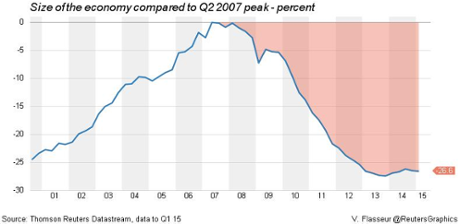
IOBE is presenting the report now in Athens, and it has urged the Greek government to conclude its bailout talks quickly. Any delay would cause even deeper damage, it argues:
“The recent turbulence in the banking system and its impact on its capital adequacy along with the wait for the outcome of negotiations for a new programme would be the main cause for a suspension of the overwhelming majority of business investment in the second half of 2015.”

Over in Athens, talk of divergence in Syriza will be topping discussions between prime minister Alexis Tsipras and House speaker Zoe Konstantopoulou this lunchtime.
Our correspondent Helena Smith reports
The long -awaited meeting between Konstantapoulou and Tsipras began a short while ago when the outspoken president of parliament arrived at the Greek prime minister’s office with a huge stack of papers (presumably the third bailout accord) under her arm.
Tsipras meets with speaker of parliament Constantopoulou - http://t.co/uUrhdSZJvY pic.twitter.com/d1ZFaHHyzE
— enikos_en (@enikos_en) July 23, 2015
There is perhaps no one in Syriza who has been more outspoken about the u-turn Tsipras has made than the fiery lawyer. Addressing the 300-seat House ahead of last night’s vote she repeated that the democratically elected government had been blackmailed into enacting legislation that it was diametrically opposed.
Eloquent, strong-willed and seemingly oblivious to the criticism that her tough stance - and legalistic formalism - is wont to engender, Konstantopoulou has become a huge internal problem for Tsipras who may well be hoping she will voluntarily step aside.
As the measures Greece has signed up to start to be felt, Konstantopoulou may well attract support as the true embodiment of the fight against austerity.
But while the government spokeswoman admitted this morning that Syriza was now plagued by a serious “political problem” it is unlikely that Tsipras will ask the president of the parliament to resign before he deals with the internal machinations in Syriza once a deal has been reached with creditors in the autumn.
Greece’s stock market workers face a longer wait before they can do any actual trading.
The Athens exchange shut down when capital controls were introduced at the end of June, and officials say it won’t reopen this week.
Greece to decide next week when Athens stock exchange will reopen. It's been closed for 4 weeks after capital controls imposed. @BBCNews
— Ben Thompson (@BBCBenThompson) July 23, 2015
Our friends at the Financial Times may be about to change hands.
The wait will soon be over... PEARSON SAID TO IMMINENTLY ANNOUNCE SALE OF FT: REUTERS
— Robert Passarella (@robpas) July 23, 2015
Apparently the lucky buyer is a “global digital news company”. The sensible money may be on Bloomberg. But who knows?.....
The FT has been on the brink of being sold more times than Greece has been on the brink of leaving the eurozone. But the City is taking this rumour seriously, with Pearson’s shares price up 1.8%....
I, for one, welcome our new global digital news company overlords. https://t.co/UGK29euu6E
— Peter Spiegel (@SpiegelPeter) July 23, 2015
Over in Athens, parliamentary speaker Zoe Constantopoulou has arrived for talks with prime minister Alexis Tsipras.
PM #Tsipras meets with House Speaker Zoe Constantopoulou at Maximos Mansion #Greece
— Kathimerini English (@ekathimerini) July 23, 2015
That could be a rather interesting meeting, given Constantopoulou’s steadfast opposition to Greece’s latest austerity programme - and the way it has been forced through parliament without proper scrutiny.
Revealed: Which MPs rebelled, and which didn't
The big question at last night’s vote was whether Alexis Tsipras would suffer fresh defections, which would have weakened his grip on power.
In the event, he emerged unbowed, with three fewer rebels than a week ago.
But the full picture is slightly more nuanced, with four abstainers voting yes this time, but two MPs going the other way.
Only ex-finance minister Yanis Varoufakis was nimble enough to execute a full spin from no to yes [he’s blogged about how he supports these latest reforms, and also wanted to help the government]
And thanks to the Irish Times’s Damian Mac Con Uladh, we can see all the details:
Spreadsheet showing all no/abstaining/absent #Syriza MPs in last two parliamentary votes https://t.co/eWNHB7Dadn pic.twitter.com/fhS3Es5tVM
— Damian Mac Con Uladh (@damomac) July 23, 2015

The Athens News Agency has rounded up some of the headlines in today’s papers:
-
AVGHI: The left government is a fortress
-
DIMOKRATIA: First victory of small bond holders
-
EFIMERIDA TON SYNTAKTON: The rift remains
-
ESTIA: Grexit plan is totally naive
-
ETHNOS: Divorce platform at SYRIZA
-
IMERISSIA: Further cuts in public sector salaries
-
KATHIMERINI: SYRIZA with rift
-
KONTRANEWS: Elections on September 13
-
NAFTEMPORIKI: Anxiety over fiscal gap
-
RIZOSPASTIS: ‘No’ to the new barbarous memorandum
-
TA NEA: (Prime Minister Alexis) Tsipras does not take a step back on agreement and rebels
-
TO PONTIKI: The fight against corruption is a step to elections
Spanish youth unemployment dips below 50%
Today’s Spanish jobs data shows that youth unemployment has hit a three and a half-year low, and is finally below 50% again:
Spain's youth unemployment rate dips to 49.2% in Q2, below 50% for the first time since Q4 2011 http://t.co/4KOdeTsteR
— Markit Economics (@MarkitEconomics) July 23, 2015

Greece’s economic plight is driving more and more of its young people to seek jobs overseas, making it even harder to return to sustainable growth.
And many are trying to head to the UK, as Bloomberg reports:
Data provided by U.K. jobs site CV-library.co.uk shows that visits to its website from Greek workers last week more than doubled from a year ago and that traffic from Greece has hit an all-time high.
Based on weekly growth rates, CV-library expects the overall number of Greek workers searching its site for U.K.-based employment to double from June to July.
#Greece job seekers flock to UK web sites http://t.co/OUF7faWanD @andretartar pic.twitter.com/G6KZPOC2f9
— Richard Bravo (@richbravo2) July 23, 2015
Pound slides as UK retail sales miss forecasts
Britain’s consumers reined in their spending a little last month, according to the latest data from the Office for National Statistics.
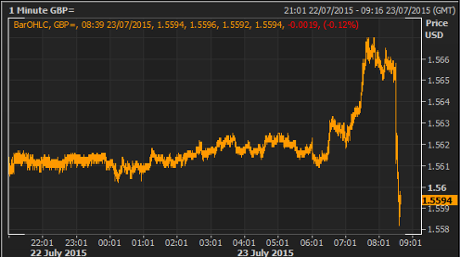
Retail sales volumes dropped by 0.2% compared to May, a weaker performance than expected (economists had pencilled in a 0.3% rise).
The ONS say:
Falls were reported by predominantly food stores, other stores, household goods stores and petrol stations.
Sales volumes were still 4% higher than a year ago - marking the 31st consecutive monthly increase.
But still, it doesn’t suggest the economy is overheating and in urgent need of an interest rate hike. And that’s why the pound just dropped by half a cent against the US dollar.
A hiccup for the UK! Compared with May 2015, the quantity bought in the retail industry was estimated to have decreased by 0.2%. #GBP
— Shaun Richards (@notayesmansecon) July 23, 2015
Oops UK retail sales - June
— Michael Hewson (@mhewson_CMC) July 23, 2015
Encouraging news from Spain this morning. The unemployment rate has fallen to 22.4% in the second quarter of this year, down from 23.8% in January-March.
That certainly doesn’t resolve Spain’s jobs crisis (the worst in the eurozone after Greece). But it does suggest that recent growth is finally feeding into the labour market.
A good tourism season would help too; and possibly give prime minister Mariano Rajoy a boost ahead of the next general election (due before the end of 2015).
First analyst reaction after Spain unemployment rate fell at record pace, to 22.4% in 2Q: "avalanche of new jobs" should put Rajoy at ease
— David Roman (@dromanber) July 23, 2015
The flaws in Greece’s bailout deal are well-documented -- too many recessionary measures, unrealistic targets, a frankly unconvincing and provocative plan to privatise €50bn of state assets.....
And no guarantee of really effective debt relief at the end, although it will at least be discussed.
But yet, it has sailed through the Athens and Berlin parliaments:
Much is missing in the €-area, but not Parliament support: #Greek Parliament 230 yes, 63 no, #Bundestag 439 yes, 119 no 40 abstentions.
— Francesco Papadia (@FrancescoPapad1) July 23, 2015
Stock markets rise on Greek optimism
Europe’s stock markets are all up this morning, as traders welcome the news that Greece can now begin formal negotiations with creditors over a third bailout.
Here’s the situation:
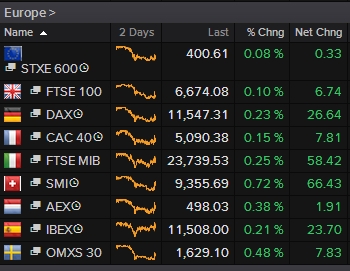
It’s a partial recovery after yesterday’s selloff. Conner Campbell of SpreadEx explains the mood in the City:
Greece and its creditors now have to utilise the co-operative momentum (slash Greek capitulation) that has fuelled this latest wave of breakthroughs in order to try and create a more long-term solution to this saga.
Whilst this still may prove to be a too tall an order, the relief of the Greek vote success, which was never really in doubt but still provides some much needed breathing room, boosted the DAX and CAC after the bell, with both looking much healthier than they did on Wednesday.
It could be a busy day for central banks too - with South Africa expected to raise interest rates, and Turkey expected to sit tight, according to informed City types:
SA and Turkish Central Banks today. proper markets with proper decisions (+25 and flat expected)
— Burnett Tabrum (@BTabrum) July 23, 2015
Overnight, the Bank of New Zealand cut borrowing costs by a quarter-point.
An autumn of electoral activity looms, even if Alexis Tsipras holds his coalition together:
Looking to be busy autumn of elections in Europe: Catalonia (27 Sept) & Spain (end of Nov?), Portugal (4 Oct), Poland (25 Oct) & poss Greece
— Raoul Ruparel (@RaoulRuparel) July 23, 2015
French bank BNP Paribas has also cautioned against assuming that the Greek crisis is now on the back burner.
Analyst Andrew MacFarlane told clients this morning:
Greece approved the second set of measures demanded by creditors this morning; formal negotiations on a new bailout programme can now begin, although risks remain...including differences between the IMF and European creditors on debt relief as well as concerns over whether the Greek Government will be able to implement the socially unpopular deal.
Two serious hurdles, there, which may keep us all busy over the autumn.
Slovakia: Now Greece faces the hard part
Slovakia’s finance minister has welcomed the Greek vote, but warned Athens that it actually has to implement these economic reforms:
The Greek parliament vote is another step in the needed direction. We still have a long way to go #eurozone #Greece #ECB #IMF
— Peter Kažimír (@KazimirPeter) July 23, 2015
The tricky part - called implementation - comes now. The Baltics, #Ireland, #Portugal, #Spain and #Slovakia showed it can be done
— Peter Kažimír (@KazimirPeter) July 23, 2015
Peter Kažimír has limited sympathy for consumers and retailers struggling to cope with the higher sales taxes introduced this week:
The introduced hike in the value added tax (VAT) is a painful measure, but means quick and instant budget revenue #Greece #eurozone #reforms
— Peter Kažimír (@KazimirPeter) July 23, 2015
#Greece, like #Slovakia, needs to focus on the effectiveness of the tax collection and the fight against tax fraud, #tax avoidance
— Peter Kažimír (@KazimirPeter) July 23, 2015
ECB council member: Extending Greece's debt repayments isn't enough
Italy’s central bank chief has warned that Greece’s debt problems can’t be solved simply by extending its existing loans.
Reuters has the story:
Extending Greece’s debt repayments would not be enough to resolve the country’s problems, European Central Bank Governing Council member Ignazio Visco said in an interview with an Italian newspaper on Thursday.
Visco told daily Il Foglio that the issue of Greek debt needed to be dealt with “even by lengthening further its maturities, but it is clear that this will not be enough to overcome the country’s problems.
“The cost of debt of Greece is already low, repayments are spread over time.”
The IMF has suggested that a 30-year grace period may be needed for Greece, unless some of its debt mountain is actually written off.
Last night, Alexis Tsipras reminded MPs that Greece’s creditors are committed to discussing debt relief once the third bailout is agreed. But with Germany insistent that nominal haircuts are impossible, it could be a struggle.
At around 4am Athens time, the vote came too late for today’s Greek newspapers. So they focus on the splits within the Syriza party.
Divorce, battle, rift: 3 newspapers headline the split within leading SYRIZA after vote #Greece pic.twitter.com/bimDOR6bwE
— Nathalie (@savaricas) July 23, 2015
The 36 MPs who voted No last night do present a problem for Alexis Tsipras, and meant he relied on support from opposition parties to win last night.
European stock markets are expected to rise this morning, following the Greek vote:
Our European opening calls: $FTSE 6700 up 32 $DAX 11568 up 48 $CAC 5102 up 20 $IBEX 11551 up 67 $MIB 23793 up 111
— IGSquawk (@IGSquawk) July 23, 2015
Introduction: Greece takes another step to third bailout
Good morning, and welcome to our rolling coverage of the Greek debt crisis, and other events across the world economy, the financial markets and business.
There’s a touch of relief in the eurozone this morning, after the Athens parliament voted by a wide margin to accept a programme of economic reforms demanded by creditors.
After hours of debate, 260 Greek MPs voted in favour of the measures to shake up their legal and banking system, and just 63 opposed them.
That clears the way for formal talks to begin over a third bailout, which could be hammered out within four weeks.
Three government MPs who had rebelled in the first vote last week returned to the fold last night, including former finance minister Yanis Varoufakis.
Greek Parliament approves second tranche of measures despite 36 no votes in #Syriza -@yanisvaroufakis surprisingly supports #Tsipras #vouli
— 'Ελενα (@Elena_Deve) July 23, 2015
If you didn’t stay up all night, you can relive the action with our special catch-up service (no extra charge)
Greek parliament approves bailout reform package - as it happened http://t.co/qs5iiGi4Ju pic.twitter.com/64IhO9LCts
— Graeme Wearden (@graemewearden) July 23, 2015
Although nothing is guaranteed, the vote may end this particular phase of the Greek debt crisis. The third bailout, despite its well-documented flaws, is now on track.
But the possibility of early elections still looms over Athens.....
As the Financial Times puts it:
The Greek side had been under pressure to strike an agreement quickly so that funds from the new loan could be released to repay €3.2bn due to the European Central Bank on August 20.
But implementing the new agreement could be delayed, to the creditors’ dismay, if Alexis Tsipras, the prime minister, decides to call a snap general election.
What else is coming up today?
We have....eurozone consumer confidence data at 3pm BST. That’ll show whether the Greek crisis has caused much damage to the wider economy.
In the UK, the latest retail sales figures hit the wires at 9.30am BST.
And it could be another lively day in the financial market, after fears over the Chinese economy sent commodity prices falling on Wednesday:
We’ll be tracking all the main events through the day....