Lifting the curtain of secrecy currently hanging over the grand jury investigation into the death of Eric Garner will help restore public trust in the criminal justice system, a Staten Island judge was told on Thursday. It would also answer questions about the fairness and impartiality of the process that led to a decision not to bring criminal charges against the officer who placed Garner in a chokehold before his death, the court heard.
“Transparency is better than secrecy. Light is better than darkness,” Arthur Eisenberg, the legal director of the New York Civil Liberties Union, told judge William Garnett on Thursday.
The NYCLU was joined by the Legal Aid Society; Letitia James, the city’s public advocate; the New York Post and the National Association for the Advancement of Colored People in pushing for the release of the grand jury transcripts. The Garner family did not participate in the lawsuit but submitted a statement of support in favor of disclosure.
The case stemmed from a grand jury decision not to indict Daniel Pantaleo, the New York police officer who was seen on video placing Garner, 43, in a chokehold as Garner gasped: “I can’t breathe.” Garner died of injuries sustained during the arrest. The decision touched off protests that roiled the streets in New York City and beyond and raised issues of police brutality, racial equity and the efficacy of grand juries.
Speaking before the start of the arguments, Garnett reminded the parties that grand jury secrecy was “embodied” in the state’s constitution, and that the parties must prove a “compelling and particularized” need for disclosure.
“What the public is dying to understand – and what it has the right to understand – is how this process works,” said Matthew Brinckerhoff, an attorney for the city’s public advocate. He added: “This case is the catalyst for what will undoubtedly be reform measures.”
The parties argued that the Garner case is substantively different from other cases in which judges have ruled in favor of secrecy, describing it repeatedly as a “catalyst” for a nationwide debate on reforms.
Disclosure of the grand jury minutes was opposed by the office of the Richmond County district attorney Daniel Donovan, which argued that the grand jury witnesses gave their testimony with “assurances of secrecy” and that making their testimony public would bring the “inevitable result of harassment or retaliation”.
In court, assistant district attorney Anne Grady countered that heightened public interest in a case is not a compelling enough reason to justify disclosure, something that could possibly put witnesses’ safety in jeopardy. “Snitches get stitches,” she reminded the courtroom, a comment that was met with audible groans from the pews.
Protesters gather on the steps of the Staten Island Supreme Court ahead of oral arguments #EricGarner pic.twitter.com/teTRIAyFVG
— Lauren Gambino (@LGamGam) February 5, 2015
Grady added that the result of disclosing the transcripts could have a “chilling effect” on witnesses in future grand jury cases. She called a decision by a Missouri district attorney to release the minutes of grand jury proceedings concerning the police killing of black teen Michael Brown “appalling” and said it was an example of how disclosure unnecessarily exposed witnesses.
Judge Garnett said then, and repeated each time someone mentioned Missouri, that the decisions made there were immaterial to the Garner case.
Following the non-indictment in December, Donovan, the district attorney, requested that limited information about the grand jury be released. In a brief order acquiescing to the request, a judge revealed that the grand jury heard from 50 witnesses – 22 civilians plus police officers, emergency workers and doctors – over the course of nine weeks. On Thursday, the parties capitalized on the prosecutor’s request, calling his opposition to their push to unseal the transcripts “hypocritical”.
Among the information being sought are the charges presented against officer Pantaleo, the grand jury minutes and instructions given to the jury. The parties agreed that some information such as the names of the jurors and witnesses should be redacted.
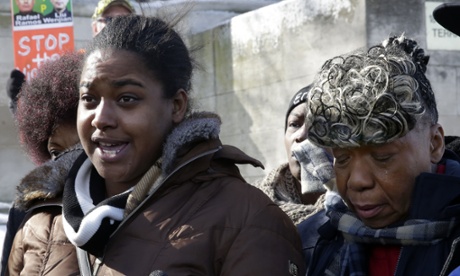
Among those in the courtroom on Thursday were Garner’s mother, Gwen Carr, and his daughter, Erica Garner.
From the pew, the family members nodded their heads in agreement as NAACP attorney James Meyerson spoke, telling the judge that the circumstances would have been different if a black man had placed a white man in a chokehold.
Releasing the transcripts, Meyerson argued, would “pierce the perception and belief that this whole thing is rigged”.
Speaking to the Guardian during a break, Erica Garner said she believes the grand jurors would have acted differently if her father had been white.
“An indictment would have come down in a minute and a half,” she said. Her grandmother agreed: “It would have been different if the circumstances were different.”
During a press conference after the hearing, Erica Garner thanked a group of protesters who turned up in the bitter cold carrying signs and banners in solidarity with the push for disclosure.
She asked supporters not to give up on the fight for justice, and urged them to vent their anger at the ballot box.
“We can control who our elected officials are,” Garner said. “We can do this with very little effort. I challenge each of you to commit to getting registered to vote today … They cannot win an election on this island without us. All we got to do is show up.”
Donovan announced last month his intention to run for Congress to replace the former US representative Michael Grimm, who resigned after pleading guilty to federal tax evasion.
“From now on,” Garner said, “we pick our leaders, and they pick our issues. Period. Never forget.”