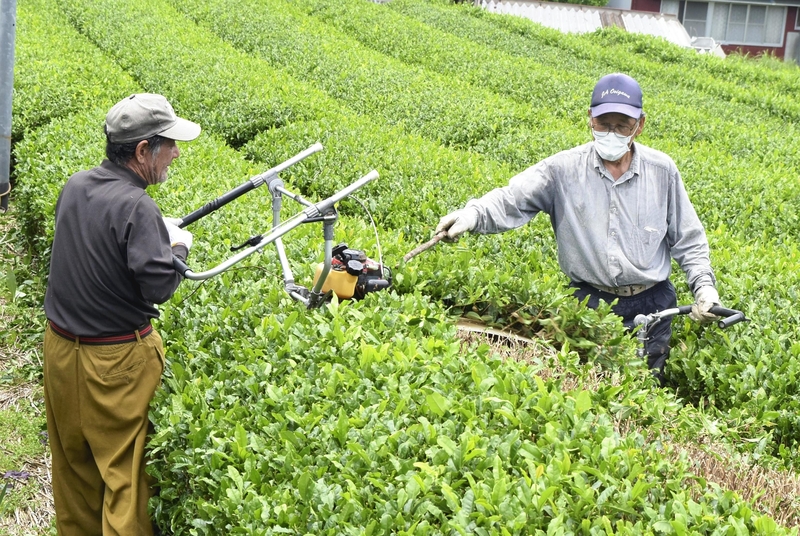
The number of elderly people registered with public entities that offer easy jobs for people aged 60 or older has dropped below 700,000 for the first time in 19 years, as senior citizens are opting for higher wages amid a surge in hiring.
An increasing number of elderly people are healthy and active, and some refuse to regard themselves as "silver," a word often used for senior citizens in Japan. The spread of the novel coronavirus has also put a damper on centers' efforts to increase membership.
Dubbed silver human resources centers, these facilities were established to empower the elderly and revitalize communities through employment. The national and local governments subsidize part of the operating costs for about 1,300 centers nationwide, which primarily arrange for jobs involving short hours, such as weeding and cleaning. The average monthly pay is less than 40,000 yen.
According to the National Silver Human Resources Center Association, there were approximately 698,000 members of such centers at the end of fiscal 2020, comprising 462,000 men and 236,000 women. This was down 17,000 from the previous year.
The forerunner of the silver human resources centers was established in 1975 in Tokyo's Edogawa Ward. It was regulated under the law in 1986, and centers were subsequently established nationwide. Members surpassed 700,000 by the end of fiscal 2002, and 790,000 by the end of fiscal 2009.
Since then, however, the number has been on a downward trend, due partly to companies' moves to raise employees' retirement age and rehire retirees. This comes as the government is incrementally delaying the age when public pension payments start amid Japan's aging society.
With the spread of the virus, more and more elderly people have refrained from going out and given up their jobs, observers said.
In areas where there is a serious labor shortage due to a decline in population and other factors, some centers have been forced to turn down requests from companies, local governments and households because they cannot secure enough members to dispatch.
There are also said to be mismatches between job seekers and employers. Even if members are eager to work, the centers may not be able to offer jobs that are suitable to their abilities and experience.
The centers prioritize work that supplements the pensions of elderly people, and the wages are not high enough for those who want to earn more.
Some centers are trying to increase their membership by asking companies and other organizations to offer more job options, such as assisting at nursery schools and care facilities for the elderly, or serving customers at supermarkets.
"The centers in each region need to make efforts to find jobs that match the characteristics of each region, and link them to members who are willing to work," said Prof. Atsuhiro Taki at Hiroshima University's Graduate School, who specializes in socioeconomics.
Read more from The Japan News at https://japannews.yomiuri.co.jp/