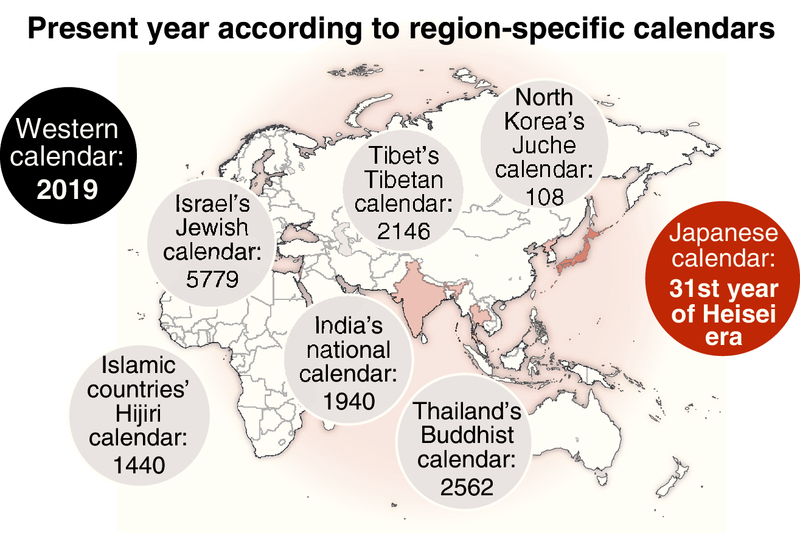
How will the era that will follow the current Heisei era be named? This is a very important concern for Japanese people. Japan is not the only country, however, that has a system for numbering years differently from the Western calendar. In various parts of the world, unique calendars that have derived from the cultures and histories of diverse peoples are ticking away the passing time.
Western calendar
Ancient China is believed to have been the first nation in history, about 2,200 years ago, to use era names.
The custom spread before long over all of Asia. In the Korean Peninsula and Southeast Asia, various dynasties laid down their own era names, which changed in accordance with royal or imperial succession.
But in modern times, many countries began using the Western calendar after reforming their political systems, leaving Japan as the lone country in Asia that still uses era names.
The Western calendar, mainly used throughout the world now, is supposedly based on the birth year of Jesus Christ. It was originally exclusive to Christian nations.
That it has come to be used commonly around the world is the result of past imperialism by European countries including Spain, Britain and France.
The Western calendar took root in various parts of the world through the advance of Christianity and colonization after the Middle Ages.
In Asia, the Western calendar was adopted as trade with Western countries flourished in the 19th century.
Even Saudi Arabia, a country with a large number of strict Muslims, began officially using the Western calendar in 2016.
The adoption stems from the country's need to standardize written expressions in accordance with contractual periods and trade dealing dates, among other reasons, as its trading partners have multiplied around the world, in line with the global economy.
Lunar calendar of China
China has also officially adopted the Western calendar. On the other hand, its traditional "Agricultural Calendar," equivalent to Japan's former lunar calendar, is deeply rooted in the life of its citizens, making it a custom for newspapers, for instance, to use dates according to both the Western and Agricultural calendars.
The Agricultural Calendar year starts on the "Lunar New Year," also known as the Spring Festival.
A holiday period of more than a week around that day has become a period when masses of people who now live in Beijing, Shanghai or other major cities travel to visit their rural hometowns.
Meanwhile, Taiwan ushered in the "108th year of the Republic" this year, according to the year-numbering system that originated in 1912 when the Republic of China came into being. The year 108 is also printed on receipts from local convenience stores.
National calendar in India
In India, different calendars, mainly based on the Hindu calendar, have been traditionally used varying by region, ethnic group and religion.
After its independence from British rule in 1947, the country standardized its calendars, considering it undesirable for different calendars to be used within the country. The Indian national calendar has been in use since 1957.
But the national calendar has yet to be favored by the general public. It is mainly used by official gazettes, in news broadcasts by public radio stations, and in calendars and communications issued by the state government.
1 year with 354 days
In Islamic countries in the Middle East, the Islamic or Hijri calendar is used. It finds its starting point in the Western year of 622, when the Prophet Muhammad migrated from Mecca to Medina in the north.
The current Islamic year is 1440. The Hijri calendar consists of 12 lunar months in a year of about 354 days, about 11 days shorter than those in the Western calendar.
The famous Ramadan holiday is held during the ninth month in the Hijri calendar. Its expected dates this year are May 6 to June 4.
As countries in the Middle East cannot resist the current of the times, the use of the Hijri calendar has increasingly been limited to such purposes as conducting religious rituals and choosing holidays.
No calendar, no problem
There are peoples in the world who have no concept of a calendar.
According to Brazilian BBC, the Piraha, an indigenous tribe of an estimated 200 to 400 people living deep in the Amazon Rainforest, have no future or past tense in their language, only present. As they have no concept of numbers, either, they do not count years.
The average lifespan of the Piraha is 40 to 45 years. They eat the game their hunters killed that day, putting nothing in storage. They have no need for counting months or years, which may have much to do with their way of life.
Read more from The Japan News at https://japannews.yomiuri.co.jp/