Not long after the second world war, the Jewish, German-born political philosopher Leo Strauss coined the term reductio ad Hitlerum. It suggests that simply comparing something to Adolf Hitler does not inevitably taint it with the Nazi dictator’s terrible crimes. Hitler was a vegetarian, but that doesn’t make all vegetarians bad people.
When the internet arrived several decades later, attorney Mike Godwin updated Strauss. “As an online discussion grows longer,” he said, “the probability of a comparison involving Nazis or Hitler” increases.
These days, few are willing to compare anyone or anything to Hitler, for fear of invalidating their argument. This can have the effect of closing off comparisons that could be illuminating.
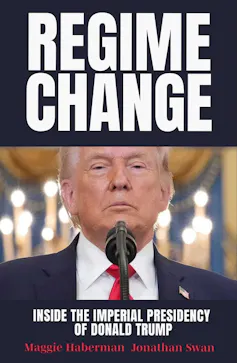
Review: Regime Change: Inside the Imperial Presidency of Donald Trump – Maggie Haberman and Jonathan Swan (Simon & Schuster)
Nowhere is this more strikingly illustrated than in the closing scene of Regime Change – Maggie Haberman and Jonathan Swan’s excellent, glowingly reviewed book about the first year of the second Trump administration – in which the authors finally gain an interview with the president to fact-check the damning material they have gathered.
Haberman has been reporting on Trump since his New York property developer days, and Swan has covered both his presidencies. The New York Times journalists knew from experience that Trump had two main modes of dealing with journalists: silk-smooth salesman’s patter and outright bullying.
Days before their interview, Trump had unloaded on Haberman via his Truth Social site in personal terms, threatening to add her to his latest lawsuit against the newspaper
When they met at the Oval Office on March 16 this year, 17 days into Trump’s ill-conceived, unlawful war on Iran, the president wanted to talk about the maple trees he was ordering for the White House, as part of the large-scale renovations that were under legal challenge. He wanted to talk about the 339 billion views of Trump TikToks: “That’s some number, huh?”
And he wanted to let them know that, in a historian’s view, he is “without question, the most powerful man that the planet has ever known – by a long way.” More powerful, in the historian’s assessment, than Alexander the Great, the Caesars, William the Conqueror, Genghis Khan, Attila the Hun, Tamerlane, Mao, Stalin – and, yes, Hitler.
Leaving aside the only-in-Trumpworld twist that the “historian” turned out to be the caddy of golfer Gary Player, for Trump, what mattered was that while previous leaders had huge power, he had more.
What was revealing was not really that Trump agreed with the thesis, but the way he inhabited it: the evident pleasure he took in the company of Mao, Hitler and Stalin, masters of state control through murder, torture and detention – and the untroubled ease with which he accepted a place among men who had reshaped the world through conquest and fear. He drew no distinction between those who built and those who destroyed, between those who liberated and those who enslaved.
It is a revelation that chills to the bone. And it makes sense of how Trump has behaved in his second term, untrammelled by the adults in the room who advised against or blocked his impulses between 2017 and 2021.
The authors show how Trump has willingly, if not wilfully, upended decades of international law, treaties and conventions to wield as much power as possible – at home and, especially, abroad. This power is being exercised pitilessly, sometimes capriciously, against political enemies, perceived and real. Trump’s targets have ranged from trans people to the news media and entire nations, such as Venezuela, Iran and potentially Greenland.
Trump has also, according to both Regime Change and exhaustive reporting by David Kirkpatrick of the New Yorker, abused his power to enrich himself and his family.
Most alarming, is Trump’s deep aversion to any consideration of the morality of his actions. There is little if any evidence that Trump cares about other people’s suffering. His narcissism, plain to see for years, is underscored in Regime Change.
Haberman and Swan report an incident during the 2024 trial over charges that Trump falsified business records before the 2016 presidential election, to conceal a payment to porn actress Stephanie Clifford (aka Stormy Daniels) to cover up his alleged affair with her. On the fourth day, a mentally ill man consumed by conspiracy theories set himself on fire in the park across the street from the courtroom.
“Do you think he did it for me?” Trump asked an adviser. The answer didn’t matter. “Let’s tell people that he did it for me,” Trump said.
Such narcissism and callousness goes back a long way. In her biography of Trump, Confidence Man (2022), Haberman recounts an incident in which Trump, aged five, was found pelting rocks over the fence at a neighbour’s baby in a playpen.
Disturbed, but better informed
If it is not already clear, you finish reading Regime Change feeling deeply disturbed and dispirited – if undeniably better informed. Over 464 pages, it lays out the seemingly endless extent of the venality, corruption and cruelty of the first 14 months of the second Trump administration.
Wading through the catalogue of the administration’s actions to date is exhausting. Here is a small sample of what the authors detail.
Immigration and Customs Enforcement (ICE) officers, whose faces are less visible than a Muslim wearing a burka, have detained, often violently, thousands of people. They either deport them or hold them in centres deliberately designed to prompt immigrants to leave the United States.
The administration has launched an unlawful campaign against drug traffickers from Venezuela, treating the problem as foreign-based terrorism rather than crime. It has used the US military to attack and kill people on boats, some of them probably not drug traffickers.
Presidential pardons, the authors argue, are a prime example of Trump’s approach in his second term, exercising his power in a way that is “pure, unobstructed, and enshrined in the constitution”. Pardons are bound by convention rather than black-letter law – and Trump delights in crashing through conventions.
Historically, according to political scientist Stewart Ulrich, the power to pardon was not intended “as a personal token for the president to hand out but as an act of mercy meant to check the other two branches”: congress and the judiciary.
The exact terms of the power were deliberately vague, according to historian Kathleen Bartoloni-Tuazon, leaving space for presidents to use the power and for the US people to decide at the ballot box whether they agreed with a president’s actions.
Presidents mostly give pardons near their term’s end. Trump upended this on day one of his second term, pardoning 1,500 people charged over the riot at the Capitol on January 6 2021, the aim of which was to overturn Trump’s election loss.
Haberman and Swan report that Trump was emboldened by his predecessor Joe Biden pardoning his own family, including his son Hunter, on his final day in office.
Biden’s decision was controversial and provided cover for Trump to stretch convention even further. But Biden was, the authors argue, at least partly responding to credible threats from Trump about pursuing him and his family legally once Trump re-entered the White House.
Worth remembering, too, is that in Trump’s first presidential term, he pardoned his son-in-law’s father, Charles Kushner, who was convicted of tax evasion, among other things.
Presidential pardons have become almost an assembly line for Trump’s allies and white-collar criminals, who soon learned to bypass the official system and appeal directly to the president. They know to tell Trump that they, like him, have been “persecuted by a weaponised justice system”, the authors write. Bada bing, bada boom: a further 166 pardons were granted in the first year of the administration.
While railing against the scourge of drugs entering the US, Trump has even pardoned a Honduran trafficker serving a 45-year sentence for smuggling 400 tonnes of cocaine into the country.
Justifiable secret sources
Surveys of historians have rated the first Trump administration one of the worst in US history. Their verdict on the second administration would be premature, given it has not even reached the halfway mark, but it is hard to see how it will not be even harsher.
Regime Change will be essential reading for them. Halderman and Swan, in addition to their own reporting, draw on more than 1,000 interviews with campaign officials, White House staff, government departmental and agency officials, former aides, donors, friends and business associates.
Many interviews were conducted on “deep background”, meaning the reporters could use the information but not identify the person by name. This controversial convention was made famous by Carl Bernstein and Bob Woodward, the Washington Post reporters who broke the Watergate scandal. They deployed the convention to great effect in two works of book-length journalism: All the President’s Men and, especially, The Final Days.
Deep background enables journalists to learn what has been happening behind an administration’s carefully constructed public relations facade. But it can be manipulated by politicians and officials who know they won’t be held accountable for their words. Alicia Shepard, a journalist and journalism academic, argues this has happened on occasion with Woodward, who has continued writing journalistic books.
The second Trump administration is made up almost entirely of loyalists. Key decisions are made by a very small group. This was most starkly illustrated by the absence of the secretaries of commerce (Howard Lutnick) and treasury (Scott Bessent) from decisions about waging war against Iran.
The deep background sources are justifiable in Regime Change, given the high stakes and the care with which Haberman and Swan appear to have weighed various people’s accounts. They found the second Trump administration to be highly secretive – in stark contrast to the first administration, which leaked like a busted tap.
The deeply secretive nature of the administration meant Swan and Haberman were able to uncover only a tiny proportion of what it is doing, or plans to do. As Swan told ABC Radio National’s Late Night Live, Trump gives a “performance of transparency”. He gives many more media conferences than Biden and his personal mobile phone number is known to seemingly every journalist in Washington. But journalists have learned, or are learning, that Trump says little of value in interviews and responds to difficult questions with either a flat refusal to answer or personal abuse.
If you want to get a sense of just how tightly the second Trump administration controls access, witness the hurdles the ABC’s John Lyons had to clear to put even a couple of questions to Trump for his 2025 Four Corners program about the president’s wealth. As Lyons observed, even the place where he was allowed to ask questions – on the tarmac with Air Force One’s engines whirring noisily in the background – was chosen to give the president control and restrict the journalist.
The acid test for the kind of anonymous interviews on which Regime Change is founded, though, is accuracy. Have important facts been proven wrong, or credibly contested? Apart from preemptively denigrating the book, Trump has since said of it:
Based on a very quick and boring briefing concerning the Magot Hagerman [sic] book about me, it is mostly made up, Fake News, largely fiction, as have been most of the things she has written about me for so many years.
Given the number of times Trump has labelled any news article or outlet he doesn’t like “fake news” and the sheer number of lies the Washington Post found he told in his first term, this statement carries little weight. By 2026, it’s fair to conclude that if Trump was caught on CCTV footage robbing a bank, he would describe it as “the hoax of the century”.
Jaw-dropping disclosures
According to The Atlantic’s Gal Beckerman, the prevailing publishing industry wisdom is that, as the second administration unfolds, readers of Trump books – overwhelmingly critics of him – are “thoroughly wrung out after more than a decade of content about his behavior, his psychology, and the swirl of chaos that surrounds him”.
Yet Regime Change is on track to be the nonfiction bestseller of the year, with 500,000 copies already sold, according to an Axios report. This speaks to the authors’ ability to compress an extraordinary amount of material in clear, smoothly flowing prose. But Beckerman points to other elements contributing to success of Regime Change.
Ahead of publication, Haberman and Swan published some well-chosen extracts. They reported in detail how Trump overrode or ignored advice from his CIA director, John Ratcliffe, and secretary of state, Marco Rubio, about the dangers of agreeing to the Israeli government’s urgent pleas to sign up to a war against Iran.
Ratcliffe’s term for the Israelis’ plan for regime change in Iran was “farcical”. Rubio said, “In other words, it’s bullshit.” Trump, however, bought prime minister Benjamin Netanyahu’s pitch, saying: “Sounds good to me.”
Published a fortnight before the book’s release, the second extract concerned mid-2025 meetings in the Situation Room, a space normally reserved for national security matters, to discuss what the administration was going to do about the Jeffrey Epstein files. Trump was not part of the meetings. They were led by his vice president, J.D. Vance.
The Situation Room disclosures were jaw-dropping for several reasons. The first was the lengths to which senior officials went to keep Americans in the dark about the files’ contents, before they finally caved to public pressure. The second was the lack of any care for victims of the convicted sex trafficker.
The third was a detail from an FBI report about one Epstein victim, who said another woman in Epstein’s sex trafficking ring had told her she had met Trump and he had a nipple fetish. Sarah Ransome said she had shared a bathroom with the woman, named Jen. The authors report Ransome saying: “They looked incredibly painful as they were red and swollen and I remember wincing when I looked at them.”
It is important to note that the FBI report has not been corroborated and Ransome has made other claims she later retracted – though she did this, she said, out of fear for herself and her family. Haberman and Swan report that Epstein settled a lawsuit, initiated by Ransome against him and Ghislaine Maxwell, now in jail over her role as Epstein’s accomplice. Epstein died in jail in 2019.
Haberman and Swan comment:
The nipple claim was, in miniature, the entire problem the White House had with the Epstein files: Piles of accusations were impossible to disprove, and equally impossible to make go away. Every door they opened led to another room, and in every room were more claims from more women. And now they were threatening to avalanche onto a President who wanted nothing to do with it.
Beckerman notes that concern among even some MAGA supporters over the Epstein files, along with declining opinion polls for Trump in the wake of ICE officers’ brutality and rising petrol prices as his Iran war grinds on – and even some recent pushback from supine Republican congressmen – all point to the sense of a shift in US politics.
Those opposed to Trump’s actions “have felt helpless against the barrage of executive orders and power grabs that marked the past 18 months”, Beckerman writes, but “they are approaching a moment when they can do something about it” by voting in the midterm elections in November. Reading a book like Regime Change is starting to seem “less like trying to focus while getting beaten up and more like thinking back on the fight the next day”.
Why international law exists
It is beyond the scope of a work of book-length journalism such as Regime Change – not to mention a review – to explore the implications of all the authors have laid out. But it would be remiss not to recall the original reason for setting up the system of international laws and treaties Trump has been ransacking. This takes us back to 1945 and the end of the second world war, which cost around 60 million lives, including six million Jews murdered as part of Hitler’s Final Solution.
The United Nations was set up with the explicit aim of maintaining international peace, preventing future global wars, and promoting cooperation among different countries. In the decades since, many have rightly criticised the UN for being overly bureaucratic and ineffectual.
Do we really want to return to a world where there are no checks at all on powerful nations like the US, led by someone like Trump? Or for that matter, on authoritarian, even dictatorial regimes such as China or Russia? Isn’t that why the US and the rest of the Allies – including Australia – fought Hitler in the first place?
This article was originally published on The Conversation. Read the original article.