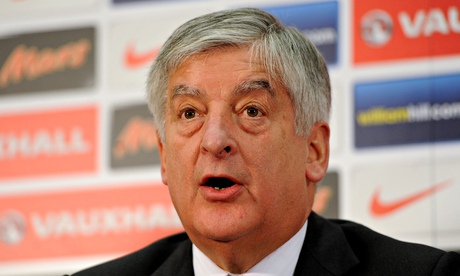
Conforming to the unwritten rule that former FA executives must become bold reformers only after leaving Wembley, David Bernstein has joined calls for European nations to boycott Fifa and the 2018 World Cup if football’s governing body is not fundamentally reformed.
“It sounds drastic but frankly this has gone on for years now, it’s not improving, it’s going from bad to worse to worse,” said Bernstein, who added that Sepp Blatter standing down as president should be a precondition of any reform. “There are 54 countries within Uefa. There’s Germany, Spain, Italy, France and Holland – all powerful. You can’t hold a serious World Cup without them. They have the power to influence if they have the will.”
Bernstein’s call comes after a similar suggestion by the German Football League president, Reinhard Rauball, that Uefa should give “serious consideration” to resigning from Fifa if Michael Garcia’s report on the World Cup bidding process is not published in full. As an antidote to all the procedural rows and the endless Kremlinology dissecting the minutiae of the tinpot politicians who stride football’s corridors of power, it has an appealing simplicity.
But back in the real world, it is just not going to happen. For one thing, Uefa itself is split on whether Blatter should step down.
Having won the right to host the 2018 World Cup, Russia remains close to Blatter. Spain, whose World Cup bid is mysteriously absent from judge Eckert’s disputed summary of Garcia’s report, also backs Blatter.
Speaking for his confederation, the Uefa president, Michel Platini, has made it clear that Blatter’s time is up but has ducked the opportunity to stand against the long-serving Fifa president next May, again keeping his powder dry for a possible tilt in 2019. Nor has Platini’s image been burnished by his close association with the Qatar vote.
Having said that, the strength of feeling within many of the big western European footballing nations against Blatter is real. The Germans, the Dutch and the English FAs have been leading the charge.
It provided a telling insight into Blatter’s mindset when he spluttered that the relatively mild criticism from the Dutch FA president, Michael van Praag, who said in June the 78-year-old ought to make his current term his last as promised, was “the most disrespectful thing I have experienced in my entire life”. A couple of days later, a proposal to introduce term limits for the Fifa president were voted down by Fifa’s 209 members at its congress. Blatter supressed a smirk.
The most hawkish figures within Uefa talk hopefully of finding a consensus candidate who can challenge Blatter. That candidate may come from Asia rather than Europe, with Prince Ali bin Al-Hussein of Jordan mooted as the latest man who might.
Anyone considering such a move would have to be prepared for a sustained onslaught as Blatter ranges the apparatus of Fifa against them. Mohammed bin Hammam, who tried to lubricate the wheels of his campaign with cash, was soon seen off when he dared to challenge Blatter.Even Harold Mayne-Nicholls, the Chilean academic who has considered standing, suddenly finds himself the subject of a Fifa ethics committee inquiry.
So far only Jérôme Champagne, the former Fifa executive who has advocated reform but lacks enough support to cause Blatter many sleepless nights, has shown his hand before May’s election.
Away from eye-catching but highly unlikely talk of boycotts and breakaways, Uefa’s other hope is that the gradual changing of the guard on the Fifa executive committee will eventually prise Blatter from power. The former Manchester United chief executive David Gill, who is seeking to take up the British seat on the executive committee, and a handful of other new Uefa appointments will hope to forge links with the likes of Sunil Gulati, president of the US Soccer Federation, and Moya Dodd, vice-president of the Asian Football Confederation, as the old guard move on.
Blatter’s plan has been to repeat his tactics of the past, grooming new members of the executive committee through flattery and patronage in the hope they will remain loyal. But not only is Blatter is getting older and his tactics are growing more nakedly transparent.
A boycott is not going to happen, at least not for football reasons. Uefa is too diverse, too divided to make it a possibility. The wider political situation, given the obvious tension between Russia and the west over Ukraine, might yet force the issue if the calls for a boycott escalate to heads of state rather than football officials.
But history has taught Blatter that if he rides out the temporary storm then the impetus for change will dwindle and he can go back to shamelessly plotting his next move.
Only an escalation of the ongoing FBI probe and sustained pressure from sponsors and broadcasters, combined with attempts from European nations to reach across the world in an effort to build an anti-Blatter consensus, is likely to come close to unseating the cunning, controversial ruler of world football.
And without the end of Blatter’s tenure, reforming Fifa itself is impossible. People remember the Salt Lake City bribery-for-votes scandal as the moment when the International Olympic Committee healed itself. But in truth it wasn’t until Juan Antonio Samaranch moved on, and the chapter with which he was so closely entwined could be considered closed, that real renewal was possible.