When I’ve been to the funerals of friends – particularly those who have died young – there’s always one point where I fall apart. It’s the montage of photos, usually from Facebook, showing holidays and parties and arms around friends. How can this person – captured so full of life – be in that coffin, never to return?
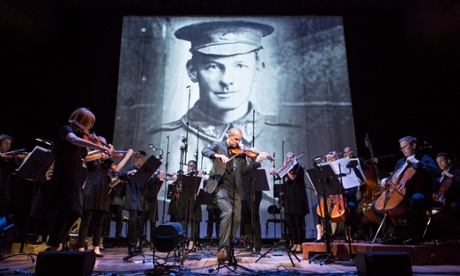
The Australian Chamber Orchestra’s show, Reflections on Gallipoli, uses music, images of Turkish and Australian soldiers, the words of those who were there, and further portrait photography to render the horrors of this particular war. And before we reach a final denouement – the portraits flashing across the stage while the ACO plays Ralph Vaughan Williams’ The Lark Ascending – there has been a contained and effective narrative arc of war.
The performance starts with Bartók’s almost militaristic, Arab-inflected String Quartet No 2. Behind the orchestra, we see images of prewar excitement: the marches, the flags, and the boats pushing out, filled with Anzacs bound for Turkey. The dogs of war are unleashed in the ACO’s flurry of sound, quieted only when the actors Nathaniel Dean and Yalin Ozucelik read out accounts from the front in both English and Turkish.
Through music, words and images, we experience the landing and the battle, but the performance lingers most on the after-effects at the Turkish peninsula – the bodies and the burials, the flies and the shit, the blood and brains. The slaughter is described unsparingly: “There were bodies, crumpled in blood, lying in scrub.” The morning after the battle “revealed a carpet of death”.
There is a strange ceasefire when the dead are buried and cigarettes traded. By this stage, Australian bitterness towards the Turks had reduced: “They had their job to do, we had ours.” An evacuation soon follows. Nearly 9,000 Australians died in the conflict while more than 85,000 Turkish soldiers died in the campaign.
The soprano Taryn Fiebig sings a haunting lament, the inscription of the Turkish Memorial at Anzac Cove on the screen behind her. Then come the final images, dozens of portraits of soldiers – Turkish and Australian – their gaze direct into the camera, as if in old-fashioned selfies.
The ACO’s performance is as world class as usual, and the program mixes new compositions (the premiere of Carl Vine’s Soliloquy and Our Sons) with first world war classics including Elgar’s Sospiri and Kelly’s Elegy for strings “In Memoriam Rupert Brooke”. Accompanying those portraits, the emotional impact is haunting.
Each soldier – dressed in their military gear, their slouch hats, their packs – sparkles with a life force and personality. Some of them, of course, look appallingly young and hopeful. You can tell from their open faces and eyes that these are farm kids, gangly footballers, dashing country-town heroes. It’s so hard to reconcile their faces with the bloated corpses of the battlefield.
The staging is by Nigel Jamieson and Neil Armfield. These two giants of Australian theatre have created – along with the ACO’s Richard Tognetti – something beautiful, understated and at the same time horrific. It brings Gallipoli into focus and plays as much to the emotions as it does to the ear. For those wondering – with the anniversary wave of books, TV shows and tributes – why Gallipoli still matters, they would do worse than to catch this performance.
• Reflections on Gallipoli runs at City Recital Hall, Sydney until 27 March