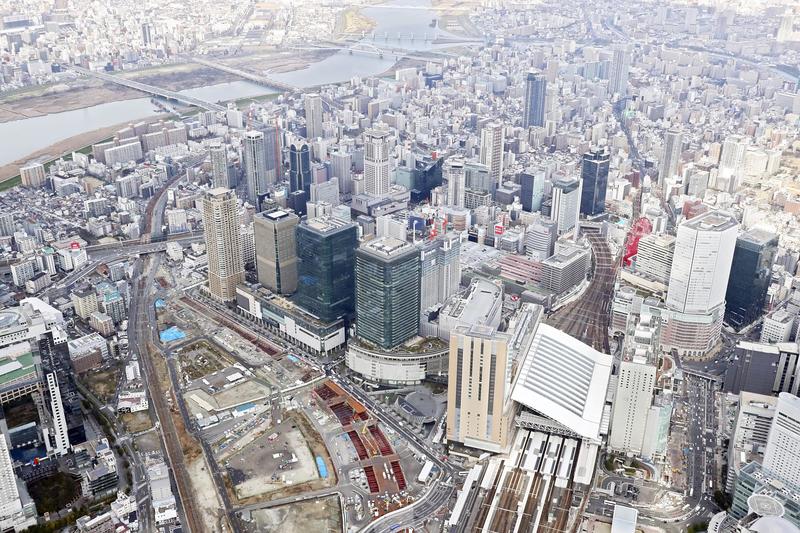
OSAKA ― A local referendum is likely to be held on Nov. 1 to seek residents' judgment on a plan to break up the city of Osaka into special wards and realign them with Osaka Prefecture.
Internal Affairs and Communications Minister Sanae Takaichi approved a scheme proposal, which is equivalent to a blueprint for the realignment plan, on July 28, saying, "I don't have any particular opinion on it." The proposal was formally decided on July 31 at a meeting of the legal council consisting of heads and assembly members of Osaka Prefecture and Osaka. If the scheme is approved by a majority vote in the referendum, the city of 2.7 million will be deprived of its status as a government-designated city and divided into special wards, the first such case in the history of local autonomy.
--Voted down narrowly
The Osaka metropolis plan is modeled after the administrative relationship between the Tokyo metropolitan government and the capital's 23 special wards. The plan calls for dissolving the municipality of Osaka, which has administrative authority on par with that of the Tokyo metropolitan government and prefectural governments, and establishing four special wards. Cross-jurisdictional authorities such as that for the maintenance and expansion of large-scale social infrastructure will be concentrated in the Osaka prefectural government while daily administrative services for residents such as over-the-counter inquiries will be handled by the special wards.
Osaka Prefecture and Osaka have many similar facilities and policies. Toru Hashimoto, who assumed the post of Osaka governor in 2008, criticized this as "dual administration" and put forth the Osaka metropolis plan. The Tokyo metropolitan government was established in 1943 during wartime after abolishing Tokyo prefectural and municipal governments. Hashimoto suggested that "the elimination of dual administration has contributed to the development of Tokyo."
To work toward realizing the plan, Hashimoto established a regional party named Osaka Ishin no Kai in 2010, which became the dominant force in both Osaka prefectural and municipal assemblies. As the party ramped up its influence in national politics too, the Diet enacted the law on establishment of special wards in major cities in 2012 and this led to a referendum in 2015.
At the time, all parties except Ishin no Kai opposed the Osaka metropolis plan. As a result, the plan was rejected by a narrow margin in the referendum, forcing Hashimoto to retire from the political world.
However, then Osaka Gov. Ichiro Matsui (currently Osaka mayor), who succeeded Hashimoto as a representative of Ishin no Kai, and its acting representative and then Osaka Mayor Hirofumi Yoshimura (currently Osaka governor), conspired in spring 2019 to simultaneously hold gubernatorial and mayoral elections in which they were elected into each other's positions of mayor and governor. Ishin no Kai made further gains in the prefectural and municipal assembly elections, capturing a majority of seats singlehandedly in the prefectural assembly and gaining the biggest number of seats ever in the municipal assembly. Thus, Ishin no Kai became a dominant force overwhelming other parties.
As a result, Komeito changed its stance to approve the metropolis plan, saying public support for it was shown in the elections. Ishin and Komeito together occupied the majority of seats in both prefectural and municipal assemblies. This led to the second referendum planned for Nov. 1.
-- Points of contention
The new institutional plan calls for splitting Osaka, which consists of 24 administrative districts, into four special wards each having a population of 600,000 to 750,000. Administrative districts are simply integral parts of a local government, but special wards are independent local governments with mayors and assembly members chosen through elections.
Of about 2,900 administrative services, 85% will be transferred to the special wards and the remaining 15% to the Osaka prefectural government. The Osaka municipal government's revenue, which totaled about 850 billion yen in fiscal 2016, will be fiscally adjusted so that about 650 billion yen is distributed to the planned four special wards and about 200 billion yen to the prefectural government.
A big point of difference from the metropolis plan rejected in 2015 is the number of special wards. The 2015 plan called for dividing Osaka into five special wards, each having a population of 340,000 to 690,000. But under the current plan, the number of special wards has been reduced to four to decrease the differences in population and fiscal size among them.
A major point of contention is the fiscal effect to be brought about as a result of realizing the Osaka metropolis plan. A research institute entrusted with the task by the Osaka prefectural and municipal governments has made a preliminary calculation that it will be possible to cut spending by up to 1.1 trillion yen over 10 years through streamlining efforts such as enhancing operational efficiency. However, experts are divided over this estimate, with the camp opposing the metropolis plan arguing that "costs will increase conversely."
In their own trial fiscal calculation, the Osaka prefectural and municipal governments said that the four special wards will not suffer a shortfall in revenue even if costs for administrative transfers are deducted. But this calculation does not reflect cuts in revenue for the Osaka municipal government caused by the coronavirus pandemic, with some people saying that "calculations must be made again."
Attention is also focused on how administrative services for residents will be affected. The current administrative policies provided by the Osaka municipal government will be maintained for the time being even after the city is divided into the four special wards. But whether to maintain them will be left to the judgment of ward mayors in the future.
-- COVID-19 casts dark shadow
The Osaka metropolis plan was discussed at the legal council for three years. The scheme will be put to a vote on Aug. 28 at the prefectural assembly and on Sept. 3 at the municipal assembly. It is most likely to be approved by a majority vote by Ishin no Kai and Komeito among others. A local referendum is expected to be announced on Oct. 12 and held on Nov. 1.
The referendum will cover the about 2.24 million citizens of Osaka who are aged 18 or older. As in typical elections, campaigning activities such as door-to-door canvassing and vote-buying are banned based on the Public Offices Election Law. Since the referendum does not involve any candidates, there are no regulations to restrict ads and promotion methods and no limits are set on expenses for campaigning and advertising.
Even if the metropolis scheme is approved by a majority vote, the Japanese name of Osaka Prefecture will remain Osaka-fu. A change to Osaka-to -- in the same vein as Tokyo -- would require a different legislative arrangement.
The biggest uncertainty could be the new coronavirus. As a condition for holding the referendum, Mayor Matsui said that "there must be no expansion of virus cases." But the number of cases in Osaka Prefecture has reached a record high since July, a factor that does not foster optimism on whether the referendum can be held as expected.
A public hearing to listen to citizens' opinions was called off this spring. There is a possibility that briefing sessions for residents will not be held due to the difficulty of securing enough places and sufficient time. Given this, opponents of the metropolis scheme call for postponing the referendum and concentrating on measures to cope with the virus crisis.
Read more from The Japan News at https://japannews.yomiuri.co.jp/