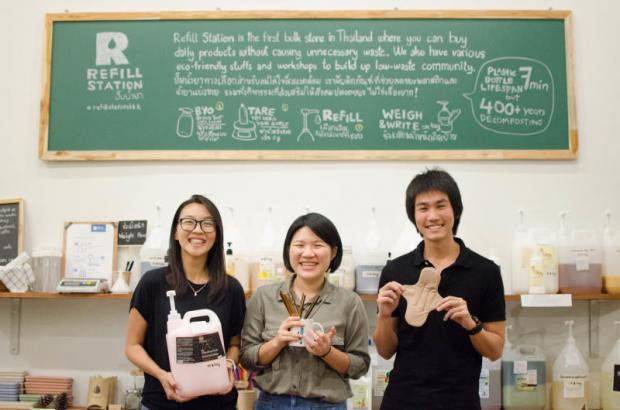
Refill Station (fb.com/refillstationbkk) is the brainchild of Supatchaya "Ann" Techachoochert, alternative energy engineer Chanin "Nammon" Srisuman and co-founder of Better Moon cafe Papawee "Pear" Pongthanavaranon. Ann, who studied biology for her doctorate degree and writes for green-living website Greenery (www.greenery.org), told us how they trail-blazed the zero-waste movement and are tackling the plastic waste issue in Thailand through their unique service, which recently turned one.
How did Refill Station come about?
My co-founders and I are interested in zero-waste lifestyle and realised that Westerners could live like that because they had bulk stores and refill stations, things that didn't exist in Thailand a few years ago. We realised that we could start the change ourselves. We discussed different ideas to help the public live a more sustainable lifestyle like setting up refill spots for drinking water to reduce the use of single-use plastic bottles.
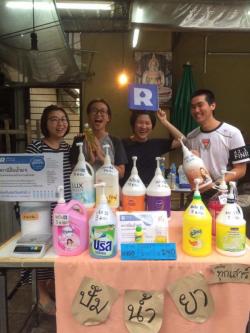
We first did some market research to find out what our customer base would be. We set up tables to sell toiletries and cleaning products of mainstream brands at local markets where we asked customers to bring their own containers. We noticed that low-income people tend to buy these products in small sachets instead of buying them in bigger containers. Those discarded small sachets added up so we wanted to tackle that and help consumers save money too because they paid less for the same amount of products. However, the idea didn't quite catch on with our intended group of customers.
We finally arrived at the idea of setting up a refill station and, luckily, my co-founder Pear was planning to open a cafe, which later become Better Moon. That's how our first refill station came about. We started with the table in July 2017 and opened the refill station in December the same year. Later, we visited a few bulk stores in Canada and Malaysia, which gave us ideas on further improvement. We realised those who are interested in our message are the middle-class who have money to take care of themselves and also care for the environment.
Was there any particular event that inspired your interest in the zero-waste lifestyle?
There wasn't a particular thing or event but I think it's an accumulation of my interest in various facets of environmental issues.
What does Refill Station offer?
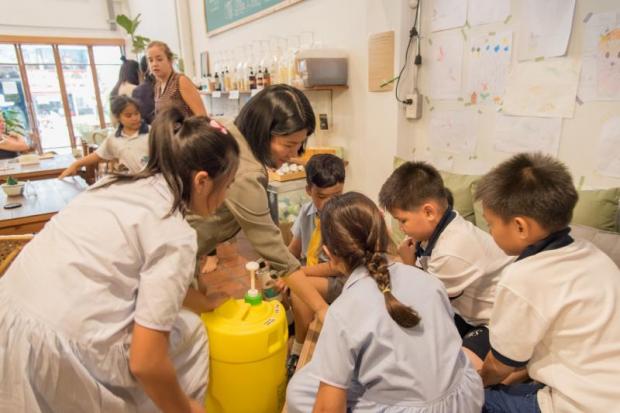
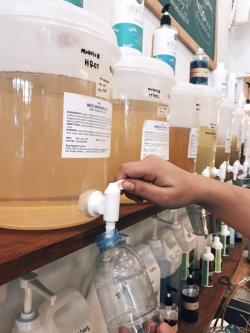
We supply products, equipment and give advice to those who wish to set up a refill station so they don't have to go through trial and error like we did. Last year, we helped set up refill stations at Atnest hostel, Eco Regents Club [inside Regent's International School], OC Organic and Less Plastic Able. Our product range includes soaps, shampoos, lotions, conditioners, detergents and floor cleaners. We have natural and organic products, as well as mainstream brands at our refill station, which is inside Better Moon Cafe.
What was your goal when you first opened the refill station?
It was purely an experiment for us. At the very least, we hoped to raise awareness on the zero waste lifestyle. We didn't expect that the feedback would be so positive and people would embrace our message so quickly. Thai people have become more aware of the plastic waste problem and last year, took more action to curb it. I've seen more and more Thais tackling this issue by changing their everyday habits. Also, our service is the first of its kind in Thailand and Southeast Asia. We're so glad to meet and inspire people who later went on to open their own refilleries.
How's feedback from Thai customers compared to foreign?
It changed so much in one year. At first, our customers were almost all Westerners. Now the ratio between Western and Thai customers is about 50:50. Thai people have increasingly embrace this concept.
What are future plans for Refill Station?
We will open at least two more branches this year, as well as pop-up stations at events. Our new branch at Whizdom 101 near BTS Punnawithi opens today. Another branch will open at a mall but details are yet to be finalised.
What advice would you give to people who want to live a low-waste lifestyle?
Start with small things. Say no to plastic bags when you shop; it's the easiest thing you can do. Don't buy things that you know you won't use later. There's no point in hoarding. Carry a stainless straw everywhere and make it a habit to use it. Think of the plastic straw as a small challenge that you can overcome. Change your perspective on the items that you're accustomed to daily and you may find yourself wanting fewer things, thereby creating less waste.
Join online communities of like-minded people such as the Low-waste Lifestyle by Refill Station or Greenery to realise that you're part of a movement that cares about the environment and its future. Once you realise you're not alone in this, you'll be inspired by real-life examples to keep trying.