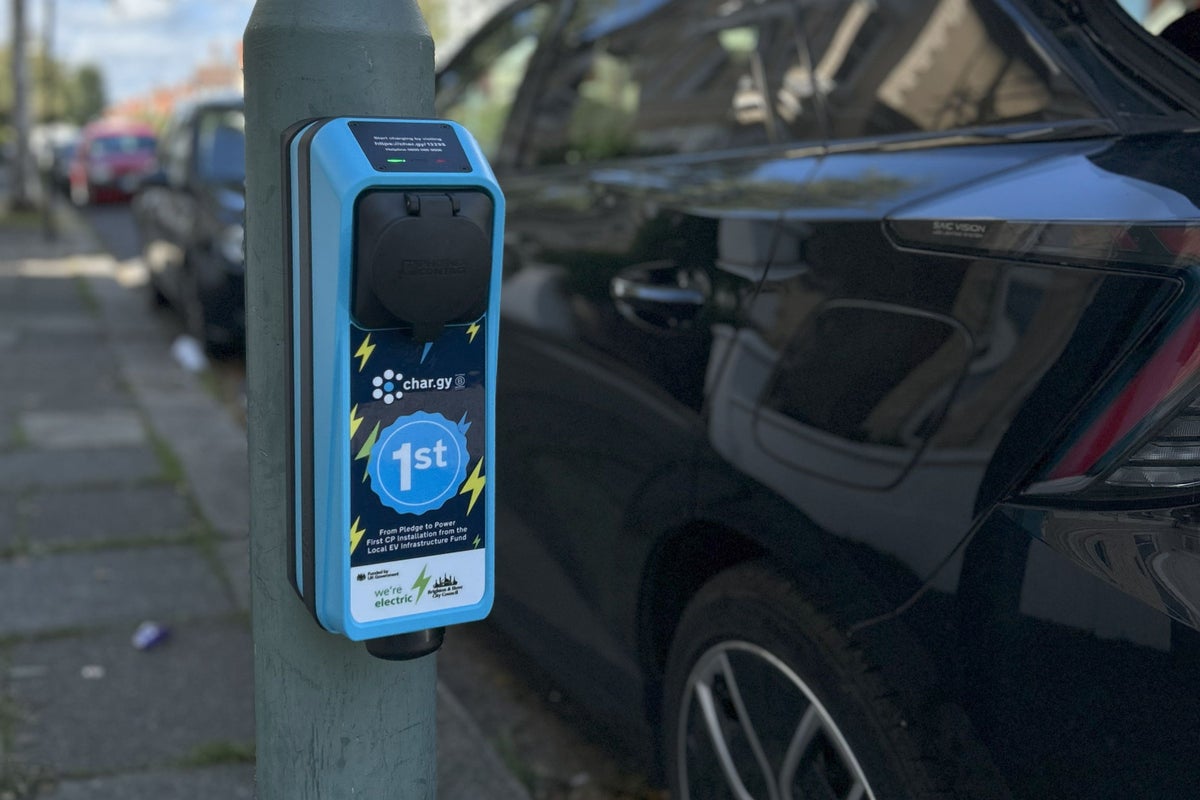
The government has moved to accelerate the rollout of public electric vehicle charging across England by removing one of the biggest administrative hurdles facing chargepoint operators.
The new Planning and Infrastructure Act includes a clause that means chargepoint operators will no longer be required to obtain a section 50 licence before carrying out works on the public highway. Instead, they will be able to apply for street works permits, putting them on a similar footing to utilities and other infrastructure providers when installing equipment on public highways.
At present, any company installing a public chargepoint on the highway must apply for a section 50 licence under the New Roads and Street Works Act 1991. While designed to protect road users and manage disruption, the system has become a significant bottleneck for EV infrastructure, with application timescales and costs varying widely between local authorities. In some cases, this has added months to projects before ground can even be broken, something often raised by the charging industry.
The new approach is intended to streamline that process. Chargepoint operators in England will be able to apply for street works permits through Street Manager, the digital platform already used by all highway authorities and utility companies to coordinate works on the road network. Ministers say this will make applications quicker to process and cheaper to obtain, reducing complexity and cutting delays that have slowed charger installations to date.
The change is expected to have a direct impact on the rollout pace for on-street charging, particularly in residential areas where the majority of drivers do not have access to off-street parking.
Reducing installation cost is also a key part of the policy. By moving away from section 50 licences, which can be expensive and unpredictable, the Government believes operators will be able to bring chargers online at lower cost, improving the business case for investment and helping to expand coverage beyond the most commercially attractive locations.
The legislative change sits alongside a broader package of measures aimed at speeding up EV charging deployment and cutting costs for drivers. The Government has also brought forward proposals to remove the need for planning permission for most home charger installations, a move it says could speed up applications and save drivers up to £250 per installation.
That is complemented by a £25m scheme designed to help residents without driveways install home charging solutions, making it easier for cross-pavement charging solutions to be used. According to the Government, these measures could enable some drivers to charge their cars for as little as 2p per mile, depending on energy tariffs.
Funding remains central to the strategy. An additional £600m has been announced this year alone to accelerate the national chargepoint rollout, building on a wider commitment to deliver more than 100,000 new public chargers across the UK – that number currently stands at 87,168, up 21% since the end of 2024.
The Government has also launched a review into the cost of public electric vehicle charging, which will examine the impact of energy prices, wider cost contributors and options for lowering prices for consumers. With public charging costs often cited as a barrier to EV adoption, the review is intended to address concerns about fairness and affordability as the market matures. Whether it addresses the disparity between public charging VAT rates at 20 per cent and home charging VAT at five per cent remains to be seen.
Transport Secretary Heidi Alexander said the changes are designed to support businesses while accelerating the transition to electric vehicles.
“Businesses are crucial to delivering the charging network we need for the EV transition, helping to give drivers the confidence to make the switch and creating jobs and growth across the UK,” said Alexander.
“But backing the EV revolution shouldn’t be a drain on companies’ time or balance sheets. That’s why our landmark Planning and Infrastructure Act will speed up processes and reduce planning delays, making it easier and cheaper than ever for firms to install public EV chargers.
“We’re also backing this action with £600 million announced this year alone for EV charging infrastructure, on top of supporting the rollout of 100,000 new public chargepoints to power up the EV revolution.”
Commenting on the new act, John Lewis, CEO of char.gy, said: “This is a genuinely positive step that tackles one of the biggest practical barriers to rolling out public charging at pace. Moving away from section 50 licences to a streamlined Street Works permit system will cut unnecessary red tape, reduce costs and, crucially, speed up installations on the ground. For operators like char.gy, that means getting chargers onto streets faster, with less disruption for councils and residents.”
I hired an EV for a long weekend away. This is what I learnt
I’ve seen the new Jaguar GT uncovered – and it’s better than I expected
I’ve been on the road in the new all-electric Jaguar
I’ve seen the new Jaguar GT uncovered – and it’s better than I expected
I’ve been on the road in the new all-electric Jaguar
Chery Tiggo 8 Super Hybrid review – seven-seat plug-in hybrid promises 750 miles of range