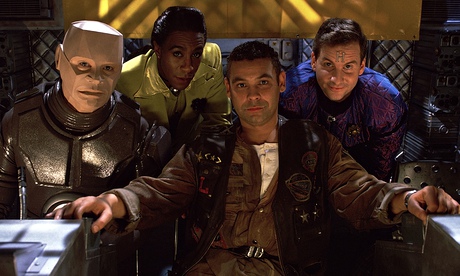
A scouser wakes up on Titan in the 23rd century, hungover and nude except for a set of fishing waders. He hatches a plan: join the Space Corps, but do a runner as soon as his ship docks on Earth. To make the voyage more pleasant he smuggles a cat on board, but ends up spending the journey in suspended animation. Then, thanks to a radiation leak, he is kept in that state for 3 million years, waking up in deep, deep space with just a hologram and the evolved cat (Felis sapiens) for company.
There have been Earth-set sitcoms with wilder premises than Red Dwarf, which first aired on BBC2 in 1988, but few as imaginative or downright funny. From the moment our scouse hero Lister (Craig Charles) wakes up, the jokes zing past like meteorites. And one of the biggest jokes is that, of the 169 crew on board, the ship’s computer chooses to digitally resurrect Arnold Judas Rimmer, a fellow traveller who perished in the radiation leak. He is now a hologram, and a neurotic, underpants-ironing stickler, played by Chris Barrie. The two men detest each other and that’s what propels the humour of Red Dwarf.
Lister and Rimmer’s bunk scenes are on a par with Porridge, while the sight of them in bed provides the perfect foil for all those cosmic backdrops. The show knows how to ration the science too: for every parallel dimension or virtual reality helmet, there are gags about the post only arriving after 3 million years. When explaining his stay in suspended animation to a shape-shifting dominatrix, Lister admits it’s a long time to go without sex, “Even for an Albanian shepherd who’s allergic to wool”.
Aided by the show being shot in front of an audience, and some early genuine animosity between the two actors, Lister and Rimmer’s spats (such as swapping each other’s toothpaste for spermicidal jelly) meant Red Dwarf soon went into rolling production. Along with Danny John-Jules as the highly evolved, fashion-conscious Cat, and Robert Llewellyn as middle-class cyborg Kryten (the perfect antithesis of the Terminator), the show gave us a reassuring take on the future, a place where mindbending technology still looked cheap. Teleporters rattled, time machines had to be slapped. Nor were the people using them your usual clean-cut astronauts: they were time-wasting curry-eaters who frequently used the space swearword: smeg. Craig Charles may have toned Lister’s slobbiness down for later episodes, but he still couldn’t resist eating out of bins, or turning his boxers inside-out to get three weeks’ more wear out of them. They may have been in deep space, but life aboard Red Dwarf was full of your standard sitcom fare, from strained relationships to characters who never moved on. Lister, Rimmer, the Cat and Kryten were rejects forced together: their loss of everything they held dear spoke to everyone trapped in school or crap jobs. The audience’s non-canned laughter was filled with warmth because they too had lived through the same ordeals, the same endless mundanity.
After six series of watertight hi-jinx, co-creator and co-writer Rob Grant departed, leaving Doug Naylor solely at the helm. He was contracted to deliver more series to the BBC, which sadly lacked the enthusiasm of the previous six (all eight are included in this box set). But before that, for a mighty 36-episode stretch, Red Dwarf was the tightest show on TV, a place where viewers of all ages could improve their ribbing skills, all on a trip through outer space, where you needed a thick skin as well as a spacesuit.
When Lister and Rimmer become stranded on an ice world, there are no monsters, just two blokes insulting each other to stay alive. When Lister is erased from history, he frantically tries to convince his oblivious bunkmate that he knows him: “Fiona Barringson! You got off with her in your dad’s greenhouse. You thought you got lucky, but it turned out the whole time you had your hand in warm compost.”