Having a go at McLaren’s performances this season has had a whiff of seal-clubbing about it. It’s been a little too easy to lay into Britain’s foremost Formula One team and Honda, the suppliers of their new power unit. They have not been merely bad – they’ve been awful.
Behind a McLaren you have not so much a slipstream as the phosphorescent spoor of a snail. And that’s if they’re lucky enough to be actually moving. Next week, though, we’re off to Austria and Red Bull’s home race at their very own track. That doesn’t mean we will be letting McLaren off the hook. When the racing is as bad as it has been on occasions this year an F1 reporter is a little like the drama critic who, in the words of George Bernard Shaw, “leaves no turn unstoned”.
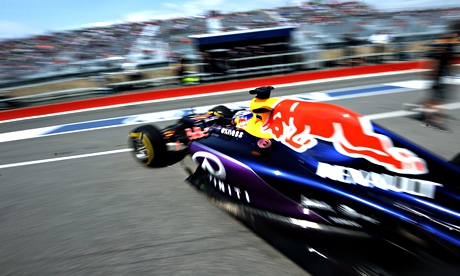
But at the Red Bull Ring the focus will be very much on Red Bull, their team principal, Christian Horner, and their drivers Daniel Ricciardo and Daniil Kvyat in particular. The race is promoted by the team owner Dietrich Mateschitz, who was born 40km from the circuit.
Helmut Marko, the team’s motorsport adviser, is not expecting an easy ride. After a disappointing weekend in Canada he said: “Spielberg will be even more difficult for us. The circuit is all about accelerating out of tight corners into quite long straights, which in our current engine situation is the worst thing possible.”
Last month Marko declared that Red Bull would pull out of F1 if they could not get a competitive engine, or do a deal with Audi. Renault’s failure to get on top of the hybrid engines brought in last year has been the leitmotif of Red Bull’s sorry story this season. But it is also clear that their chassis is not much cop either. This is a car with handling difficulties as well as power problems.
That’s why Ricciardo, who had the widest smile in the history of F1 last year now wears an expression not unlike Bob Hoskins at the end of The Long Good Friday.
In Montreal the Australian, who won the race last year, started ninth and finished 13th. In truth, he struggled for pace all weekend. He said after the race that he felt confused, that his car lacked pace and he wasn’t sure why.
Red Bull are a distant fourth in the constructors’ championship, some 54 points behind third-placed Williams. Williams have the advantage of a Mercedes engine and the ability – as we saw last season – to punch above their weight. Red Bull have the funds to out-develop them, but it’s not looking good.
It all feels so different from the scene in Spielberg in 2014. Red Bull had already lost their astonishing four-year hegemony to Mercedes. But they had brought Formula One back to Austria. Marko told me then: “It will be an emotional moment for me because I thought it was all over here. To see top motor racing back in my country is a wonderful feeling. I remember the first grand prix here, in 1970. It was an unbelievable atmosphere. We lost the race here twice. And when we lost it the second time it looked like it would never come back.”
Next week is likely to be another emotional experience for Marko, but of the wrong kind. Red Bull are hoping to bring updates to the car in Spielberg, though getting the engine right will take a little longer. Much longer.
All this comes at a time when Horner, the outstanding team leader in the paddock, is being talked up as the man who could replace Bernie Ecclestone. If one person is placed in charge of F1 it is more likely to be a money man than a racing man, such as Horner. But there could still be a part for him to play in the long-overdue restructuring of the sport.
He knows the workings of F1 thoroughly and moves within it with the nimbleness of a tap-dancer. His greatest quality, perhaps, is his ability to identify and appoint the right people and then give them a degree of autonomy. Right now, though, he is more worried about rescuing Red Bull’s season than taking over the insane, travelling circus of the sport.