The largest solar storm in over 20 years triggered spectacular auroras on Tuesday night, unusually widespread across the southern hemisphere skies as far north as Queensland in Australia.
Images shared on social media by Australian skywatchers showed auroras in vibrant green, purple and pink, powerful enough to be seen with the naked eye.
The space weather phenomenon is called aurora borealis in the northern hemisphere and aurora australis or southern lights south of the equator.
The phenomenon is the result of charged particles from solar storms – also known as Coronal Mass Ejections – colliding with molecules in our planet’s atmosphere.
Another Aurora Australis photo from last night. The beams were naked-eye visible. This event was even better than 11 May 2024.
— Sandy Horne (@SandyHorne61) January 21, 2026
Near Truro, South Australia.#aurora pic.twitter.com/fUGinBg24K
Accelerated electrons from solar storms follow the Earth’s magnetic field down to the polar regions where they collide with oxygen and nitrogen atoms and molecules in the upper atmosphere. These collisions see electrons transfer energy to the atmosphere, exciting atoms and molecules to higher energy states. When they relax back down to lower energy states, they release their energy as light.
People in Tasmania, Victoria, New South Wales, and Queensland reported seeing the spectacular light show over the horizon.
Auroras are very rarely seen from latitudes above 35° South.
Aurora borealis from Suffolk last night and Aurora australis from Victoria, Australia yesterday (taken by my sister). pic.twitter.com/4FSYWWw0Wc
— Matthew Deans (@DeansMatthew) January 20, 2026
“Typically, it is the far south of the country which has the best opportunity to see the aurora, but last night was such a strong event that photos were captured as far north as central Queensland,” Australia’s Bureau of Meteorology said.
It is “rare” for auroras to be visible from so many parts of Australia at the same time, astrophysicist Sara Webb from Swinburne University told ABC News.
Experts say the strong auroras and the solar storms that caused them are a sign that the Sun is still in the Solar Maximum, the peak period of intense activity in its roughly 11-year magnetic cycle.
The Australian Space Weather Forecasting Centre had issued an aurora alert for last night.
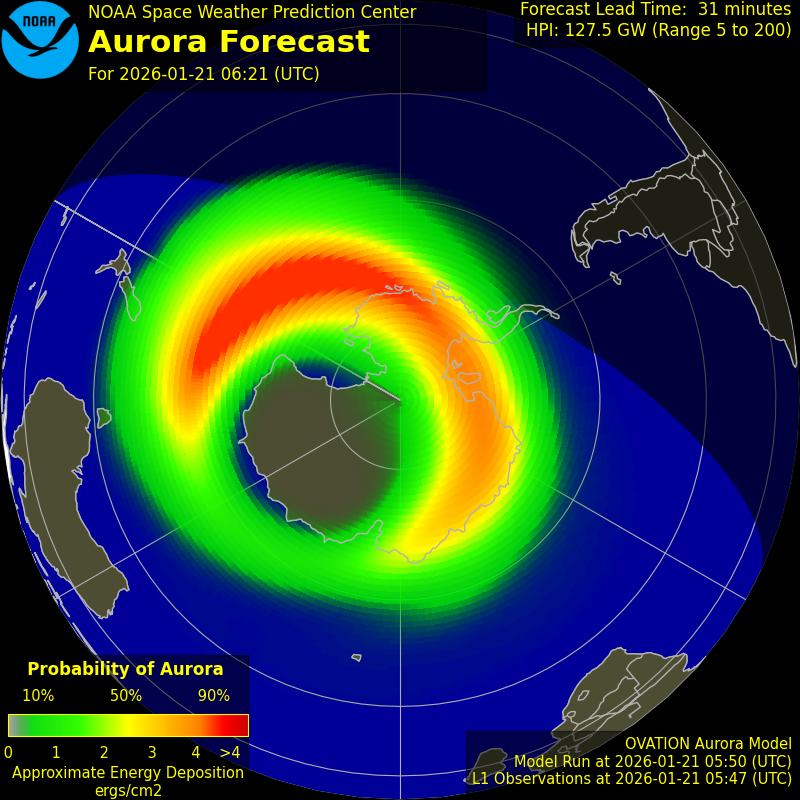
It predicted solar wind speeds to decline over Wednesday and Thursday, hinting that southern lights could still be visible this week but relatively fainter.
"It is likely to be weaker than last night, meaning it won't be visible as far north as yesterday, but people in Victoria, Tasmania and southern Western Australia may still have a chance to capture the lights on the southern horizon," the bureau said.
Largest solar radiation storm in more than 20 years could trigger auroras on Earth
NASA astronaut who was stuck on space station for months retires
Elon Musk suggests he could buy Ryanair amid spat with boss Michael O’Leary
Nasa to take astronauts around the moon for first time in 50 years
This country wants to build a nuclear power plant on the moon
NASA will close the International Space Station after three decades. Here’s why