MIAMI _ For many residents of Baracoa, the Cuban city hit hardest by Hurricane Matthew, it could be a long time before life returns to normal.
Two weeks after the ferocious storm plowed across the eastern tip of the island, schools were back in session and construction materials and heavy equipment from Venezuela and Japan had started to arrive, helping Cuban government efforts to clear roads and restore electricity and communications systems.
But despite offers from U.S. charities to send food and other relief, shipments from the United States has been rebuffed thus far.
"The problem is the (Cuban) government is not allowing emergency relief to come in from the United States," said the Rev. Jose Espino, a Hialeah priest who is helping coordinate Archdiocese of Miami relief efforts for the Diocese of Guantanamo-Baracoa.
The Miami archdiocese has asked for canned food, donations of rice and beans, cash and help with transporting goods to both Haiti and Cuba. Shipments already have been dispatched to Haiti, but none have gone out to Cuba.
Teams from Baltimore-based Catholic Relief Services rode out the storm in towns on Haiti's southwest peninsula and immediately after Matthew tore through began distributing pre-positioned supplies. But there hasn't been a similar pipeline to Cuba. CRS says the "most likely scenario" is that it will provide funding to Caritas Cuba, the Catholic relief mission on the island, so that it can buy supplies in-country.
"The problem buying in the local market in Cuba is there is no wholesale and buying in quantity means there wouldn't be supplies for other people in Cuba," Espino said. "So the church is buying supplies little by little."
Among the most immediate needs, according to CRS, are zinc sheeting to repair homes, mattresses, food, hygiene supplies, kitchen utensils and seed and tools to help farmers get back on their feet.
Espino said there's plenty of willingness from the U.S. to help Cuba _ including the offer of a 727 to fly in food _ but the church in Cuba hasn't been able to get permission to receive such supplies.
Instead, Espino said, the archdiocese has been helping with monetary donations that have been used to purchase food and supplies in Havana and other cities for distribution in the eastern Cuba communities ravaged by Matthew.
"Our role in Miami is to support the church in Cuba," said Espino, pastor of San Lazaro Church in Hialeah. "The church will be there."
Msgr. Wilfredo Pino Estevez, the bishop of Guantanamo-Baracoa, made an arduous 20-hour journey over destroyed roads to Baracoa immediately after the hurricane to see what help was needed.
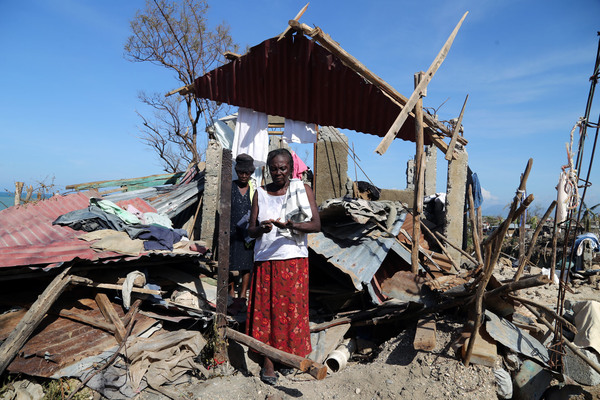
Baracoa is the first Spanish settlement on the island. Before Matthew's 140 mph winds and a storm surge that came over the seawall and raced three blocks inland reduced sections of Baracoa to tinder, it was known for its picturesque colonial buildings, its three forts and its wide coastal boulevard, the Malecon.
In an open letter, Pino said the diocese and Caritas-Guantanamo are now in the process of visiting affected towns, "returning again and again, locating vulnerable people due to illness, disabilities, their age to bring them a little relief, a little food: a soup, rice, crackers with guayaba."
The U.N. World Food Programme said it plans to distribute food to 180,000 people in coordination with the Cuban government over the next six months. The Cuban press recently reported that temporary warehouses and chlorine tablets to purify water had arrived, but it did not mention any food shipments.
Up to now there haven't been any international food arrivals, the Rev. Mateo Costinobi, a parish priest in Baracoa, said in a telephone interview. "The state has given out 7 pounds of rice and a week after the hurricane, the stores reopened but there are immense lines and police at each store."
Some Cuban-American families who want to help relatives in Baracoa have resorted to sending food packages through Supermarket23.com, a Canadian online company, and say their families have received them.
Pino was in the Dominican Republic this week to purchase 10 chain saws and to put in an order for roofing materials.
Immediately after the hurricane, mudslides, washouts, fallen trees and flooding cut off some towns in Guantanamo province. But construction crews, heavy machinery and bucket trucks now crowd the streets of Baracoa as linesmen hurry to restore electricity and fixed-line telephone service.
Despite the heavy damages, no loss of life was reported in Cuba.
On Sunday, a second military ship from Venezuela arrived in Santiago on Cuba's southern coast. Its cargo: 396 tons of electrical transformers, dump trucks, concrete mixers, and materials for home construction. Two more shiploads from Venezuela are expected despite the severe economic problems Cuba's staunch ally is experiencing at home.
Japan has donated a planeload of tents, rolls of cables, water purifiers and other relief supplies.
The Venezuelan army also is working with Cuban specialists to rebuild a bridge over the Toa River that used to connect Baracoa and Moa, according to Cuban press reports.
Over the weekend, Jose Ramon Machado Ventura, the second secretary of Cuba's Communist Party, visited Baracoa and Maisi, another hard-hit eastern Cuba town, to discuss efforts to revive coffee plantations and damaged cacao and plantain crops as soon as possible. Cuban leader Raul Castro also has visited the two communities.
Granma, the official newspaper of the Communist Party, reported that about 90 percent of homes in the Maisi area were damaged. "You received a heavy blow, but we will recover," Castro said during his visit to Maisi.
In an optimistic sign, students returned to classes at 70 schools in the hurricane zone Monday.
Restoring communication with the rest of the island has been a priority for the Cuban government. In Punta de Maisi, ETECSA, the government telecom company, has installed three public telephone posts where residents can make free calls of up to three minutes to any Cuban province. In San Antonio del Sur, Imias, Baracoa and Maisi people who lost their homes can apply to have their phone lines temporarily switched to other dwellings.
Some who lost their roofs have remained in their homes to protect their possessions. Although rafters and framing for new roofs can be seen on some houses, other residents have attached makeshift porches to crumbling homes so they'll have something over their heads.
Others whose homes were washed away or damaged beyond recovery have been staying with family or friends or sheltering in polyclinics and schools. But the resumption of classes meant they had to leave shelters in schools.
"Many have returned to where they had their homes, trying to recover the half roof that they had; they're living under the open sky," said Costinobi.
Yaliseidy Londres Cobas, who lives in German, a remote settlement in the municipality of Baracoa, took 60 people into her home during the height of the hurricane. She is still sheltering two families who lost everything in the storm, according to Granma.
The government has offered to pick up half of the cost of construction materials for homes that were damaged or lost during the hurricane. Municipal Defense Councils are assessing damage at each home and will decide what resources are needed to rebuild. Hurricane victims also may apply for bank credits at low interest rates with long repayment terms.
"In the municipalities of Baracoa, Maisi, Imias many, many (homes) have been left without roofs and more than just a few are totally destroyed," Pino wrote in his letter. Four churches in Cabacu, Pueblo Viejo, La Tinta and Punta de Maisi also were destroyed and several others sustained damage to roofs, walls and windows, he said.
The official Cuban media has been reporting on recovery efforts in Guantanamo province, but the Miami Herald was told it wouldn't be able to report from Baracoa because access was limited to those involved in recovery efforts. Six journalists from Periodismo de Barrio (Neighborhood Journalism), an independent digital magazine, were detained Oct. 11 while trying to cover the aftermath of Matthew. They were told that reporting activities would not be possible because Baracoa, Maisi, and Imias were under a state of emergency.
An essay recently published in Periodismo de Barrio said that not only were its journalists silenced but "also silenced were all the communities and people who wanted to talk to our journalists."