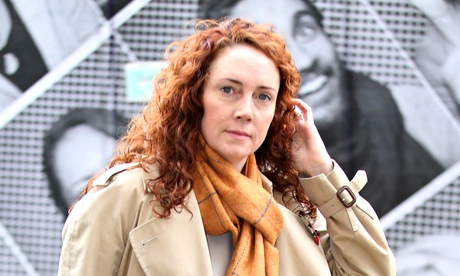
Rebekah Brooks insisted that all reporters had to email her if they needed a cash payment for a source when she was editor of the Sun, a jury has heard.
Brooks is said to have laid down the edict in February 2006 after a new policy was announced that deputy editors could no longer sign off cash payments.
On 2 February 2006, the day before, Dudman had told Brooks that cash payments had gone down on the paper as a whole, but had gone “through the roof” on the Bizarre showbusiness column.
“Cash payments in total across the paper have gone down over the last three years,” he wrote. “In news, they dropped from 2003 to 2004 but went up last year. Biggest increase is in Bizarre’s use of cash which has gone through the roof from £2,000 to £14,000,” he wrote.
The email exchange was prompted by an email from Dudman on 1 February in which he conveyed the new policy to staff. “With immediate effect: no cash payments will be paid without Rebekah’s written approval,” he had written.
Dudman said he would not have had sent the email without the approval of Brooks.
The jury heard that the Sun’s head of news, Chris Pharo, had objected to the new system, complaining that Brooks was out of the office much of the time and would be unable to sign off payments as often as they were needed.
Addressing the concern, Brooks told the then managing editor, Graham Dudman: “I don’t want to sign cash payments. If any reporter wants one, they email me and if they get an email back saying yes, then it is authorised. Otherwise I will be signing all day.”
Giving evidence for the second day on Tuesday, Dudman told jurors: “The inescapable fact was if a reporter was getting cash, there was a possibility they were not giving it all to the source.
“As I was the last man pressing the button on sending money out the door, I wanted to be sure it was being spent on journalism,” he told the jury at Kingston crown court.
Dudman, Pharo and four other current or former Sun staff are on trial for conspiracy to cause misconduct in public office in relation to alleged payments to public officials for tips and stories. All six deny all charges against them.
Dudman told how Brooks’s priority was the “quality and content of the newspaper” and the budget of the paper “definitely came second, sometimes third, sometimes fourth”.
Jurors heard that she had sent him a “rather terse” email demanding he “stop spending”, after a weekly expenditure audit found the Sun was £101,000 over budget because of outgoings on stories such as one about Madonna that cost the paper £30,000.
Dudman agreed under questioning that the email was “a hissy fit” and that she later “calmed down and started signing again”.
If the overspend carried on at this level the Sun, which had an editorial budget in excess of £60m, would have been over budget by £3m to £4m that year, the jury was told.
Asked by his counsel, Oliver Blunt QC, if he agreed there was a “culture of industrial scale bribery and corruption” at the Sun, Dudman replied “absolutely not true”.
Was he “aware that public officials were paid” at the paper? “Yes, on very rare occasions,” Dudman replied.
What was the justification for that? “That the material that was obtained was absolutely in the public interest.”
The jury heard that one executive on the paper emailed Dudman to say that as sure as “night follows day” some reporters were putting in claims for “exclusive tips” for every story they did.
The full email from the executive to Dudman read: “I sometimes get asked to pay out hundreds for “exclusive” tips that have been in other papers.
“Also there are some reporters who as night follows day always seem to bung in a confidential cash demand on the heels of nearly every story they do.”
Dudman admitted he had falsified expense claims at the Sun when he was a jobbing reporter, submitting claims for meals with a BBC contact, an Essex PR and a City of London police contact, none of which existed.
Dudman said falsifying expense claims was “completely common practice” across the industry and the management on all newspapers were complicit as it was a way of paying in lieu for overtime.
“My colleagues did exactly the same. When I became managing editor it was abundantly clear to me this was a practice across all departments.”
He said when he became managing editor he did “absolutely not” take any of the submissions made by staff “seriously” as a consequence.
He agreed there was also a “suspicion that some journalists were treating the cash payment system rather like their expenses”, though nobody was ever accused of this.
As managing editor he had to satisfy himself cash was not being pocketed by reporters. In one email he sent to one of his co-defendants he said: “Just for the files for my own safety can you drop me a line to explain why do you need to pay cash for the following stories?”
He told jurors he was satisfied with the response from the reporter but “if there is ever an issue where the cash had gone, who got it, I would have had questions asked of me,” he said.
Separately during examination, Dudman was quizzed about the three stories that connected him to the charges. He said the were all “absolutely in the public interest”.
The three charges relate to allegations of payments to a healthcare assistant at Broadmoor, an unknown prison officer at HMP Whitemoor and allegations about a series of leaks from the Soham murder investigation.
The jury heard the three stories related to Rachel Nickell’s killer Robert Napper, a career criminal found hanging in Broadmoor and a story about Ian Huntley.
Dudman said he was “terrified” when he was arrested in a dawn raid three years ago, when 10 police officers in five cars turned up at his home and detained him.
He fought back tears when he recalled how his nine-year-old son and 14-year-old daughter came into his room when he was getting dressed in front of the police.
“I said to them I’m going to … talk to these policemen about work. I didn’t realise at the time but my wife told me, my son’s deeply, deeply, deeply distressed and a few weeks later we notice that my daughter had a bald patch by her temple – a small one about the size of a 50 pence piece.”
The trial continues.