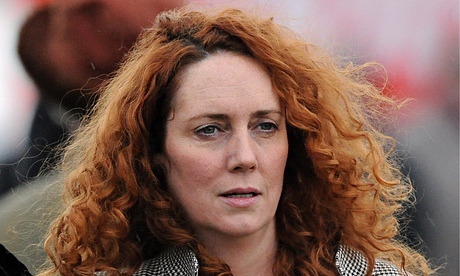
Rebekah Brooks signed off on virtually all cash payment requests when she was editor at the Sun, it has been claimed at a trial of journalists on the tabloid accused of approving payments to public officials for stories.
The head of news at the Sun was asked by the trial judge on Tuesday afternoon what proportion of payment requests the editor refused to sign off.
“A very small percentage,” Chris Pharo replied. Asked whether he could give an idea of the percentage, he said “two to 3%”.
The 45-year-old is on trial along with five other current and former Sun journalists for allegedly approving unlawful payments to public officials, a charge which they all deny.
Pharo said “what you might get is a protracted process of her stalling on the payments”, before clarifying to the judge that in two to 3% of cases there would be “no payment at all”.
He was being quizzed by prosecutor Peter Wright, QC, about an email in February 2006 telling staff that with immediate effect no cash payments would be paid “without Rebekah’s approval”.
Pharo had replied to the email containing the edict, by saying this would “dramatically increase my workload”.
This was because up to then, a cash payment could be approved by a deputy editor, he said.
Earlier in the trial, he had quipped that he had to deal with so many cash payment requests by his reporters that he spent half his time in the editor’s office.
In a grilling by Wright, he was accused of creating a “cock and bull story” to explain the paper’s “practice” of paying public officials at a criminal trial.
Opening his cross examination, Wright put it to Pharo that the ends justified the means at the Sun and there was a “preparedness to pay public officials”. Pharo replied: “That’s not true.”
Pharo said this was not so. “I stayed silent at the police station, because I was absolutely terrified.”
He went on to tell jurors that the company had decided to hand him and others “to the police” and repeated earlier references to 3m emails being deleted by the company .
This, Wright put it to him, was what upset him. “That‘s what grates you isn’t it, that the company’s shopped you?”
Pharo replied: “No, what really grates me is that the company has provided a fraction of the evidence in this case and we fitted the bill.”
Wright asked him how these missing emails could exculpate him, suggesting they were a “smoke screen” in his trial. “I simply don’t think we’re looking at anything like the full picture,” Pharo said. “I am not using it as a smoke sceen.”
Wright went on to quiz him about the paper’s decision to run a story “Mumbai Raid Fear on Xmas Shoppers” four years ago.
The article reported that Metropolitan police firearms officers were patrolling shopping centres including Westfield and Bluewater as fears that al-Qaeda might be inspired to commit a British version of a massacre by the terrorist attack in India.
“Did you consider it was for you to decide to jeopardise any on going operation that may be undertaken by counter terrorism in the metropolis?” Wright asked.
“I don’t for any moment accept your [assertion] that [the story] would jeopardise a counter terrorism [operation] in the metropolis,” said Pharo.
Pressing him on the issue, Wright asked him if it was not “arrogant” of the Sun to decide it was in the public interest to reveal a confidential operation.
“No,” said Pharo, explaining the story suggested the police were already deployed and active.
Pharo was being quizzed about the story in relation to an email request for a payment of £700 to a source who was “well-placed in the Met”.
He also said that there were no instructions at the paper after Brooks told a parliamentary select committee in 2003 that the Sun paid police officers.
He said he was shocked about what Brooks said to the culture, media and sport select committee and that it caused “a great deal of consternation in the office and the wider industry”.
“After that statement by Rebekah Brooks about the ‘we pay police officers’, did anything change?” Wright asked.
“No,” said Pharo. He said there was no legal guidance given to reporters on the matter until the Bribery Act came out in 2010.
The trial continues.