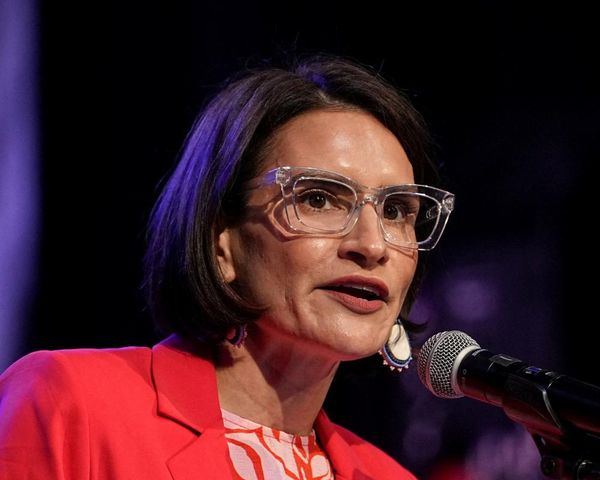
Now the Greens' Rebecca Vassarotti has returned to the Legislative Assembly, she's eager to spend less time there.
"It's easy to get caught in the busyness of this building. ... I absolutely want to be in community as much as I can," Ms Vassarotti said.
After losing her seat at the last election, the former Greens deputy leader was returned this month in a countback process after long-standing party leader Shane Rattenbury retired.
With a little over half the term left to the next election, Ms Vassarotti said there was not a day to waste and has sought to position herself as the one to build and harness popular backing for an expansive left-wing agenda of more government services.
"I think it's a different time. I just think the community is different. I think politics is different," Ms Vassarotti said.
Ms Vassarotti won the respect of colleagues across the chamber in her first four-year term spent in the joint Labor-Greens cabinet, but a swing against the Greens in Canberra's inner city kept her out of the Assembly in 2024.
"Not being re-elected was actually really challenging, but the last 18 months has actually been a real gift in terms of actually being outside this, you know, being outside the system, being outside the building," she said.

Just after the 2024 election, Ms Vassarotti said she did not actually like the performative and adversarial parts of politics and was not sure what she would do next.
But speaking to The Canberra Times this week, she said the decision to put her hand up to run in 2024 stood as a commitment to the community and whatever dissatisfaction.
"There really wasn't a question about whether or not to take up that opportunity, even knowing that there are real challenges with the system," she said.
Ms Vassarotti said her sense of the task of a Legislative Assembly member had changed in the time she had been out of the system.
"Parliament is important. There's really important things that happen in parliament," she said.
"We are actually making decisions that change people's lives. But rather than us thinking about those changes and then consulting with the community, how we actually turn that round, so political decision-making is actually nestled into a broader community response, I think is really important."
Ms Vassarotti said regular town hall meetings would be part of the way she would seek and reflect community involvement in the political process.
Ms Vassarotti said parliamentarians needed to be more deliberative and community-driven and while her view of the job had changed, she said it was a fact the community's view had changed too.
"I'm actually quite interested in terms of the system that we have and the tools that we currently have, what are the ways that we can reimagine it with the tools that we have, particularly as they sit outside of executive government," she said.
"Because it is very clear that the community has a concern around a system that delivers pretty well a single political party holding power for a long period of time."
Ms Vassarotti said it was a legitimate question for the community to ask whether the Westminster parliamentary system was the right one for a self-governing city state.
"It doesn't engender that collaborative approach," she said.
"And it's potentially a really interesting time to do some experimentation and think about different ways of doing it. But if we do that, we have to bring the community with us. We can't do it just sitting in parliament ourselves."
Before she was returned to the Assembly, Ms Vassarotti had been involved in the Canberra Alliance for Participatory Democracy's re-imagining governance for the ACT project, which is now hosting a series of public events to consider alternative governing arrangements for the ACT.
All members of the ACT Greens are also now voting to determine who will lead the party permanently into its post-Shane Rattenbury future, with Ms Vassarotti and Jo Clay the two candidates vying for the post.
"This is a pretty pivotal moment. You know, this is a new chapter," Ms Vassarotti said.
While conventional wisdom (and a cursory glance at recent events in the United Kingdom) might suggest a leadership contest playing out in public over a long period of time is a politically damaging process, Ms Vassarotti sees it differently.
"I think what we're really doing is living our values. And ... we're always going to be strongest when we do that," she said.
Ms Vassarotti announced she would seek the leadership after her return to the Legislative Assembly was confirmed in a countback on June 4.
Ms Clay, who has served as leader since Mr Rattenbury retired, also confirmed she would seek the position permanently.
"The Greens are a really united team and actually our whole party room and our party make decisions by consensus, so we all work very collaboratively," Ms Clay said at the time.
"I'm really pleased that we're going to have a choice for our members to decide who they'd like to be as leader. It actually doesn't matter who wins that on one level because we will all be working together."
The leadership ballot follows a summer of discussions between the Greens and the Liberals, which brought the two parties to the brink of forming an alliance to oust the long-standing ACT Labor government.
Ms Vassarotti was part of a Greens campaign group that resigned over the internal handling of the talks.
"Look, it's been a journey for the party over the last, you know, six months or so. But ... we're going to come out very, very strong. And I think really united. And that's a really positive thing," she said.
Ms Vassarotti said the Greens were entering a new era in the ACT and needed to be open to the fact anything can happen in politics and they had a part to play in shaping what was possible.
"I think that absolutely what has happened in terms of the Greens' history over the last two decades has been completely something to really celebrate in the context of that period of time," she said.
"We are just in a very different time."