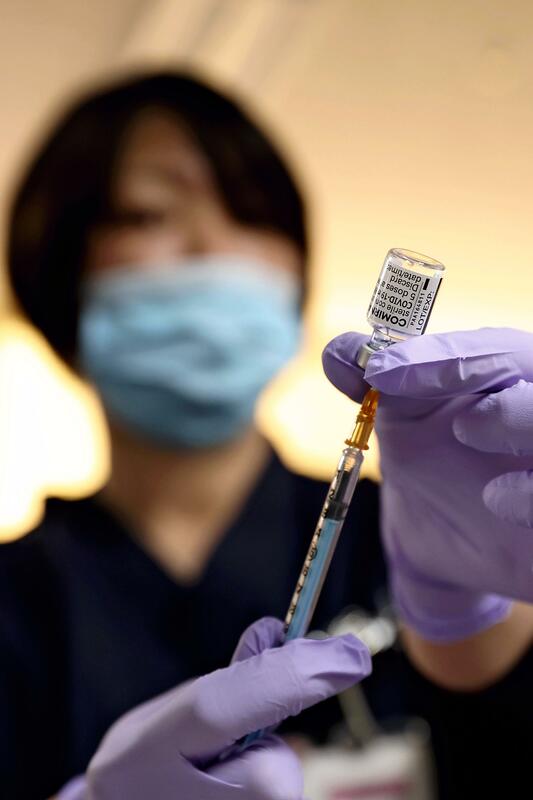
Japan's first vaccinations against the novel coronavirus started Wednesday, with health care workers at 100 medical institutions nationwide to be inoculated first.
The inoculation of this first-priority group is aimed at verifying once again for people in Japan the safety of the vaccines, by monitoring possible side effects before the start of vaccinations for the general public later this year.
The vaccines are expected to prove highly effective in containing the incidence of the disease, but there is unease about adverse side effects and other issues. The government intends to secure the credibility of vaccines by actively providing relevant information to the public.
-- Monitoring 20,000 staff
"The most important thing is to properly convey information about the vaccine's safety. We will swiftly report the information we obtain," said Suminobu Ito, a visiting professor at Juntendo University who is also a member of a study team that will analyze side effects from the vaccines. Ito emphasized the significance of the first-priority inoculations at a press conference held at the Tokyo Medical Center in Meguro Ward, Tokyo, on Wednesday.
The center belongs to the National Hospital Organization and was the site of Japan's very first vaccinations against the novel coronavirus.
The Health, Labor and Welfare Ministry has newly established the study team, which will conduct a detailed survey of 20,000 out of the 40,000 health care workers scheduled to be inoculated first. The aim is to provide the public with relevant information.
At the Tokyo Medical Center, 85% of the staff wanted to take part in the survey, and 800, or about half, were ultimately chosen to participate.
They will measure swelling in the injected area and keep records on a designated form. This will also include such information as whether they experience headaches or fatigue, and how acute those conditions are, over the first week after each of the two vaccine doses they will receive.
The study team will follow up on changes in the physical condition of the participants over seven weeks from the time of their first dose, to analyze such factors as the group's infection rate with the novel coronavirus. The data will be compiled at top speed, with the findings expected to be made public once every week.
Only 160 people participated in a Japanese clinical trial of the vaccine manufactured by U.S. company Pfizer Inc., before its approval by the health ministry, not enough to examine the side effects.
Ito said: "The side effects of the vaccine may vary depending on the country or region where people get inoculated. We want to check the side effects based on data collected from a large number of Japanese people."
-- Govt strives to disclose info
The government is working to collect data on side effects and make the findings public because how the relevant information is conveyed to the public in the days ahead will greatly affect the vaccine's perceived credibility and the number of people who get inoculated.
At a meeting of an expert panel at the health ministry, some said that if only the side effects of the vaccine draw attention, this will slow the pace of inoculations and it will take even longer to get infections under control.
The Immunization Law requires doctors administering a vaccine to report to the central government any symptoms that are suspected to be side effects.
Yet there are symptoms whose connection to the vaccine is unclear or which may have developed due to other factors. The central government will hold frequent meetings among experts, to swiftly examine the cause-and-effect relationship of such developments by studying data, including that to be obtained from the people inoculated first.
-- Headaches and fatigue
The coronavirus vaccine made by Pfizer, the first vaccine approved by the health ministry, is a new type of vaccine, developed using the genetic information of the virus. One of its features is that it sets off a strong immune response, and likewise strong side effects.
International clinical trials have demonstrated the vaccine's high efficacy, reducing the incidence rate of the novel coronavirus by 95%. But it has also shown a higher incidence rate of side effects than that of the vaccines against seasonal influenza.
Side effects related to the injection site have been reported, with 84% experiencing pain at the site, 63% complaining of fatigue, and 55% having a headache. Most of these symptoms subside within a few days, but some people have symptoms similar to the novel coronavirus for a few days, such as a fever exceeding 39 C.
Anaphylactic shock, an acute allergic reaction, is said to occur with the Pfizer vaccine at a rate of approximately one in 100,000 to 300,000 people.
Junichiro Nishi, a professor at Kagoshima University who is also the chairman of the vaccine committee of the Japanese Association for Infectious Diseases, said: "Under the present conditions, the benefits [of the vaccine] are considered to be far greater than the risks. It is important that the central and local governments distribute relevant information that is accurate and easy for people to understand, so that people can make their decision based on lots of facts."
Read more from The Japan News at https://japannews.yomiuri.co.jp/