Looking back on St Paul, F Scott Fitzgerald’s narrator Nick Carraway remembers “not the wheat or the prairies or the lost Swede towns, but the thrilling returning trains of my youth, and the street lamps and sleigh bells in the frosty dark and the shadow of holly wreaths thrown by lighted windows on the snow”. The Twin Cities may function in The Great Gatsby as little more than a snowy refuge from east coast excess, but according to Susan Choi the novel is a “weird book, so much stranger than its reputation” anyway – a description that could apply equally well to the Twin Cities’ literature, which is compelling, unusual, far stranger than its reputation.
Take Charles Baxter’s short story Kiss Away. Jodie loves the cipher, Glaze, who has “an air of scruffy unseriousness” about him. The two fall in love. Baxter is expert at subtext and he pens an illuminating account of the technique in The Art of Subtext: Beyond Plot. The ease of Glaze’s demeanour and “the cottony hazy heat” of the Minneapolis summer feed Jodie’s contentment. Then comes the late-night phone call from Glaze’s ex who tells Jodie to beware of him. He’s abusive. “He broke two of my ribs. I had a shoulder separation from him. He got very practiced in the ways of apology and remorse. He has a genius for remorse.” Tension in Baxter’s work is subterranean, repressed. Garrison Keillor has long mined midwestern self-effacement for humour. In Baxter’s midwest, such manners are a thin veil over passionate and self-destructive desires which illuminate, forcefully, all the characters seek to mask. In his 1997 Atlantic Monthly interview, Baxter says, “I think most fiction is about desire. So one of the interesting features about violence is that it’s the meeting point of desire and destruction. It takes you to that boundary where respectability ends and darkness starts to fall, as desire gets out of hand.”
The same meeting is the force running through Louise Erdrich’s novel Shadow Tag. Irene America keeps two diaries since she discovered that her husband, Gil, has been reading one. One diary she writes for Gil’s eyes, the second – the real one – she keeps locked in a safe deposit box at a Wells Fargo in Minneapolis. In lieu of confronting Gil, Irene chooses deception. Gil is a famous painter. (“He’d been called a Native Edward Hopper – irritating.”) His lifelong subject is his wife. (“Irene America was over a decade his junior and had been the subject of his paintings in all of her incantations – thin and virginal, a girl, then womanly, pregnant, naked, demurely posed or frankly pornographic.”) The prolific and immensely talented Erdrich, author of 14 novels, volumes of poetry, short stories, children’s books, and winner of the 2012 National book award for her novel The Round House, depicts a harsh marriage fracturing amid the claustrophobic archetypes of muse and master, embodied by Irene and Gil.
In poetry, Graywolf Press will be publishing St Paul poet Danez Smith’s forthcoming second full-length collection. His powerful first collection, [insert] Boy, received the Lambda literary award. Matt Rasmussen’s Black Aperture, a 2013 National book award finalist, is a moving elegy after his brother’s suicide. There is a nomadic beauty to Ed-Bok Lee’s Whorled, which pulses with raw political anger and vital lyricism.
Blues Vision: African American Writing from Minnesota edited by Alexs Pate showcases poems, fiction, and essays by Gordon Parks, Taiyon Coleman, Kim Hines, and others. In the introduction Pate writes: “What the writer’s eye sees, especially in a world where the history of the writer is saturated in struggle, affects everything.” The Twin Cities have a rich immigrant history and The Somali Diaspora: A Journey Away by Abdi Roble and Doug Rutledge chronicles the lives of Somali immigrants in the US, including St Paul and Minneapolis. Nuruddin Farah’s Crossbones is a gripping political novel and the third instalment in his Past Imperfect trilogy. “When Ahl arrived in the Twin Cities in the mid-1980s, there was only one other Somali in town, a delectable young woman studying art.” Set partly in Minneapolis and partly in Somalia, Farah – author of 12 novels – writes of family ties amid the chaos of war, set during the rise of al-Shabaab.
The St Paul of Jonathan Franzen’s Freedom is reminiscent of Nobel and Pulitzer prize-winning author Sinclair Lewis’s Main Street, both novels that evoke the midwest through the lens of pathos, satire, and comic tragedy. Bob Dylan’s Chronicles tells of his journeyman days, early recordings, and the influence of Woodie Guthrie. Particia Hampl’s I Could Tell You Stories is an intimate and intellectually formidable series of essays.
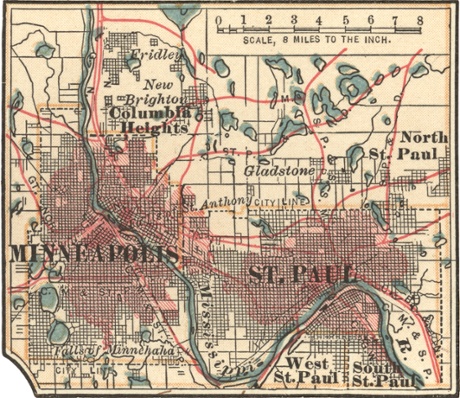
The literary culture of the Twin Cities is, like the weather, a rich landscape of variety and contrast. In 2008, the New York Times ran an article on a corridor of Washington Avenue in downtown Minneapolis undergoing a “literary revival”. Last fall, Charles Baxter gave a craft lecture at The Loft Literary Center and relayed an anecdote his mother told him growing up: if he didn’t watch out, she warned, he’d wind up on Washington Avenue. The anecdote harks back to an era when the street was all industrial warehouses. The city has evolved since that time. Now, the street that hugs the root beer-hued Mississippi river is neighbourhood to Graywolf Press, Coffee House Press, Milkweed Editions, and The Playwrights’ Center. I walk the riverfront on my lunch break, passing a two-storey portrait of Anton Chekhov staring out from the walls of the Guthrie Theater. The crumbling flour mill on which his gaze falls has turned into a museum.
- Kathryn Savage is a Minneapolis-based writer and education program manager at The Loft Literary Center. You can find her on kathrynsavage.com.