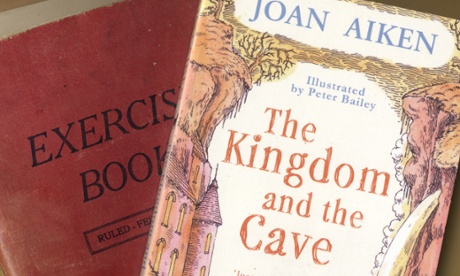
Joan Aiken (famed for writing children’s classics including The Wolves of Willoughby Chase) wrote this story for her 10-year-old brother when she was 17, or in fact told it to him chapter by chapter and then wrote it down in an old exercise book. Her 17th birthday was in 1940 in the middle of the second world war, at the time when England was being bombed by German aircraft in what was known as the Blitz. As her brother David was a passionate plane spotter living near the coast in Sussex where her story is set, she naturally included the threat of airborne invaders just like those that he would have heard in the skies every night. And the hero is a boy just like him, defending his country with the help of a faithful and magical friend - Mickle the Court Cat.
Many years later Joan Aiken sent the book off to publishers, who asked her to take out some of the war details (too many aeroplanes!) and make the story a bit shorter – perhaps she had answered too many questions about what happened next, and why and where and how it all came about!
Now this exciting adventure - The Kingdom and the Cave is coming out again for a new audience and we thought it would be fun share some of those missing stories and let you in to some of those secrets. For instance how did Mickle the mysterious magical cat come to be living at the palace of Astalon?
This is where the story really began...
Mickle – Joan Aiken’s lost chapter
No one had seen Michael since breakfast, and his mother began to worry. It was now getting on for teatime, and though the Crown Princes of Sussex were allowed much more freedom than ordinary children because it was obvious that they could wander all over the kingdom and come to no harm, still Queen Elfrida felt that it was careless of him.
“Besides,” she said rather anxiously, to the King, “it’s beginning to rain and it’s very cold for May, and I know he hadn’t his raincoat with him because I saw it in the hall cupboard.” The King frowned, “Stenning, you haven’t seen. Prince Michael anywhere, have you?” he asked.
“No, Your Majesty,” the butler answered, “I will instruct the servants to keep a look-out for his Royal Highness. Tea is laid in the library, Your Majesties.”
All through tea the Queen kept half an eye on the drive through the window, though the King told her not to worry.
“He’s only four, though,” she said. “And even with the Crown Prince’s privilege I can think of a lot of things he might have done. Supposing he’s fallen into Amberley Wildbrooks? Or got lost on Romney Marsh?”
“Oh well, there’s no use thinking things up,” the King said rather hastily.
But he looked distinctly relieved when, ten minutes before dinner, Stenning came in and announced that an individual driving a cart had brought back Prince Michael.
“Where was he found?” asked the queen.
Stenning shook his head.
“The individual, Your Majesty, picked up Prince Michael somewhere in Fairmile Bottom, but where he had been before that, or how he got there, it would be impossible to say.”
“Oh well,” said the King, “give the individual a mug of beer, Stenning, and our grateful thanks. Is Prince Michael in the nursery? Good. Tell the Head Nursery Maid that we will go along presently when he has had his supper.”
A shocking scene was presented to the King and Queen when they went into the royal nursery later on that evening. The Head Nursery Maid stood in the middle of the floor looking considerably exasperated. About her feet lay a mass of the most beautiful toys in the world, most of them slightly battered, as if they had been flung there from a distance. And at the end of the room, sitting huddled on the window seat was Prince Michael, scarlet in the face and howling at the top of his lungs.
“Good heavens,” said the Queen, “What’s all this about?”
“I’m sure I don’t know, your Majesty,” said the Head Nursery Maid, who was obviously at the end of her tether.
“The Prince came in and sat down and gobbled up his supper, and then he suddenly looked behind him and said something like ‘Where’s Mickle?’ and I said ‘Come along like a good boy and be washed’ and he searched about as if he’d lost something and began crying fit to break his heart, and he’s been like that ever since. We can’t stop him.”
“Michael,” said the King, “Aren’t you ashamed of yourself, a big boy like you? What are you crying for?”
Michael opened his tear-filled eyes long enough to look at his father and then shut them again and gave another howl.
“I - want - Mickle,” he gulped.
“Mickle?” They looked at one another. “What can the child mean?”
But no questions of any sort could make Michael say what Mickle was. He sat crumpled up in his corner and refused to go to bed before he had Mickle.
“Listen Michael,” the King said at last, reasonably. “We can’t get you Mickle tonight because it’s far too late, long past your bedtime, but your birthday is the Friday after next, and then you shall have Mickle.”
Michael was, after all, a prince, and very intelligent, so at that promise he stopped howling, opened his eyes and allowed the Head Nursery Maid to undress him and wash him in his own bathroom with the hot and cold showers and the bath large enough to swim in. Then he went peacefully to bed.
In the library the Queen said to the King:
“Well, what are we going to do now? You’ve promised to give him Mickle, and the Kings of Sussex never break their promises. But we haven’t the faintest idea what Mickle is.”
“He’ll have forgotten all about it in the morning,” said the King hopefully. “Anyway surely we can give him an aeroplane or something called a Mickle? You know, like a Heinkel.”
The Queen shook her head. “You won’t get round Michael like that. He knows perfectly well what it is he wants. You’ll just have to find out what Mickle is. Perhaps the man with the cart could help us?”
But he had drunk his beer and jolted away, no one knew where.
“Anyway,” said the King again, “you’ll see, the child won’t remember a thing about Mickle in the morning.”
But all night long the Crown Prince sighed and muttered in his sleep about Mickle, and an old man who lived on an island, and beautiful birds and animals. The first thing he said in the morning was:
“Where’s Mickle?”
“Don’t you remember,” answered the Head Nursery Maid hastily, “Your father is going to give you Mickle for your birthday.”
Michael’s face clouded at this, but he took it quietly, and ate his breakfast as if deep in thought. The Head Nursery Maid went to the King after breakfast and told him what Michael had said in his sleep.
“An old man and an island, eh?” said the King.
“Perhaps he’s been over to the lake at Arundel. Mickle might be a bird of some kind he’s taken a fancy to. No harm in seeing, anyway.”
He sent over at once, but the result was disappointing. The Prince had not been there, and no one knew of an old man, or of Mickle. The King’s face grew grave at this. Michael had been most unlike himself the whole day. He was quiet, and inclined to brood, hunched up on the window seat, not even looking out when a plane passed over, although the King himself recognised one of the new Kircudbrightshire Camels which could close up their wings, become quite streamlined, and dive into the depths of the sea.
Michael would tell no one what he was thinking, but he looked anxious, as if he were trying to learn something by heart, and when he was told that the Head Gamekeeper had a pair of ferrets for him, seemed quite uninterested and said he didn’t want them and he wished people would leave him alone.
“We must find Mickle,” said the Queen rather tearfully. “There’s something wrong with him, I’m sure. You don’t think he could be bewitched do you?”
“Of course not, of course not,” the King answered hastily.”We’ll advertise, in the papers and on the radio, and see if that doesn’t get some answer.”
Advertising got a number of answers, but none of them satisfactory. A farmer drove up a cow called Mickleberry on Saturday, and a witch, who had seen the notice in the West Sussex Gazette, came along with a flower she had invented, which had the power of turning anyone who smelt it into a seagull. She said it was called Mickle, but the King and Queen felt that even if it was what the Prince wanted, which seemed unlikely, it would be an unsafe thing to have about the Palace. Moreover when the King made enquiries about the witch, he found that she bore the Royal family a grudge because a gun fired at the coronation had knocked off her chimney. So she was quickly escorted away.
A deaf old woman in Washington heard the message on the radio and sent in an old-fashioned recipe for marrow pickle, but though the Queen was delighted to have it, no one felt that it was exactly what was wanted.
So a week went by, and the atmosphere in the Palace became very anxious.
“You know, the trouble is,” said the King eventually, “that no one in Sussex reads the papers or listens to the wireless in weather like this. They’re all too busy in the garden. We’ll have to resort to the old-fashioned method of proclamation.”
And he ordered heralds to ride out in all directions all over Sussex with loudspeakers proclaiming a reward for anyone who produced the mysterious Mickle.
One herald went east, through Hastings and Winchelsea and Rye and East Guldeford, and finally, late on the Thursday evening before Prince Michael’s fifth birthday, he came to the farthest borders of Sussex. He stopped his motor bicycle for the hundredth time that day, unpacked his loudspeaker, and shouted out his proclamation, that if anyone possessed, or had information about, anything called ‘Mickle’, animal, vegetable, or mineral, they were to come and tell him at once, as it was of the greatest importance to the Royal Family, and they would be suitably rewarded.
A small crowd assembled to hear him, but they none of them showed any inclination to come and tell him about Mickle, and he asked his way, discouraged and tired, to the nearest pub.
“I’ll take you there,” said a man, coming forward. “I’m going myself.”
The herald wheeled his motorbike and they walked along side by side.
“Do you think everyone heard that proclamation?” asked the herald.
The man grunted. “Couldn’t help it, could they, unless they was as deaf as adders? No one knows anything about Mickle, and that’s the truth.”
The herald sighed. “Who lives over there?” he asked, pointing to a tiny thatched cottage, squatting down on the marsh about half a mile away.
“Over there? Young Linkwater. He won’t know anything about this here Mickle you keep worriting about. Keeps himself to himself, he does.”
“I’ll leave my bike at the pub and stroll over there,” said the herald, who was a conscientious man. The other man looked at him as if he was simple-minded, but said nothing.
The path to the thatched cottage was very rough, and he was glad that he had left his motor bicycle, as he had to keep jumping over dykes. When he came to the cottage he saw a young man bending over a row of cabbages in the garden.
The herald leaned over the gate and said “Hey!”
“Hey?” the young man answered, straightening his back. He seemed rather annoyed at being interrupted.
“Do you know anything about something called Mickle?”
“Mickle? Of course I know Mickle. Isn’t he in sitting by the kitchen fire this minute?”
“He is?” exclaimed the herald excitedly. “Who is Mickle, then?”
“Mickle,” called the young man. There was no answer.
“He’s probably asleep,” Linkwater, muttered. “You’d better come in.” The herald stooped his head under the low porch and came into the dark kitchen among the pot-plants. A clock shaped like a little house ticked loudly on the mantelpiece, and a kettle sang on the hearth.
“Where is Mickle?” asked the herald eagerly, looking around him. The young man pointed.
Curled up on the red and blue rag carpet in front of the range was a large, handsome black cat, who as they watched rose to his full height, arching his back, yawned, and fixed them with an unblinking stare. Round his neck was a small red collar.
“Mickle,” said the young man.
“Prrr?” the cat replied, and then, dismissing the question, began to wash behind his left ear.
“What do you want, anyway?” Linkwater asked the herald. He explained his errand.
“I’ll give you any sum you like for him,” he said. “Though how Prince Michael should have met your cat I can’t imagine.”
“No Prince has ever been here,” the young man agreed, “but you can never tell where Mickle may have been. He’s not a common cat, not at all”.
“But the question is,” the herald said, “Can I have him?”
“Have him? That’s nothing to do with me. If he wants to go with you I expect he will. That’s how he came to me, one night in a storm, with the sea ramping and roaring all along. He walked in a year ago, and he’s stayed with me since then. I never thought he’d stay long.”
“Mickle?” said the herald tentatively, and snapped his fingers.
Mickle quite silently walked across to him, jumped on to his shoulder and sat there, purring all the way down from his whiskers to his tail.
“I’ll just give him a drop of milk before you start,” Linkwater said, and went into the scullery for a saucer. The herald tried to press a reward on him, but he wouldn’t hear of it, saying that Mickle didn’t belong to him.
The ride back was uneventful. It was a dark, starry night. Mickle refused to be carried in a basket, and insisted on perching on the herald’s shoulder, balancing himself by digging his claws in and sticking his tail upright. The herald found this particularly trying when he was going up one side of Beachy Head and coming down the other. But he consoled himself by thinking of how pleased the King would be. He would certainly be rewarded for his trouble. Near Arundel they had a puncture, and while the herald mended it, muttering under his breath, Mickle sat upright and dignified at the side of the road with one ear cocked sideways for bats or night-walking mice.
By the time they arrived at the palace gates the sun was on the point of rising; the herald thought he had never been so hungry in his life. No one was stirring about the place as he went in by a back door, so he helped himself to a cold sausage and Mickle to a sardine from the larder before going upstairs.
In the library the King was sitting wrapped up in his red velvet cloak over the embers of the fire.
“Here is Mickle, Your Majesty,’ said the herald.
“Thank goodness,” said the King. “I knew that if you hadn’t found him we should have failed. The other heralds all turned up in the course of the night. I’m terribly sleepy. Are you? We might as well take Mickle up now. The prince has been awake since half past one.”
They tiptoed up the stairs and into the Night Nursery. Michael was lying on his stomach reading, with a patent six-foot candle burning beside his bed. The candle had been invented by the King; as it burned down, another inch grew up out of the floor.
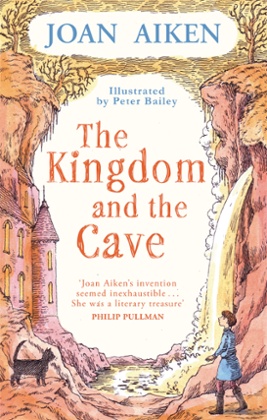
“Many happy returns, your Royal Highness,” the herald said. “I have brought you Mickle.” He felt a great yawn moving up through him, which he struggled to suppress. But he need not have bothered.
The King was yawning frightfully himself, and the Prince was looking at Mickle.
Mickle had no hesitation. He climbed down off the herald’s shoulder, jumped on to the bed with a little “Prrrmp?” and curling himself under a corner of the royal eiderdown, went to sleep. Michael followed his example, and was asleep before the King and the herald were out of the room.
Joan Aiken’s The Kingdom and the Cave is published on 5 November 2015, by Virago Modern Classics.