Closing summary
Today was dominated by political developments from opposite ends of the social spectrum: welfare claimants and lords.
The Department for Work and Pensions released its long-awaited statistics on mortality rates among benefit claimants. More than 80 people a month are dying shortly after being declared “fit for work” according to the data, prompting campaigners to call for an overhaul of the government’s controversial welfare regime. The DWP stats revealed 2,380 people died between December 2011 and February 2014 shortly after a work capability assessment (WCA) found they were able to work.
Meanwhile, 26 Conservatives were appointed to the House of Lords, including a former MP who claimed expenses to clean his moat, a City banker who has given millions to the party and a chief executive of a company criticised earlier this year for failing to pay the minimum wage.
Elsewhere today in the world of UK politics:
- The Labour leadership candidate Andy Burnham is charging guests up to £125 a head to attend a Manchester fundraising event, prompting some of his invited supporters to question the cost.
- Leadership hopfeul Jeremy Corbyn says Labour should take responsibility for resolving “the mess” left behind by private finance initiative (PFI) deals used to fund the building of hospitals under Tony Blair and Gordon Brown.
We’re closing the politics live blog now, but we’ve opened a specially constructed blog here to cover the Guardian Live Labour leadership hustings - which you can also watch live here.
Updated
BBC: we will aim to protect spending in Scotland, Northan Ireland and Wales
The BBC has responded to Nicola Sturgeon’s proposals for the BBC in Scotland and has pledged to aim to protect spending in Scotland, Wales and Northern Ireland (which it collectively refers to as the Nations). A BBC spokeswoman said:
Audiences across Scotland get great value from the licence fee, and are some of the highest users of BBC services.
The licence fee funds much loved services across the UK – like BBC One and Radio Two – but also specific services, like Radio Scotland and BBC Alba. Services for smaller audiences clearly cost more to provide, and that is why we spend more in the Nations per head than the rest of the UK – that’s the right thing to do.
We recognise that there is audience demand for greater representation and portrayal of Scottish audiences on all BBC services and we want this to be part of our response in Charter Review.
The BBC’s funding has now been set for the next five years and this will mean cuts across the BBC – we will have to balance our investment on pan-UK services with dedicated services in the Nations.
We will aim to protect spending in the Nations so that content investment is cut less than in other parts of the BBC.
We look forward to working with the Scottish Government on these issues, and to consulting with licence fee payers in Scotland about how they would like to see their licence fee spent.
Nicola Sturgeon at Edinburgh international TV festival - verdict
Appearing on stage at the Edinburgh international TV festival, Nicola Sturgeon continued to display the bold and assured attitude she wielded with devastating effect during the general election campaign.
Her appearance was only an hour long but the first minister managed to squeeze in enough food for thought to keep us full until parliament returns (which in Scotland is next Monday). Here are the highlights:
Who should lead Labour? Not bothered?
Sturgeon said she wasn’t tempted to pay £3 and attempt a vote for the Labour leadership. Asked who she was most scared would win, with an air of defiance and unstoppable confidence, she bluntly answered: “I’m not that bothered.” She added this was not meant to be disrespectful to any of the candidates. The first female first minister of Scotland said she was disappointed Yvette Cooper and Liz Kendall have added so little to the debate and gave credit to Jeremy Corbyn for enlivening an otherwise uninspiring campaign.
Twitter trolls have “nae pals”
In a discussion about Twitter abuse from SNP supporters, as well as other politically-affiliated social networkers, Sturgeon revealed her view of these online trolls. “They all sit in their rooms behind their computers in their pyjamas... they have nae pals” she said, prompting laughter from the audience.
The media is still too old-fashioned
Sturgeon told the audience in Edinburgh that she was proud of what she had done to raise the profile of women in politics but there was more to be done. Attitudes towards women in sport, politics and media are “unacceptable in 2015”, she said.
Complaints about referendum coverage were well founded
Although her tone appeared to want to draw a line under the debate about the partiality of the BBC’s coverage of the Scottish independence referendum, the first minister made it clear that she believed the broadcaster had a lot to answer for. She accused the BBC of being led by predominantly anti-independence newspapers. She said dismissing protests as intolerance of a free media was the “easy” choice for broadcasters.
A federal BBC is what Scotland needs
The first minister said she ultimately wants to see responsibility for broadcasting in Scotland transfer from Westminster to the Scottish Parliament, moving to a more federal structure, with separate boards for each of the nations and each of the national boards represented on the UK board. She wants a “distinct BBC Scotland TV channel” to be created. They are bold, radical proposals.
"I wd struggle to vote for any" of the main labour leader candidates says Sturgeon #edtvfest
— jane martinson (@janemartinson) August 27, 2015
Q: Who would play you in a film about the independence referendum?
A: I think Kelly Macdonald is a fantastic actress.
Q: Given SNP record on health and education, is control of the BBC wise?
Q: I don’t accept the premise. I’m proud of our record on health and education. I don’t rest on laurels.
Q: Will SNP field candidates south of the border?
A: Probably not. We should probably stick to Scotland. I made this during the general election campaign. As long as we’re part of Westminster system, I want SNP to work with others.
Q: Are you still the most dangerous woman in world?
A: I don’t think I ever was. But I’ve said before, it’s by far the nicest thing the Daily Mail has ever said about me.
Q: Turning to the Labour leadership. It costs £3 and you get a vote, tempted to join?
A: No. I’m enjoying watching.
Q: Who would you vote for?
A: I’d struggle to vote for any of them. Jeremy Corbyn, give him his due, at least he has got people talking. He’s got people thinking this is something worth taking part in. Give him credit for that. My disappointment is none of the women have seized the moment and shone through. The other three apart from Jeremy Corbyn I can’t think of an issue-led thing they’d said in the campaign. If I was labour supoporter I would be disappointed.
Q: Who are you most scared will win?
A: I’m not that bothered.
Q: SNP supporters have been accused of being quite vocal on Twitter?
A: Many people who would tweet abuse in the name of the SNP, aren’t SNP members. But many people across political spectrum tweet abuse. This is unacceptable on all sides. Let’s all of us stop trying to score points and come together and say cyber abuse is completely and utterly unacceptable.
Q: Is it disproportionately targeted at women?
A: Yes, not exclusively. But there’s an element to which women get more of it. The kind of person who would tweet abuse, they’ve probably got no pals.
Q: Is Scotland a feminist paradise?
A: I wouldn’t go that far. I spoke about the media. Political parties still have a long way to go. Yes, we’re going in the right direction. I’m optimistic that we’re not far away from a tipping point.
Q: Let’s turn to the image of the New Statesman cover, which asked: why are so many women childless? (The image of the front page is shown)
A: That did infuriate me. The article is perfectly good and reasonable. The New Statesman put the cover out in advance. My objection to that is two-fold. It suggests woman who don’t have children and are successful make cold-hearted about it. Which is rubbish. The imagery is awful. That’s what I’m talkinig about. That would put some young women off politics.
Q: You spoke in a nuanced way about the coverage of the independence referendum. Was Alex Salmond over the top in his comments about Nick Robinson?
A: Nick has reflected honestly on mistakes he made in his coverage of the referendum. I think Alex would agree with that. Let’s debate properly some of the issues. Learn lessons, agree to disagree in some ways. And do that in a rational way.
Q: Alex Salmond says he won’t even watch the BBC?
A: There’s an easy way to fix that. They just have to put Forth racing on. Believe me he’ll watch.
Q: Can you tell us more about the federated structure you’ve mentioned?
A: There’s a great need to make sure network programming better reflects Scottish issues and the life in Scotland. Not just in politics. It’s a way of structurally helping the BBC to reflect the reality of the UK and how the UK is organised. Structural change don’t deliver programme changes. I’m putting forward a principle that Scotland has a fairer crack of the whip.
Q: You don’t think you have enough funding?
A: No, I don’t. We’re at early stage of charter renewal. I think it’s important we get it right.
Q: It has been suggested that £75 million would be needed to fund a BBC Scotland channel. This seems low. What could be done with this level of funding?
A: You would get lots of ideas about how with greater resources the production sector here could do great things. What I’m trying to do now at this stage are some principles to guide us. These are set out with intention to strengthen and enhance what the BBC does. None of us can stay stuck as we are.
Q: Scottish BBC channel? What would be on it?
A: Content that reflects our lives, reflects world affairs from a Scottish perspective. There is demand for more Scottish content. This isn’t Scotland want to be parochial. We want to see ourselves reflected better. We need to make the BBC better.
Sturgeon is now taking questions from the audience and the Guardian’s editor-in-chief Katharine Viner. The feed has been dipping in and out so please bear with me if there are any gaps or pauses.
Updated
The first minister says she wants a “distinct BBC Scotland TV channel” to be created.
It would help to secure the sustainability of the independent production sector in Scotland, it would see more of the licence fee spent in Scotland, but more importantly, it would by some distance, be the best way of making a wider and richer.
Sturgeon puts forward her proposal for the BBC to move to more federal structure, with separate boards for each of the nations and each of the national boards represented on the UK board.
Scotland is an outward looking, internationalist country, intensely interested and active in the world around us - but we also want to see ourselves, our daily experiences and our national story, more fully reflected on our radios and television screens.
The first minister says ultimately wants to see responsibility for broadcasting in Scotland should transfer from Westminster to the Scottish Parliament.
To those who say this is about the SNP wanting to exert political control over the BBC, I say that is arrant nonsense. This is not a question of whether a parliament has responsibility for the broadcasting framework - it’s a question of which parliament has that responsibility.
Scotland, the BBC and all the nations and regions of the UK have the right to expect something truly radical from the charter review, Sturgeon says.
A BBC that puts forward a bold proposal for Scotland, for the nations and regions, and for the UK will have in us a strong and willing ally. A BBC that offers piecemeal solutions will fail to meet the demands or restore the trust of Scottish audiences.
Sturgeon sets out her key principles for charter renewal at the BBC. She says it is important to have a strong and independent BBC and should continue to provide mass-audience programming.
If the BBC does nothing except find niches that aren’t served by commercial broadcasters, it risks losing the widespread popular support on which all of its wider programming rests.
She says funding should be universal. Sturgeon says people who use the iPlayer should pay the licence fee.
The first minister says she is “drawn to the idea” of a progressive, income-based levy, rather than a flat-rate licence fee, adding that a fairer proportion of the licence fee should be invested here in Scotland.
The BBC needs to “reflect the nations and regions of the UK much more effectively than it does”, she says.
Sturgeon has now turned to BBC charter renewal and its implications for Scotland.
First she attacks culture secretary, John Whittingdale, for backing a new licence fee settlement negotiated in secret.
That represents a serious breach of the terms of the UK Government’s memorandum of understanding with Scotland. So too does the UK Government’s decision to appoint an advisory panel without any prior consultation.
So a key message from me is that the rest of the renewal process needs to be much more transparent.
Media nds to recognise tht some complaints were genuine not misplaced desire to control the media #edtvfest
— jane martinson (@janemartinson) August 27, 2015
The first minister alludes to BBC Nick Robinson’s comparisons between protests against his coverage of the Scottish independence referendum to the treatment of the media in Vladimir Putin’s Russia.
The easy thing for broadcasters to do would be to dismiss the complaints and the protests as intolerance of a free media or of opposing opinions.
But I think it needs to recognise, as the audience council has done already, that some of those complaints were well founded. The frustration that many felt was not borne out of a misplaced desire to control the media, but from a genuine concern that the playing field didn’t always feel even.
Sturgeon is turning to her experience of broadcaster media coverage of the Scottish independence referendum campaign. Her predecessor Alex Salmond has made his views on this clear, and in recent weeks has come to blows with the BBC’s former political editor Nick Robinson over the thorny issue.
That was often compounded by the fact that the daily agenda of broadcasters - and I think the BBC in particular - would often follow what was in the morning papers.
And given that most papers were anti-independence, it would be the reports casting doubt on, for example, the security of pensions that made the splash.
Any reports pointing to the erosion of pensions as a result of Westminster decisions would be buried deep inside. So more often than not the attack on independence led the news coverage.
The sense of overall balance would have been enhanced if news reports had more often been led by critical analysis of the status quo.
Sturgeon turns to social media. She says she has sent 11,000 tweets since joining the social network.
The first minister says she learned the value of Twitter during the general election when the Telegraph carried a false allegation that she had told the French Ambassador that she wanted David Cameron to win the election.
Before Twitter, it would have taken hours for my rebuttal of that story, which was published late on a Friday night, to appear in print or on TV - and then, of course, it would have been up to the media what prominence it was given. Instead, within minutes of it breaking, people could read a tweet from me saying that it was 100% untrue.
But Sturgeon warns against an “over-reliance” on social media.
My colleague Jane Martison is at the Edinburgh international television festival where Nicola Sturgeon is addressing the audience.
Diversity not jst abt women but for minority grps the "pace of change" has been glacial since being described as "hideously white" #edtvfest
— jane martinson (@janemartinson) August 27, 2015
Scotland’s first minister says she is angered by the sexist media portrayal of women and the impact it might have on women and young girls who could be driven away from pursuing a career in politics or public life.
Despite the successes of the Lionesses and athletes like Eilidh Child or Jessica Ennis Hill - women in sport receive far less coverage and prominence than their male counterparts.
Older female reporters have had to battle to stay on screen whilst their male equivalents hold premium presenting roles well past retirement age.
None of that is acceptable in 2015.
Discussing diversity, Sturgeon says the media can still feel “old fashioned” particularly in its portrayal of women.
For an industry that prides itself on being creative and innovate, an industry that is driven by new technology and the need to anticipate the changing values and tastes of its audiences, it genuinely surprises me how - dare I say it - old fashioned the media can sometimes feel. The portrayal of women is a case in point.
Katharine Viner has introduced the first minister, reminding the audience she was once dubbed the “most dangerous woman in the world” by Piers Morgan.
Before getting into her thoughts on the BBC and charter renewal, Sturgeon starts by reflecting on her personal experience with the media.
As result of the global coverage of the referendum, becoming first minister and most recently the general election campaign there has been a dramatic increase in the level of media exposure and scrutiny that I experience.
The full story from the Guardian’s Scotland editor Severin Carrell on Nicola Sturgeon’s proposals for new BBC TV and radio channels in Scotland can be read here.
Carrell reveals the proposals are based heavily on an official BBC blueprint which was scrapped after the latest £750m funding cuts.
His story comes as Sturgeon joins the Guardian’s editor-in-chief, Katharine Viner on stage at the Edinburgh international television festival. She is expected to discuss her thoughts over the future of the BBC in Scotland, as well as her relationship with broadcasters and the press.
Sturgeon's BBC proposals based on corporation's own blueprint
My colleague Severin Carrell is about to break a story that reveals Nicola Sturgeon’s ambitious proposals for new BBC TV and radio channels in Scotland are based heavily on an official BBC blueprint which was scrapped after the latest £750m funding cuts. The story comes just as the first minister stands to address the Edinburgh international television festival. He writes:
Sources close to the BBC have confirmed that its executives drew up plans for a new Scotland-only TV channel and an extra radio service funded by the licence fee, as part of the corporation’s proposals for the renewal of its charter.
Those proposals, which the BBC forecast would cost about £75m, were leaked to the first minister’s team by BBC staff because they have been shelved after Tony Hall, its director general, was forced by the UK government to accept £750m in cuts under the latest licence fee settlement.
Lord Pearson, the former Ukip leader and the leader of Ukip’s three-strong faction in the Lords, has protest about the fact that his party did not get the chance to nominate any peers. In a statement he said:
In 2014, Ukip won the European Elections, with 4.5m voting for us. This year almost 4m voted for us and made us the third largest party by vote share. Instead of recognising this fact Cameron has shown that he has an almost 18th Century attitude to the patronage at his fingertips. Awarding friends, rewarding allies rather than trying to reflect the opinions of his countrymen. Despite increasing electoral support in the country, UKIP has never been awarded a single peerage, a constitutional anomaly that must be ended.
It is clear that the prime minister has no interest whatsoever in a fair representation of the people. To that end I am tabling a motion demanding that the situation be debated fully before a single new Lib Dem peer is presented to the House.
That’s all from me, Andrew Sparrow, for today.
My colleague Jamie Grearson is taking over now. He will be covering Nicola Sturgeon’s Q&A at the Edinburgh International Television Festival with Katharine Viner, the Guardian’s editor-in-chief.
Later I will be launching a separate live blog covering the Guardian’s Labour leadership hustings. There will be a live feed at the top of the blog, so you can watch it too. Do. It should be good.
I’ve now had some clarification about the figures I wrote about earlier.
Of the 81,140 who are thought to have died while claiming incapacity benefits, 2,650 had been found fit to work after a work capability assessment. Some 1,360 died after appealing the decision that they were fit to work. I am not clear yet whether that figure is in addition to the 2,650 or includes it.
Andy Burnham and various people on social media have added these two figures together and concluded that “over 4,000” incapacity benefit claimants have died after being found fit to work.
However, I’ve spoken to the DWP and it doesn’t look like these figures can be accurately added together because there is likely to be some overlap between the two. Some of those who appealed their work capability assessment decision will have had it upheld, so been found fit to work, and some will have had it rejected. There is no information provided as to how many fit into the former or the latter category.
10 things we learn about how you get a peerage from today's dissolution honours
The House of Lords is a peculiar place. Most of its members are anonymous but reasonably respected lifetime politicos, there is a crop of remarkably distinguished public figures, and there is also some third-rate riff-raff. How do they all get there? Every honours list provides some clues.
Here are 10 things we can learn about how you get into the Lords from today’s dissolution honours.
1 - Outstanding parliamentarians have, as always, a more or less automatic pass to the House of Lords. William Hague, the former Conservative foreign secretary, is the obvious example on today’s list, but David Blunkett, the Labour former home secretary, and Alistair Darling, the Labour former chancellor, are two more. Like most honours lists, this one contains some duds, but it also includes respected political figures like David Willetts, Sir George Young, Peter Hain and Tessa Jowell. If there has to be an appointed Lords full of retired MPs, these are the kind of people you would expect to see in it.
2 - Being a member of the PM’s inner circle helps a lot. Greg Barker was a middle-ranking energy minister who in normal circumstances would not expect a seat in the Lords, but he was also one of the very first Tory MPs to back Cameron for leader in 2005, and he finally seems to have had his reward. Kate Fall, Cameron’s deputy chief of staff and a key Number 10 confidante, has been ennobled. And Nick Clegg has used his slice of the dissolution honours to give a peerage to his former chief of staff, Jonny Oates.
3- Women are under-represented at Westminster, but the Lords is being used to make up the numbers. David Cameron has given more than a third of his peerages - 10 out of 25 - to women and almost half of the Lib Dem ones (five out of 11) go to women too. At least one of these could prove controversial. Michelle Mone, the Scottish businesswoman who has become a peer and entrepreneurship tsar, has already come under fire from business figures in Scotland who think she is unsuitable for the post.
4 - Donating helps. Selling peerages is illegal, and there is nothing to suggest wrongdoing on behalf of anyone in today’s list, but an academic study has shown that giving large sums of money to a political party does have a remarkably positive effect on the chances of said donor having their talents recognised in an honours list. Today James Lupton, the Conservative party’s co-treasurer and a “businessman and leading philanthropist” according to the Number 10 citation, has become a Lord. He has given £2.8m to the party. Anthony Ullmann, a businessman and adviser to Nick Clegg who has given almost £100,000 to the Lib Dems, gets a knighthood. My colleague Rajeev Syal has more on this here.
5 - But being a Tory press baron doesn’t. At the election the Conservatives benefited from remarkable positive coverage in papers like the Daily Telegraph. But, if anyone at Telegraph HQ was hoping for some pay-back, it has not arrived today.
6 - Being a longstanding Lib Dem MP is a reliable route in. Proportionately more Lib Dem MPs probably end up in the Lords than Labour or Tory ones, and today’s list contains several Lib Dems who hardly qualify as “distinguished” but how have benefited from the Lib Dem peerage premium.
7 - Failure does not necessarily hold you back. As health secretary Andrew Lansley was responsible for the Health Act, probably the most contentious piece of legislation passed in the last parliament. Even supporters felt that Lansley handled it badly, and he was demoted. But that has not stopped him ending up in the Lords - perhaps because he used to be Cameron’s boss at the Conservative research department. See point 2 above.
8 - But getting caught in a cash-for-access sting does. Jack Straw was entitled to expect elevation to the Lords when he announced he was leaving the Commons before the election, and Sir Malcolm Rifkind, another former foreign secretary, would normally have expected automatic entry too. They were both caught in a cash-for-access sting before the election. Although they both denied doing anything wrong, they weren’t included in today’s list.
9 - The MPs’ expenses scandal won’t necessarily be held against you anymore. Douglas Hogg was vilified in 2009 after it emerged he had claimed expenses partly on the grounds that he needed money for cleaning his moat. Today he becomes a life peer. It will be his second peerage; he already has a hereditary peerage - he is Viscount Hailsham - but that did not allow him to sit in the Lords.
10 - And being rejected by the electorate is not necessarily an obstacle either. The Lib Dem list includes two people going to the Lords after being defeated at the general election, Lorely Burt, Lynne Featherstone, and the Tory list includes Anne McIntosh, who did not even get to fight the election because she was deselected by her local party. All three are women, so point 3 (see above) is coming into play here too.
Updated
And here’s Lucy Powell, Labour’s shadow Cabinet Office minister, on the honours list.
David Cameron’s promise to cut the cost of politics lies in tatters. At the election the Tories said they would make the House of Lords smaller, but they have done the opposite, leaving taxpayers with a multi-million pound bill for David Cameron’s new peers.
Time and again the Tories have rewarded those who have given them millions of pounds. At a time when families are struggling to make ends meet, people will see this as the Tories putting their cronies before the country.
The SNP, which does not nominate people for peerages because it is opposed to the Lords, has condemned today’s honours list. This is from the statement from Kirsty Blackman MP, its spokesperson on the Lords.
This is a sorry list of rejected and retired party politicians - cronies and hangers-on with big cheque books. The message from David Cameron is – even if people reject your party at the ballot box you will be handed a seat in parliament for the rest of your life – because Mr Cameron ‘can’.
It is an affront to democracy that politicians whose parties have been roundly rejected by the electorate can then re-appear in parliament a few weeks later and legislate for the rest of their lives without ever having to be accountable again. That is the scandal of today’s list.
Here is a Guardian graphic illustrating the composition of the House of Lords.
According to the Constitution Unit at University College London, David Cameron has appointed more peers in five years than Margaret Thatcher did in 11 years. And he is appointing more peers per year than any prime minister since life peerages were introduced in 1958.
Here is an excerpt from its briefing note.
- David Cameron has appointed to the Lords at a faster rate than any prime minister since life peerages began in 1958. Including today’s figures, Cameron has appointed 44 peers per year, compared to Blair’s 37, Thatcher’s 18 and Major’s 25 per year.
- The chamber’s size rose by approximately 50 members in 11 years 1999-2010. In the five years since Cameron became prime minister it has grown by roughly 150 more, including today’s appointments. Once all eligible members are included, the size of the chamber will reach 866 – exactly 200 more than the 666 in 1999.
- As of today, Cameron has appointed 236 peers – exceeding the 205 appointed in Margaret Thatcher’s 11 years as prime minister.
- As peers can claim a £300 per day attendance allowance, Cameron’s previous appointments have led to increased costs of roughly £30,000 per sitting day (rising to around £43,500 including today’s appointments).
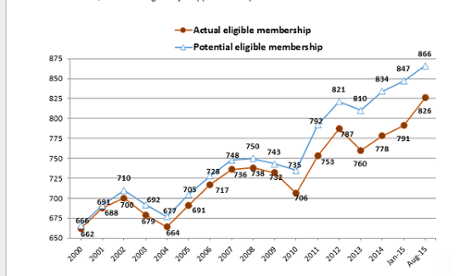
Some peers do not sit in the House of Lords, but are potentially eligible, because they have taken leave of absence.
Professor Meg Russell, the unit’s deputy director, says today’s appointments are unnecessary and that Cameron is damaging the reputation of the Lords.
David Cameron’s excessive appointments to the Lords have already been widely criticised for inflating the size of the chamber, increasing its costs, and at the same time reducing its effectiveness. The Lords has an important role in holding government to account and scrutinising its legislation. Repeated new appointments severely damage its reputation, and increasingly undermine its ability to do its job.
No doubt the government would like to be stronger in the Lords, but there is no justification for appointments to rebalance the numbers in the Conservatives’ favour. The Conservative Party is already the largest grouping in the Lords. Since 1999 the Lords has been a ‘no overall control’ chamber, and Labour governed successfully for 9 years from 1997-2006 without being the largest party. This simply required negotiation over policy, which most - even on the Labour side - agree led to better policy outcomes.
She also says that there should be a cap on the size of the Lords pending reform.
Questions remain about large-scale Lords reform, but until that happens (which is unlikely to be soon) the need to sort out the appointments system is now really urgent. Encouraging retirements is not the answer – that could simply allow the prime minister to appoint even more, strengthening his hold over parliament. We need an immediate cap on the size of the chamber, a brake on prime ministerial appointments, and a move to a far more regulated system. The Lords is in danger of serious crisis, and I believe bodies such as the Lords Constitution Committee, or perhaps even the Lord Speaker, now need to step in and help forge agreement for urgent change. The current system is costly to the taxpayer, damaging to parliament, and badly needs to stop.
Updated
Jenny Jones, the Green party peer, says today’s honours list underlines the need for Lords reform.
It is disappointing, but sadly unsurprising, that this list is populated by the establishment parties who already dominate the upper house, while the 1.1 million people who voted Green at the general election remain roundly ignored.
Almost everyone recognises the desperate need for reform of the House of Lords, as well as our wider political system. Rather than appointing a list of new Lords, David Cameron ought to be working to make parliament fit for a 21st century democracy.
The Green party wants to see a House of Lords democratically elected by proportional representation, so that it is representative of and accountable to the public.
Tessa Jowell, the Labour former culture secretary who is seeking the party’s nomination to for London mayor, has put out a statement explaining her decision to accept a peerage.
I’m very proud to have been nominated by the Labour Party.
I thought long and hard about accepting this honour given my ambition to run London. I’m accepting this, to speak up for London in the House of Lords. Our city is watching on whilst Scotland, Wales and even Manchester are enjoying more and more powers to shape their own destiny.
London must have more powers to tackle the housing crisis, fight the inequality that is dividing our city, and London should also have more freedom to decide how we invest the money we raise in our city and the power to set a higher minimum wage.
Every city should have a champion in the House of Lords, ideally an elected mayor. I want to be London’s champion. I’ll use this position for one purpose and one purpose alone – to fight for Londoners.

Here is some Twitter comment on the honours list.
From the Guardian’s Tom Clark
Politically gratuitous honour-thy-chum stuff is brazen – as highlights the disgrce of the politically understandable packing of the Lords
— Tom Clark (@guardian_clark) August 27, 2015
Say what you like about Tony Blair – he gave up his right to a resignation honours list. http://t.co/oBfiLsaAwW
— Tom Clark (@guardian_clark) August 27, 2015
The Liberal Democrats today acquire 3 more law-makers than the total they achieved in the general election. And they want 2 abolish Lords
— Tom Clark (@guardian_clark) August 27, 2015
The post-May "now we can do whatever we please" vibe radiates from these honours. Hubris before nemsis?
— Tom Clark (@guardian_clark) August 27, 2015
From Iain Dale, the publisher, broadcaster and former Conservative candidate
So, 45 new peers announced. LibDems got 2.4m votes at election and get 11 peers. UKIP get 3.8ml votes and get 0. Greens also get 0. Fair?
— Iain Dale (@IainDale) August 27, 2015
From Total Politics’s David Singleton
Electoral Reform Society reckon today's 45 new peers will cost taxpayers a tidy £1.2m per year
— David Singleton (@singersz) August 27, 2015
From the Daily Mail’s Jason Groves
Lib Dems casting net wide to fill their 11 peerage slots. Arise Baroness Shas Sheehan, a 'former councillor for Kew'
— Jason Groves (@JasonGroves1) August 27, 2015
Was your name missing from the honours list? Perhaps you need to try this.
The fact there exists a company that helps you get into the House of Lords is amazing http://t.co/btEnE09EWF
— Chris Applegate (@chrisapplegate) August 27, 2015
Here is the start of the Press Association story on the honours list.
David Cameron faces accusations of cronyism after unveiling dozens of new Tory peers, including former ministers and advisers, in the dissolution honours list.
Downing Street announced 26 names proposed by the prime minister, with 11 for the Liberal Democrats and eight for Labour - a total of 45.
They included former foreign secretary William Hague and Mr Cameron’s long-standing gatekeeper Kate Fall, as well as ex-Lib Dem leader Ming Campbell and Labour former chancellor Alistair Darling.
The appointments take the active membership of the upper House to more than 800.
Former ministers who served under Cameron featured heavily on the Conservative list, with ex-health secretary Andrew Lansley, Sir George Young, David Willetts and Greg Barker joining Mr Hague in the Lords.
Tory grandee Douglas Hogg, who came under fire during the expenses scandal after it emerged he had filed a claim for cleaning the moat at his country home, is also on the list.
Former Number 10 policy director James O’Shaughnessy is becoming a peer, as is Iain Duncan Smith’s ex-special adviser Philippa Stroud and Tory Party vice-chairman Kate Rock - a close ally of Chancellor George Osborne.
Conservative donor and former vice-treasurer James Lupton has been granted a peerage, as has businesswoman Michelle Mone.
Lib Dem former chief secretary to the Treasury Danny Alexander and ex-business secretary Vince Cable get knighthoods, after apparently turning down the chance to go to the upper chamber.
A slew of past and present Tory aides and advisers have also been rewarded for their service with other honours. Oliver Dowden, former Downing Street adviser and now MP, has been awarded a CBE, as have Cameron’s operations chief Liz Sugg and Osborne’s ex-chief of staff Rupert Harrison.
Osborne’s former media adviser Ramesh Chhabra and Hague’s former adviser Denzil Davidson are among those receiving OBEs for “public service”.
There are 45 new peers being announced today. Some 26 are Conservative, 11 Lib Dem and eight Labour.
This will take the size of the House of Lords over 800. There is a chart showing the current composition (without today’s additions) here, on the House of Lords website.
Dissolution honours - Peerages
Nominations from the leader of the Conservative party
- James Arbuthnot – former MP for North East Hampshire and Front Bench Minister
- Rt Hon Gregory Barker – former MP for Bexhill and Battle and former Minister of State at the Department for Energy and Climate Change
- Catherine Fall – Deputy Chief of Staff to the Prime Minister
- Simone Finn – Special Adviser to the Minister of State for Trade
- Stephen Gilbert – Deputy Chairman of the Conservative Party
- Rt Hon William Hague – former MP for Richmond and former Foreign Secretary
- Robert Hayward OBE – former MP for Kingswood, Board Member of Dignity in Dying and Trustee for the YMCA
- Rt Hon Douglas Hogg QC – former MP for Sleaford and North Hykeham and held several ministerial roles
- Rt Hon Andrew Lansley CBE – former MP for South Cambridgeshire and former Cabinet Minister
- James Lupton CBE – Chairman of Greenhill Europe and former Co-Treasurer of the Conservative Party
- Ruby McGregor-Smith CBE – CEO of Mitie Group PLC
- Anne McIntosh – former MP for Thirsk and Malton and Chairman of the Environment, Food and Rural Affairs Select Committee
- Michelle Mone OBE – leading entrepreneur and sits on the Board of Directors for The Prince’s Scottish Youth Business Trust
- James O’Shaughnessy – Managing Director of Floreat Education
- Emma Pidding CBE – former Chiltern District Councillor and former Chairman of the National Conservative Convention
- Stuart Polak CBE – Director of the Conservative Friends of Israel
- Councillor Gary Porter – Councillor for South Holland District Council and Chairman of the Local Government Association
- Councillor Elizabeth Redfern – Leader of North Lincolnshire Council
- Rt Hon Andrew Robathan – former MP for South Leicestershire and several Front Bench and government roles
- Kate Rock – Vice-Chairman of the Conservative Party
- Councillor Jane Scott OBE – Leader of the Wiltshire Council
- Kevin Shinkwin – longstanding voluntary sector professional
- Philip Smith CBE – Chief Executive of the Association of Conservative Clubs
- Philippa Stroud – Special Adviser to the Secretary of State for Work and Pensions
- Rt Hon David Willetts – former MP for Havant and several Front Bench roles
- Rt Hon Sir George Young Bt CH – former MP for North West Hampshire and former Cabinet Minister
Nominations from the leader of the Liberal Democrat party at the time of the dissolution
- Sir Alan Beith – former MP for Berwick-upon-Tweed and former Chair of the Justice Select Committee
- Sharon Bowles – former MEP for South East England
- Sir Malcolm Bruce – former MP for Gordon, and former Deputy Leader of the Liberal Democrats
- Lorley Burt – former MP for Solihull and former Chair of the Liberal Democrats
- Rt Hon Sir Menzies ‘Ming’ Campbell CH, CBE, QC – former MP for North East Fife and former Leader of the Liberal Democrats
- Lynne Featherstone – former MP for Hornsey and Wood Green and held several ministerial positions
- Don Foster - former MP for Bath and former Liberal Democrat Chief Whip
- Jonny Oates – former Chief of Staff to the Deputy Prime Minister in the coalition government
- Shas Sheehan – former Councillor for Kew and involved in several community groups
- Sir Andrew Stunell – former MP for Hazel Grove and former Department for Communities and Local Government Minister
- Dorothy Thornhill MBE – Mayor of Watford; former Councillor and Assistant Headteacher
Nominations from the leader of the Labour party at the time of the dissolution
- Rt Hon David Blunkett – former MP for Sheffield Brightside and Hillsborough and former Cabinet Minister
- Rt Hon Alistair Darling – former MP for Edinburgh South West and former Cabinet Minister
- Rt Hon Peter Hain – former MP for Neath and former Cabinet Minister
- Rt Hon Tessa Jowell DBE – former MP for Dulwich and West Norwood and former Cabinet Minister
- Spencer Livermore – senior Campaign Strategist for the Labour Party
- Paul Murphy – former MP for Torfaen and former Cabinet Minister
- Rt Hon Dawn Primarolo DBE – former MP for Bristol South and former Minister
- Dave Watts – former MP for St Helens North and former Chair of Parliamentary Labour Party
Updated
Dissolution honours - Honours
Here is the first dissolution honours list.
These are honours. I will post the peerages in a moment.
This is the Number 10 announcement.
Dissolution Honours 2015
The Queen has been graciously pleased to signify Her intention of conferring the following
Honours upon the undermentioned:
Kt [Knighthoods]
Rt Hon Daniel Alexander - Lately Chief Secretary to the Treasury. For political and public service
Rt Hon Vincent Cable - Lately Secretary of State for Business, Innovation and Skills.
For political and public service
Councillor Barry Norton - Leader, West Oxfordshire District Council. For political service
Anthony Ullman - CEO, Autofil Worldwide Limited and lately Advisor to the Rt Hon Nick Clegg MP. For political service
DBE [Damehoods]
Rt Hon Annette Brooke OBE - Lately Member of Parliament for Mid Dorset and
North Poole. For political and public service
Philippa Harris - Co-founder, Neal Street Productions and lately Advisor to the Rt Hon Nick Clegg MP. For political service
Rt Hon Lady Margaret Hodge MBE MP - Member of Parliament for Barking. For political and public service
Glenis Willmott MEP - Member of the European Parliament for the East Midlands. For political and public service
CBE
Oliver Dowden MP - Lately Deputy Chief of Staff to the Prime Minister, 10 Downing Street. For public service
Jean-Christophe Gray - Lately the Prime Minister’s Spokesman, 10 Downing Street. For public service
Duncan Greenland - Lately Chair of Trustees, Centre Forum. For political and public service
Rupert Harrison - Lately Chief of Staff to the Chancellor of the Exchequer. For public service
Laurence Mann - Political Secretary to the Prime Minister, 10 Downing Street. For political service
Elizabeth Sugg - Director of Operations and Campaigns, 10 Downing Street. For public service
Ian Wright - Director-General, Food and Drink Federation and lately Advisor to the Rt Hon Nick Clegg. For political and public service
OBE
Caroline Balcon - Constituency Manager, Witney. For political service
Ramesh Chhabra - Lately Special Adviser to the Chancellor of the Exchequer. For public service
Denzil Davidson - Lately Special Adviser to the Foreign Secretary. For public service
Richard Duncalf JP - Lately Strategic Adviser to the Deputy Prime Minister. For political and public service
Clare Foges - Lately Senior Speechwriter to the Prime Minister, 10 Downing Street.
For public service
Ameetpal Gill - Director of Strategy, 10 Downing Street. For public service
Matthew Hanney - Lately Special Adviser to the Deputy Prime Minister. For public service
Hilary Stephenson - Deputy Chief Executive, Liberal Democrats. For political service
Benjamin Williams - Lately Special Adviser to the Government Deputy Chief Whip. For public service
MBE
Margaret Binks - Constituency Manager, Sheffield Hallam. For political service
Kate Marley - Special Adviser, 10 Downing Street. For public service
Councillor Shaffaq Mohammed - Councillor, Sheffield City Council. For political service
Lara Moreno-Perez, Prime Minister’s Diary Secretary, 10 Downing Street. For public service
Lalini Phoolchand - Deputy Head of the Direct Communications Unit, 10 Downing Street. For public service
Steven Pooley - Head of Duty Clerks, 10 Downing Street. For public service
Phillipa Rudkin - Constituency Manager, Tatton. For political service
Michael Salter - Lately Head of Political Broadcast, 10 Downing Street. For public service
Andrew Sangar - Councillor, Sheffield City Council and lately Election Agent to Rt Hon Nick Clegg MP. For political service
Ian Sherwood - Lately Volunteer, Office of the Leader of the Liberal Democrats. For political service
BEM
Alison Depass - Catering Assistant, 10 Downing Street. For public service
Paul Schooling - Gardener, 10 Downing Street. For public service
Marjorie Wallace - Catering Assistant, 10 Downing Street. For public service
Updated
As my colleague Frances Perraudin reports, the DWP figures are far from straightfoward. (See 12.01pm.) There is no consensus yet as to what they show.
But Andy Burnham, the Labour leadership candidate, says in the headline to his press notice (see 12.37pm) that “that over 4,000 people have died within six weeks of being assessed as fit to work”.
Burnham is assuming that the 2,650 who died after being found fit to work and the 1,360 who died after appealing against being found fit to work are different people. As my colleague Frances Perraudin explained in her analysis, that is not clear from the figures. See 12.01pm.
Nick Sutton, editor of the World at One, says he cannot get any minister to come on to his programme today to talk about either immigration or the DWP figures.
We'd like to speak to @ukhomeoffice about today's immigration figures. Unfortunately no minister available for #wato pic.twitter.com/MMNkQt7lvs
— Nick Sutton (@suttonnick) August 27, 2015
James Brokenshire, the immigration minister, has been giving interviews to other programmes, but he won’t do WATO.
We'd also like to interview @DWP minister on today's mortality stats for people claiming out of work benefits. But.. pic.twitter.com/FdXUL5LnqU
— Nick Sutton (@suttonnick) August 27, 2015
Andy Burnham, the Labour leadership candidate, says the DWP figures (see 12.01am and 12.24pm) are “shocking”. He has put out this statement.
These are shocking figures that for the first time show the human cost of this government’s punishing benefits regime.
It raises serious questions about this government’s punitive approach to people on benefits.
We now need an urgent national debate about these figures, and if elected Leader I would call a full-day debate in Parliament at the first available opportunity.
This Tory government has been playing politics with the lives of vulnerable people. Under my leadership, Labour will stand for a humane approach to benefits and defend sick and disabled people from these unwarranted and stigmatising attacks.

More than 2,300 people died after losing claim for ESA, says TUC
In the light of the DWP figures (see 12.01pm), the TUC is calling for an inquiry into the government’s back-to-work regime. It says more than 2,300 people died shortly after losing their claim for employment and support allowance (ESA). This is from the TUC’s general secretary, Frances O’Grady.
We urgently need an enquiry into the government’s back-to-work regime. These disturbing findings cannot be swept under the carpet.
The fact that more than 80 people are dying each month shortly after being declared ‘fit for work’ should concern us all. These deaths relate to just one benefit – employment support allowance.
We need a welfare system that supports people to find decent jobs not one that causes stress and ill health.
Updated
Department for Work and Pensions publishes mortality figures for claimants
The Department for Work and Pensions has released its long-awaited statistics on mortality rates among benefit claimants in a typically opaque form, and the figures don’t immediately appear to give us the information that campaigners have been after – namely the number of people who have died within a year of being found fit to work.
The DWP has released two documents, one setting out the mortality rates among all out of work benefit claimants and the other – responding to a series of Freedom of Information requests – giving the number of people claiming incapacity benefits who have died.
In the first document, the DWP has tried to argue that their figures show that the mortality rates among benefits claimants have fallen at a similar rate to that of the general population. Though this at first glance appears to be broadly true, the figures show that the mortality rate among those on incapacity benefits has actually fallen at a slower rate than that of the general working age population.
Whereas somebody on incapacity benefits (which includes employment and support allowance (ESA), incapacity benefit (IB) or severe disablement allowance (SDA)) was 3.6 times more likely to die than an average member of the general working age population in 2003, they were 4.3 times more likely to die in 2013.
The second document is more interesting and the DWP appeared to be trying to burry it by drawing journalists attention to the first. It is a response to a series of Freedom of Information requests that have tried to establish the link between benefit sanctions and deaths. The data does not show the number of people who have died after being found fit for work or after being sanctioned, which is what a number of MPs have been calling for.
It does show that 40,680 died between 1 May 2010 and 28 February 2013 within a year of receiving a work capability assessment (WCA) decision. That’s out of a total of 2,017,070 who received WCA decisions during that time and there’s no detail on what the decisions entailed.
The document also shows the number of people between 2011 and 2014 whose claims for IB/SDA and ESA have ended as a result of death and the number of those people, in turn, who had also been found fit to work. Of the 81,140 who are thought to have died while claiming incapacity benefits, 2,650 had been found fit to work after a work capability assessment. Some 1,360 died after appealing the decision that they were fit to work. I am not clear yet whether that figure is in addition to the 2,650 or includes it.
The DWP has stressed that because data on benefit claimants is only collected every two weeks, they can’t be sure that a person’s incapacity benefit claim ended as a result of their death.
Updated
Yvette Cooper, the shadow home secretary and Labour leadership candidate, has put out this statement about the immigration figures.
These figures show David Cameron needs to stop the dishonesty over his failed immigration target and replace it with a sensible plan instead which properly separates immigration and asylum.
All his overblown rhetoric has achieved is a decline in public confidence as the electorate are faced with more broken promises. At the same time he has failed to tackle the exploitation by dodgy employers and agencies which is driving low skilled migration, undercutting wages and jobs and at its worst creating modern slavery. Meanwhile universities and businesses are finding the system too rigid to get the top international talent they need.
But most troubling of all, the net migration target treats immigration and asylum as the same. That is morally wrong and is preventing Britain playing its part in responding to the terrible refugee crisis that stems from Syria and has spread across Europe. We have a long tradition of providing sanctuary for those fleeing conflict and persecution abroad - yet we are completely failing to live up to that tradition now. Other countries round the world are doing their bit. It is time Britain did too.

Here’s Humza Yousaf, minister for Europe and international development in the SNP’s Scottish government, on the immigration figures.
Brace yourself for a fresh flurry of anti-immigration rhetoric from UK Govt. Proud to be part of a Scot Govt that doesn't demonise migrants
— Humza Yousaf (@HumzaYousaf) August 27, 2015
The Migration Observatory at Oxford University has put out a statement about the immigration figures. This is from its director, Madeleine Sumption,.
Migration levels are currently comparable to what we saw in the mid-2000s after EU enlargement. What this means for the UK is subjective. There is no objective way to decide what the ‘right’ number of migrants is, and reasonable people will disagree. What is clear is that reducing net migration to below 100,000 remains a distant prospect, at least under current economic conditions and policies.
It also points out that another set of ONS figures out today (pdf) show that the foreign-born population reached 8.3m in 2014, or 13% of the population. This is up from 5.3m, or 8.9%, in 2004. The proportion of foreign-born people coming from EU countries is also rising, reaching 37% in 2014, up from 28% in 2004. Sumption added:
The UK remains a major destination for international migrants, in part due to its flexible labour market and attractive higher education sector. But it is by no means an outlier by international standards. People born abroad make up a similar share of the population in other EU countries like Germany, Spain and Sweden.
My colleague Alan Travis has written a good analysis of the immigration figures. He says politicians should accept that mass immigration makes an important contribution to Britain’s economic growth. Here’s an extract.
The latest official figures showing that net migration to the UK is at record levels underline how far nearly 20 years of continuous mass inward migration has helped turn Britain into a flourishing modern economy.
It is not a message that you will hear from many, if any, mainstream politicians but, as the government’s own Office for Budget Responsibility (OBR) has pointed out, mass migration has been a key factor fuelling Britain’s economic recovery ...
Calais may be indicative of the Mediterranean migrant and refugee crisis reaching the shores of Britain, but refugee protection is now only a very small part of the British migration story.
But in the face of this widespread evidence that mass migration is now normal for the British economy, Cameron still clings to his ambition of reducing net migration from the hundreds to the tens of thousands, and pretends that deep cuts are compatible with a flourishing modern economy.
His next immigration bill, as well as creating a hostile environment for illegal immigrants, will introduce a skills levy on all new migrants to be used to train British labour to fill the gaps in shortage occupations. A worthy cause but hardly facing up to the new reality.
It would be better to start tackling some of the social problems, including pressure on public services, that follow such rapid population changes that are also here to stay.
Lord Green, the chair of Migration Watch UK, says in a statement today’s immigration figures are “appalling”.
The latest figures are appalling. We need to stop and think where this mass immigration is leading. It points to a probable increase of three million in the UK population over the next five years in the face of very strong public opinion. Any further cuts in resources for immigration control would be absurd.
The government are right to focus on the need to ensure departure. Non-EU migrants are arriving at a rate of 300,000 a year but only 100,000 are leaving. It seems that half of those staying on (about 100,000) originally arrived as students.
Meanwhile, the nearly 50% increase in net EU migration suggests that simply curtailing benefits is unlikely to be effective.
The Institute of Directors has criticised the government for having a migration target (getting net migration below 100,000) which it describes as “bizarre and unachievable”. This is from Simon Walker, the IoD’s director general.
There is a sensible and mature debate to be had about the costs and benefits of immigration. At the moment, however, the whole issue is being poisoned by the government’s adherence to their bizarre and unachievable net migration target. By announcing policies on the hoof every time figures are released, the government betrays its lack of a long term plan on migration ...
Businesses recognise the public’s concerns over immigration and on the pressure it can place on local communities, schools, housing and public services. The IoD supports British Future’s call for a comprehensive immigration review, based on evidence and expert advice. We want to help set out a sensible plan for managing inward migration in a way which supports our economy, works for our businesses and addresses public concerns. At the moment, however, while everything is clouded under the arbitrary net migration target, that is not possible.
Here is James Brokenshire, the immigration minister, on the figures.
These stark figures are deeply disappointing. While these figures underline the challenges we need to meet to reduce net migration, they should also act as a further wake-up call for the EU. Current flows of people across Europe are on a scale we haven’t seen since the end of the Second World War. This is not sustainable and risks the future economic development of other EU member states. It reinforces the need for further reform at an EU level as well as within the UK.
Brokenshire said the government has slashed student fraud, struck off nearly 900 bogus colleges and toughened access to welfare and housing.
But with nearly 100,000 non-EU students remaining in the UK at the end of their courses and British business still overly reliant on foreign workers in a number of sectors, there is much more to do. That’s why our new immigration bill will further address illegal working, the pull factors that draw migrants to Britain and the availability of public services which help them to remain here unlawfully.
We have asked the migration advisory committee to provide advice on significantly reducing economic migration from outside the EU. We will negotiate with the EU to reform welfare to reduce the financial incentives that attract EU migrants to the UK. And our long term economic plan will see many more young Britons given the training and skills they need to fill the jobs our growing economy is creating.

Immigration - The five key charts that explain what is happening
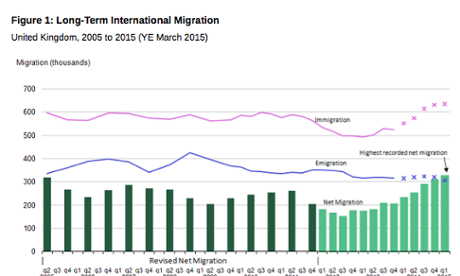
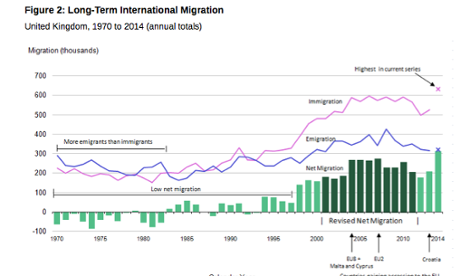
Here are the five charts that explain the developments in immigration. They are all from the ONS bulletin (pdf).
- This chart shows immigration and emigration figures for the last 10 years, and how net migration (the gap between them) has been growing.
2. This chart shows the same figures, but going back to the 1970s.
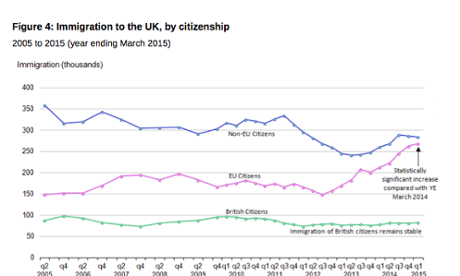
3. This shows how immigration from within the EU is almost overtaking immigration from outside the EU.
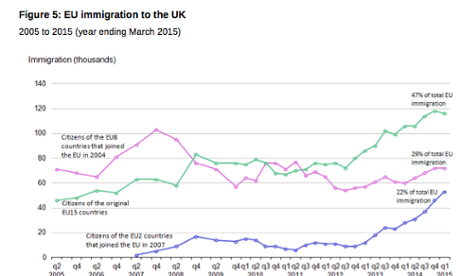
4. This chart shows how, within immigration from the EU, the numbers coming from longstanding members of the EU (the EU15) now outnumber those coming from the EU8 (the eight accession countries that joined in 2004).
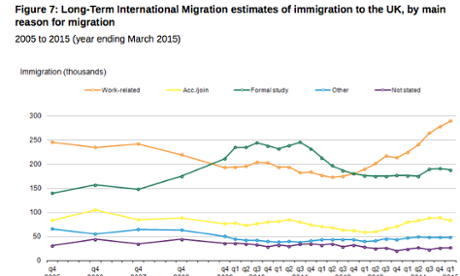
5. And this chart shows the reason from people coming to the UK, and how work-related immigration (now the main type of immigration) has taken off particularly since 2012.
Keith Vaz, the Labour chair of the Commons home affairs committee, is calling for a “radically different approach” to immigration. In a statement he said:
These record breaking figures are shocking. Only one month ago Theresa May told the home affairs committee that net migration of under 100,000 was her target.
This is clearly not going to happen. Broken promises on migration do not build confidence with the public. We need a radically different approach.
And this is from Frank Field, the Labour MP, chair of the Commons work and pensions committee and co-chair of the cross-party group on balanced migration.
These highest ever net migration figures highlight how fundamental it is that the prime minister must secure physical control of our borders as a key red and blue line in his renegotiation exercise with Europe. The failure of all the political parties in not making this a key demand will mean that they will never ever be able to tell the British electorate that they can bring immigration under control, and deliver.
Here’s Nigel Farage, the Ukip leader, on the immigration figures.
These figures reflect Borderless Britain and total impotence of the British government.
If open borders are not part of the Cameron renegotiation then what’s the point of it?
Given 192,000 from Romania and Bulgaria registered for national insurance in the year period, how can we believe the ONS figure of 53,000 from the same two countries in the same year?
The Department for Work and Pensions is not making life easy for us today.
They have published two sets of documents about death rates for claimants.
I flagged up one 10-page document earlier, mortality statistics for people on disability benefits (pdf).
But that’s not the one they want us to read, because I’ve just had a call saying I should be focusing on the other document, a four-page document covering mortality rates for out-of-work claimants going back 10 years (pdf). That’s what they want us to focus on.
I’ll explain why when I’ve had a chance to read them.
And this is from Ryan Shorthouse, director of Bright Blue, a thinktank promoting liberal Conservatism, on the immigration figures.
The Conservative government needs to develop a strong record of competence on managing our immigration system. That means new, deliverable targets - such as on non-EU gross migration rather than overall net migration - which the public can hold the government to account on, for example through an annual migration day in parliament. On this day, the migration advisory committee should also publish clear information on the economic and social implications of recent migration.
If a target is not met, and more migrants are here than expected, then the government should have to increase the amount of money in the controlling immigration fund, so local areas are given the necessary resources to cope with higher levels of migration.
This is from Sunder Katwala, director of British Future, an immigration thinktank.
Having promised a 15-year low for net migration, David Cameron’s instead delivered an all-time high. He’s got to be disappointed with that.
The problem with broken promises is that they destroy public trust. Voters realise that controlling immigration isn’t easy – but they do at least expect the prime minister to have a plan to meet the target he’s set.
Unlike the long-term plan for economic recovery on which he was re-elected, his big problem on immigration is that the prime minister has never had a credible plan to meet this target.
These figures have got to be a wake-up call that a new approach is needed. With the Lib Dems out of government, the PM has run out of excuses. Either he sets out a long-term plan to meet the net migration target - or he should set a different target that the government can actually meet.
The Department for Work and Pensions has published those mortality figures relating to claimants. Here is the 10-page document (pdf). I will post more on it when I and others have been through it.
Immigration minister James Brokenshire describes rise in immigration as 'deeply disappointing'
The Press Association has just snapped this.
Immigration minister James Brokenshire said new figures showing net migration to Britain is at a record level are “deeply disappointing”.
Here are more key points from the ONS news release.
- Latest employment statistics show estimated employment of EU nationals (excluding British) living in the UK was 250,000 higher in April to June 2015 compared with the same quarter last year and non-EU nationals in employment increased by 7,000. Over the same period, British nationals in employment also increased (by 84,000), therefore three-quarters of the growth in employment over the last year was accounted for by foreign nationals. (These growth figures represent the net change in the number of people in employment, not the proportion of new jobs that have been filled by non-UK workers.)
- In YE June 2015, work-related visas granted (main applicants) rose by 8,862 (or 8%) to 121,964, including a 5,177 (11%) increase for skilled work (Tier 2) visas.
- Long-term immigration for study increased from 176,000 to 188,000 in YE March 2015 (not statistically significant). Over the same period, visa applications to study at a UK university (main applicants) rose to 166,481.
- There were 25,771 asylum applications (main applicants) in YE June 2015, an increase of 10% compared with the previous 12 months (23,515). The number of applications remains low relative to the peak number of applications in 2002 (84,132).
- The largest number of applications for asylum came from nationals of Eritrea (3,568), followed by Pakistan (2,302) and Syria (2,204). A total of 11,600 people were granted asylum or an alternative form of protection.
Here are the key points from the Office for National Statistics news release.
Main points for year ending March 2015:
Net long-term international migration = +330,000 (up 94,000 from YE [year end] March 2014)
Immigration = 636,000 (up 84,000)
Emigration = 307,000 (down 9,000)
• The net migration figure was a statistically significant increase from 236,000 in YE March 2014 and is the highest net migration on record.
• Net migration of EU citizens showed a statistically significant increase to 183,000 (up 53,000 from YE March 2014). The increase in non-EU net migration to 196,000 (up 39,000) was also statistically significant and is a result of an increase in immigration (not statistically significant) and a decrease in emigration (statistically significant).
• The increase in long-term international immigration included a statistically significant increase for EU citizens to 269,000 (up 56,000), the highest recorded level for this group; and an increase for non-EU nationals to 284,000 (up 23,000) (not statistically significant).
• 53,000 Romanian and Bulgarian (EU2) citizens immigrated to the UK in YE March 2015, a statistically significant increase and almost double the 28,000 in the previous 12 months.
• 290,000 people immigrated for work in YE March 2015, a statistically significant increase of 65,000 from 225,000 in YE March 2014 continuing the upward trend.
• There were statistically significant increases of immigration for work for both EU citizens (from 134,000 to 162,000 in YE March 2015) and non-EU citizens (from 48,000 to 64,000). The increase for British citizens was not statistically significant. Of the 53,000 EU2 citizens immigrating to the UK, 42,000 were coming for work, a statistically significant increase of 20,000.
• 61% of EU citizens immigrating for work had a definite job to go to, whereas 39% were intending to look for a job rather than taking up an offer of employment.
Updated
Annual net migration hits record high at 330,000
The figures are out.
Annual net migration to Britain hits record 330,000 - 10,000 higher than previous 2005 peak of 320,000 - ONS
— Alan Travis (@alantravis40) August 27, 2015
Updated
It’s “take out the trash day” at Westminster. After a summer that has seen the government’s communications machine largely comatose (understandably - why would they want to make news when Labour is imploding), today we’re getting three potentially “bad news” stories from the government all at once: immigration figures, DWP figures about claimants who have died after losing their benefit, and the dissolution honours list. Ministers have been accused of “burying bad news”.
Just for good measure, we’ve also got two Labour leadership hustings.
My colleague Alan Travis has written a preview story about the immigration figures. Here’s how it starts.
New official figures are expected to show that net migration to Britain has reached record or near record levels.
The politically sensitive figure, which estimates the net flow of people in and out of Britain, stood at 318,000 in the last set of quarterly figures published in May just after the general election.
This was just 2,000 below the 320,000 record high in net migration recorded in 2005, soon after Poland and other east European states joined the EU. The net migration figure is politically significant since David Cameron renewed the Conservatives pledge to reduce it to the “tens of thousands” immediately after the general election.
The latest quarterly migration figures, covering the 12 months to March 2015, published on Thursday are expected to show that the number of foreign-born people living in Britain has passed the eight million mark for the first time and that more than three million of them have become British citizens since arriving in the UK.
I will be covering the figures, and the other announcements, in detial. Here is the agenda for the day.
9.30am: Immigration figures are released.
9.30am: The Department for Work and Pensions publishes figures showing the number of claimants who have died after losing their benefits.
Late morning: The dissolution honours list is expected to be published.
1.30pm: The Daily Mirror holds a Labour leadership hustings.
5.15pm: Nicola Sturgeon, Scotland’s first minister, speaks at the Edinburgh International Television Festival. She is doing a Q&A with the Guardian’s editor-in-chief, Katharine Viner.
7pm: The Guardian hosts a Labour leadership hustings. I will be covering that in detail on a separate live blog.
If you want to follow me on Twitter, or contact me there, I’m on @AndrewSparrow.
Updated