The Design Council, Guy’s and St Thomas’ Charity and the London Boroughs of Southwark and Lambeth have teamed up to bring more experimentation and evaluation into the design of services and spaces. We have been working closely with families and health professionals and recently launched a new Design Challenge.
When used well, design can play a key role in improving the lives of young children and their families. Whatever age we are outdoor play is essential to healthy human lives, social connectivity, problem solving, and physical development.
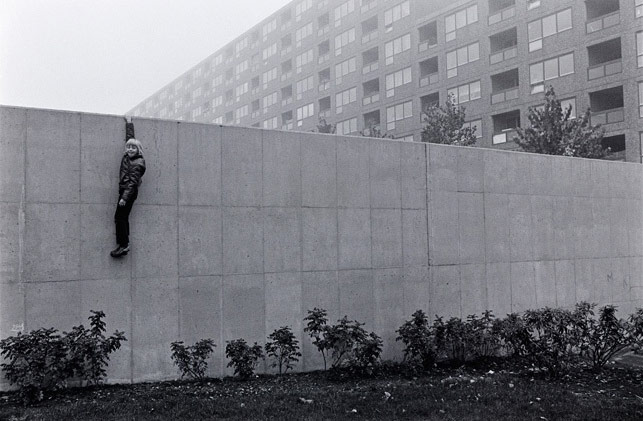
Photograph: Jens S Jensen, Boy on the Wall, Hammarkullen, Gothenburg. 1973.
Playing outside the home does not have to mean removing technology. Technology is an important tool in children’s development, but often in families it is used to keep children sedentary. How might new technology be used to actively bring children and families together away from the confines of their own home?
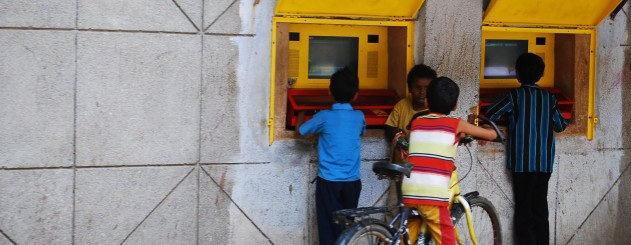
Hole-in-the-wall was established in 1999 by Suguta Mitram, a scientist and education researcher living in India. The scheme provides computers to children in urban slums and rural locations across India, Bhutan, Cambodia and parts of Africa. It started when Suguta knocked a hole in the wall that separated his office from a slum in New Delhi and inserted a desktop PC with high-speed internet. Children with little or no experience using computers formed self-organised groups and rapidly acquired computer skills and internet basics, as well as simple English.
Photograph: Education Limited 2013
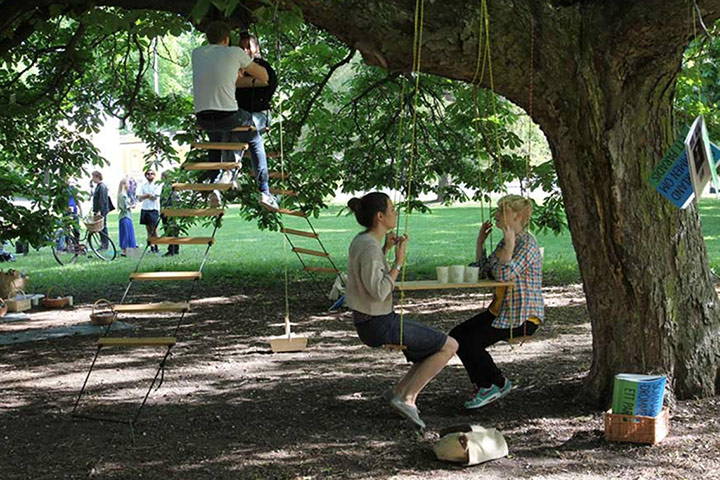
Urban parks have seen unprecedented investment over the years. They have been made safer, cleaner, more accessible, more adventurous. However many of the families we worked with during our recent research in Southwark and Lambeth did not go to parks. Not because they weren’t nearby, but because they didn’t feel relevant to their day-to-day lives. How might designers be more involved in orchestrating the short and long-term uses of public green space?
Having a cup of tea and meeting a friend is a poetic experience in the mobile café designed for trees in Stockholm. The seating and ladders are made from different wood with different characters: fir, oak, beech and lark. Constructed by Byggstudio in collaboration with Oscar Andersson. The tree-inspired café menu designed with Josefin Vargö. Photograph: Byggstudio & Petter Odevall
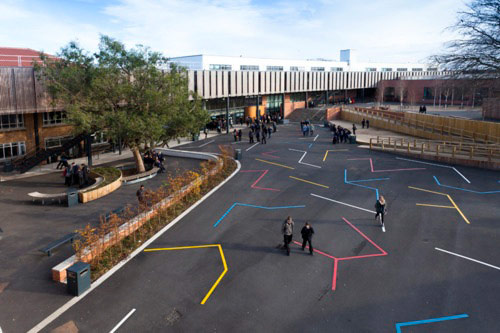
Sometimes, people need the simplest indication to nudge them towards making new choices or moving in a new direction. Design and innovation does not need to be about large-scale radical change, it can be about making moments of influence that affect people’s choices and behaviours. What would happen if public space contained more simple invitations to keep children and families active and playful as they move through their day?
The playground at Cotham School in Bristol is a great example of how collaborations between artist, designers, and young people can result in spaces that replace formal barriers with playful ones. The playground design invites children and young people to create their own routes and create their own games. Photograph: Jamie Woodley
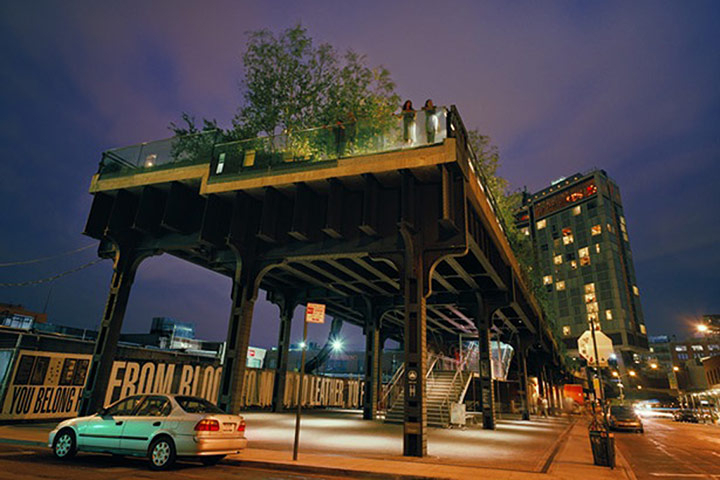
People living in a city can often find themselves limited by the routine created around them by their working hours, childcare, or the school day. For many families, using the city as a playground is a difficult transition to make. We met families living in South London who had never seen the River Thames. How might design take moments of peoples urban routine and offer up totally new perspectives, new obstacles, and new adventures?
The High Line in New York is often cited as an excellent example of bringing green planning to confined urban spaces. It is also an excellent example of giving people a new platform from which to see and understand the city. Creating spaces to reflect, meet, wonder, think, and notice, is a hugely important in urban planning. Photograph: Diane Cook and Len Jenshel
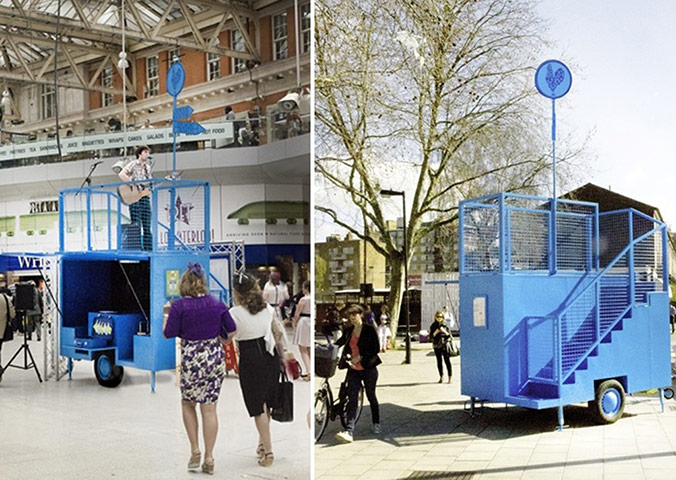
The very nature of public space is that is stays still, and you go towards it. It relies on your movement towards it, into it, and around it. Rarely will it come to you. For many families daily life happens within the square mile around their home. How might we design more optimistic shared experiences that can move towards and between people wherever they are?
As part of the renovation of Lower Marsh Market, London’s oldest market, Aberrant Architecture has just designed a blue multi-purposed mobile stall, reusing the structure of a trailer chassis. It is a local information point, with a covered seating area and a tiny stage for events. Photograph: http://aberrantarchitecture.com
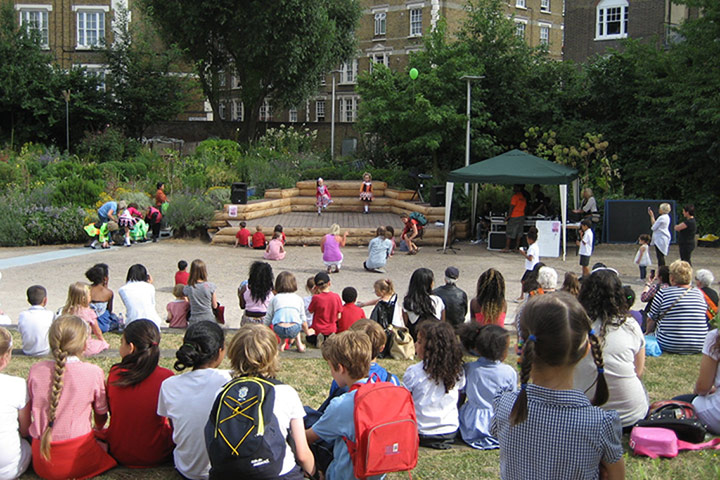
Some 91% of people believe that open spaces improve their quality of life. However, one in five think it is ‘not worth investing money in the up-keep and maintenance of local parks and public open spaces because they will just get vandalised’.
The opening of Tate Modern in 1998–99 triggered improvements. Local people formed Bankside Open Spaces Trust (BOST) and worked on a proposal to restore the park, fearing it would be built on. A steering group led the process of regeneration including local residents and businesspeople, core BOST staff, representatives from the London Borough of Southwark’s parks and youth services, the St Mungo’s hostel for homeless men and landscape architects. Photograph: http://www.bost.org.uk
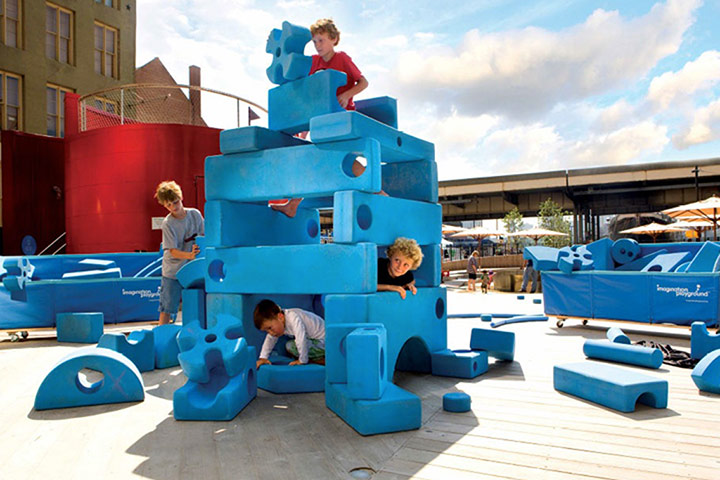
After world war two there was a re-ownership of urban spaces by children who used a bruised city as their new adventure playground. This formed the start of the design of spaces that deliberately nurtured social, physical and psychological recuperation for children. How do we again, invite children to shape, govern, invent and imagine the cities of their future?
The Imagination Playground is a mobile playground using blue form shapes to invite children to construct, deconstruct and reconstruct the playground they desire. Photograph: http://isbrooklyn.org/
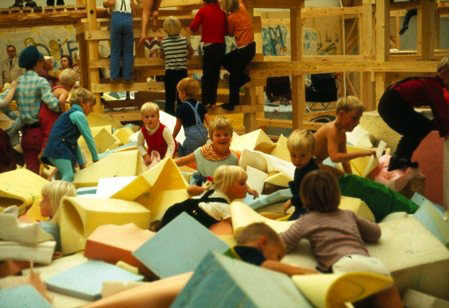
Managing risk is often cited as the main barrier in the design of high quality spaces for children to play. So how can exploration, experimentation, and possibility be designed around the limitations of risk?
After building guerilla adventure playgrounds for kids on abandoned lots around Copenhagen as a form of social activism, the Danish artist Palle Nielsen convinced the Moderna Museet in Stockholm to let him turn the gallery into a playground, too. In 1968, Nielsen's Model for a qualitative society opened with climbing scaffolding made of wood, surrounding a giant foam mountain. There were water, dirt, and craft areas, and a collection of dress-up costumes borrowed from a local theatre. The sound of the construction site was broadcast outside the museum and into the cafe, where parents were made to wait. Photograph: Palle Nielsen
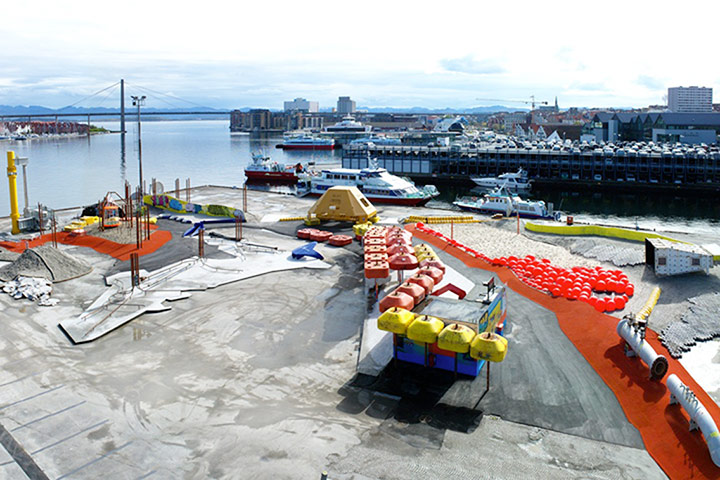
More and more people are seeing the possibilities in disused spaces, and negotiating planning regulations to create temporary public experiences, and consequently revitalising the city as we know it. What would happen if more disused spaces were shared with and shaped by the community around them?
Using disused materials from the Norwegian off-shore oil industry, and a vacant courtyard, this playful urban space was created to bring new groups of people together. This park is used by kids, parents and youths at all hours, turning the formerly abandoned site into a humming social meeting point. The park was originally planned for a temporary period of one year, but there is an ongoing discussion to make the park permanent. Photograph: Helen & Hard
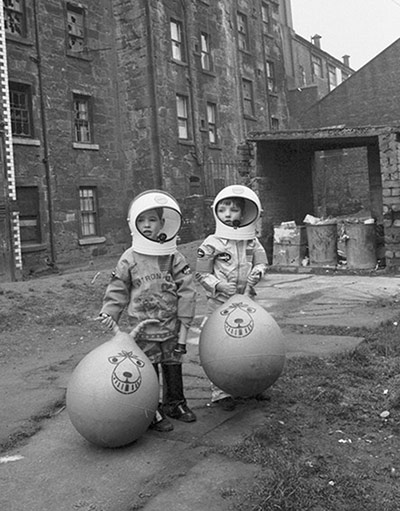
We met families from all walks of life who were turning their everyday experiences and routines into opportunities to play and learn. Whether it be putting eyes on a spoon, making landscapes out of mashed potato, or creating villages from cardboard boxes. In times of economic constraint, creativity grows from necessity. How might public spaces be shaped by the humility of children’s imagination?
This photograph, taken in Glasgow in 1970, captures “the power of design to insulate children from the often adverse circumstances in which they find themselves—to literally beam them up into an imaginative universe of their own making” - Juliet Kinchin, curator in MoMA’s Department of Architecture and Design.
Photograph: Glasgow Space Hopper, Cover of the Century of the Child: Growing by Design, 1900–2000 publication