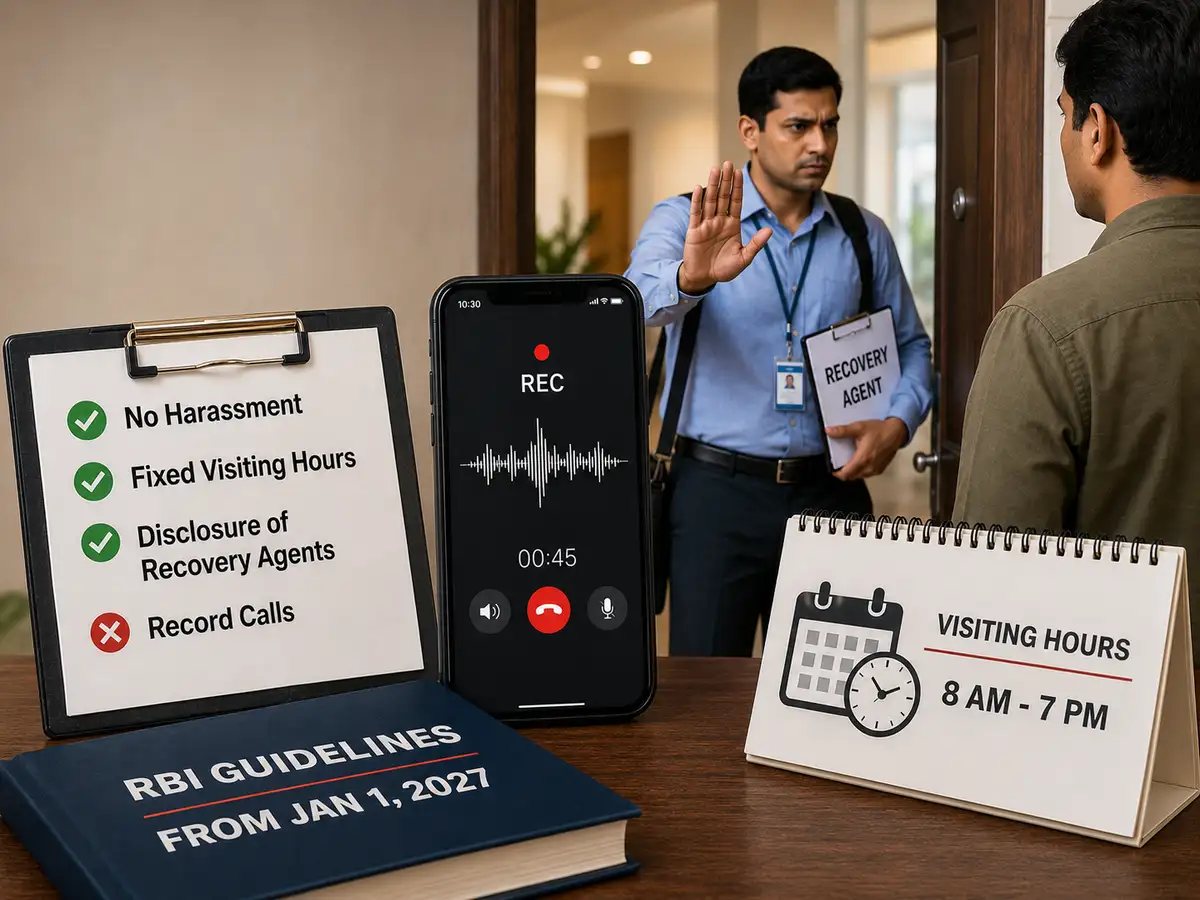
If you've ever worried about aggressive loan recovery calls or surprise visits by recovery agents, the Reserve Bank of India (RBI) has introduced a new set of rules aimed at making the recovery process more transparent and fair. Effective January 1, 2027, the central bank has issued a comprehensive framework that lays down how banks must engage recovery agencies, communicate with borrowers and conduct recovery proceedings. The directions replace the earlier recovery-related provisions under the Responsible Business Conduct Directions, 2025. Here are some of the key points of the RBI’s new directions about loan recovery.
RBI issues comprehensive code for recovery agents
The RBI has directed banks to put in place a code of conduct for both their own employees involved in recovery and external recovery agents. Where a recovery agency has been engaged, banks must obtain an undertaking from the agency confirming that its recovery agents will comply with the code of conduct prescribed by the bank.
The RBI says recovery agents should be trained and undergo the prescribed Indian Institute of Banking and Finance (IIBF) Debt Recovery Agent training.
Banks must reveal agent’s identity
The RBI says in its directions that banks should inform a borrower about the recovery agent/agency. It should notify if the agency changes and should also inform the borrower if the contract of the agency is terminated.
RBI mandates fair treatment of borrowers
The directions require banks to ensure that borrower information shared with recovery agencies is limited only to what is necessary for recovery-related work. Banks must also have safeguards, including penal provisions, to prevent the misuse of customer information.
Mr. Ananth Shroff, Co- founder & CEO, DPDzero explains, “The RBI’s new framework for loan recovery is not an incremental update - it is a structural reset. For the first time, the regulator has drawn a clear and enforceable line between recovery and harassment. Compliance can no longer remain a set of guidelines in a manual; it must be built into everyday collection operations. This means using DRA-certified agents, contacting borrowers only during permitted hours, recording every call, issuing prior notice before field visits, protecting personal data and maintaining clear audit trails.
Shroff says, "The real challenge is ensuring that these safeguards are followed consistently across millions of borrower interactions. This is where technology-led, empathy-first collection models become critical. AI can enforce calling windows and frequency limits, flag inappropriate language, maintain records and help certified agents follow the right processes, while human agents bring judgement and empathy to sensitive conversations.
For lenders, such platforms are no longer merely an efficiency tool, but are becoming essential compliance infrastructure for recovering dues responsibly and at scale."
Recovery calls must be recorded
As per the RBI directions, banks need to record recovery calls and must maintain the record for at least six months. While banks should ensure that customer information is not misused, they must also inform customers that their call is being recorded.
RBI regulates mobile phone locking for loan recovery
Banks that finance smartphones or other devices are allowed to restrict certain device functions only for loans that have been taken to buy those devices. However, the RBI has put strict restrictions for that such as, loan should be 30 days overdue before such restrictions start, and full restrictions can start only after 60 days loan overdue.
However, in that case also, banks can stop essential functions such as incoming calls, SMS, SOS, work-related functionality, etc.
Banks are also not allowed to access contacts, SMS, photos, call logs, or location data of the borrower.
Once the loan is paid, the RBI directions say, the device must be unlocked within one hour of payment.
In cases of wrongful restrictions or delay in reversal of restrictions applied on the functionalities of a mobile device after realisation of dues from the borrower, where the reason for the delay is attributable to the bank, the lender shall compensate the borrower at the rate of Rs 250 per hour till the wrongful action is remedied. However, the total compensation payable by the bank to the borrower shall be capped at the amount of loan disbursed.
Rules for taking possession of security
The RBI’s directions say where banks rely on a possession clause in the loan agreement, they must ensure that it is legally valid and clearly explained to the borrower at the time of signing the agreement.
Professional behaviour required from recovery agents
The RBI says recovery agents must carry their identity cards (ID cards) and follow strict conduct rules such as displaying their identity card, carrying an authorisation letter issued by the bank or recovery agency. They should also carry a copy of the notice issued by the bank. Banks should also provide the contact details of the recovery agency and the bank's grievance redressal officer.
Agents can visit a borrower only between 8 am and 7 pm, unless the borrower requests otherwise.
Behavioral rules for loan recovery agents
The RBI also set behavioral rules such as recovery agents should discuss recovery matters only with the borrower or guarantor. They must interact politely and maintain decency. Only authorised representatives can visit borrowers.
Recovery calls or visits can normally be made only between 8 am and 7 pm, unless the borrower specifically requests otherwise.
RBI prohibits harassment during loan recovery
The RBI has explicitly prohibited recovery agents and bank employees from using harsh recovery methods. Such as using abusive or threatening language; posting borrowers' personal details, videos or audio recordings on social media; sending inappropriate messages; making excessive calls or contacting borrowers outside permitted hours; harassing borrowers, their relatives, friends or colleagues; threatening with violence or damaging the borrower's reputation, etc.