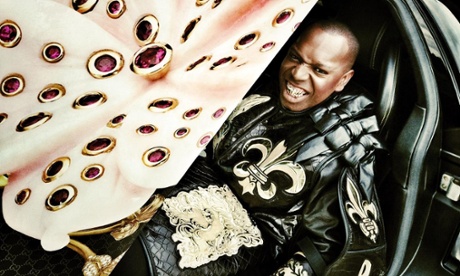
Thanks to performers such as FKA twigs, vogueing is back in, er, vogue – but the artist Rashaad Newsome has paid his dues in this still-clandestine world, with its arcane rules and rivalry, all centred on a pose-based dance created by black, gay New Yorkers in the 80s. Not only has Newsome incorporated vogueing into his artworks – which include film, opulent collages and performance – but he’s godfather of his own vogueing collective, the House of LaDurée in Paris.
On Tuesday night in Miami the artist presided over a thrilling vogue performance in the courtyard of Miami Design School while a brass brand blasted out Prince’s I Would Die 4 U. One performer, Kevin Jz Prodigy, at one point hurled himself off the stage on to his back – then, of course, sprang back as flawless as Beyoncé - if perhaps a bit sweatier.
The vogue performance was the conclusion of a pageant created by Newsome and commissioned by uber-gallerists Jeffrey Deitch and Larry Gagosian for their show Unrealism, opening to coincide with Art Basel Miami Beach. Titled the King of Arms procession, it wound through Miami’s design district – a swanky street of high-end fashion boutiques. A local biker gang went first, then the voguers heralded with two placards, one saying “Black Lives Matter”, then some drivers in vintage muscle cars, their front wheels higher than the back (a nod, says Newsome, to “southern car culture”), a battery of strutting majorettes, and finally a Lamborghini, with Newsome’s art emblazoned on the bodywork.
A collision of subcultures, it was a proud and subversive pageant of an alternative black America, partly inspired by the jazz funerals and Super Sunday parades of New Orleans, Newsome’s home town (he’s now based in New York). The marching band came from Florida Memorial University, a historically black college in Miami, while the bikers were from the Miami Bike Life Crew, who usually perform illegal stunts on dirt bikes and quad bikes. Newsome is currently working on a film about black motorcycle gangs; the Miami bikers’ involvement in the procession, says Newsome, came about as he was pondering American archetypes: “There’s very few images of brown people. I was thinking about the biker, Easy Rider … It’s such an American thing to be on a bike and riding, and these guys to me represented this Americana to me.”
With its mix of pomp and circumstance, community outreach work and protest, Newsome’s parade combined elements of the expression of a culture still rarely found within gallery walls, and felt more vital than the figurative painting and sculpture in Deitch and Gagosian’s show being eyed by the swanky art crowd. Speaking on the afternoon of the parade in his downtown Miami hotel, Newsome says that when he was commissioned to make a work for Unrealism: “I started to think about representational art or lack of representation, and that was why I chose the groups and brought them all together. It’s like a punctuation to the concept of the show, because I feel like representations that aren’t celebrated can sometimes find a place to be celebrated in a public space.”
Much of his work, he says, is about claiming a space to express yourself when the dominant culture doesn’t include you. “I think it’s so punk rock to take over the streets. In the work you can create your fantasy world, this kind of queer utopia. In making the work I bring a lot of rogue communities together.”
Newsome’s work delights in both macho hip-hop and gay, black American culture – not a contradiction, he says, but simply an expression of his own passions and experience: “The generation that I’m a part of, I don’t know what it’s like not to have hip-hop culture.” One one hand, his performance and film Shade Compositions is a camp chorus of teeth-kissing, finger-snapping and shouts of “what, girl?” that builds into a sonic collage. On the other, he got A$AP Mob to play a party celebrating his collaboration with W magazine. “Those guys are rappers, so there’s a persona,” he says. “Rappers are entertainers at the end of the day, but I know them personally and they have no problem with gay people at all.”
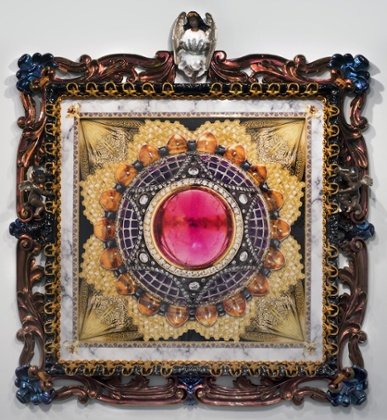
Some of his work, he says, deals with navigating hip-hop as a gay person. “It’s like me creating my own space [within rap culture] on my own terms. I’m not saying ‘I’m not going to incorporate hip-hop because it’s misogynist’ – if I really felt like that, there would be very few things that I would incorporate.”
In the same way, Newsome’s parade, the second he has staged (the first was in New Orleans), collides gay and straight African-American subcultures. After some initial wariness, he says, everyone got on, thanks to a mutual respect of one another’s talents. At the rehearsal at Florida Memorial University the night before the parade, Newsome brought together the drummers, who were straight college kids, and the very flamboyant gay dancers. “It was subtle, the drummers were looking to each other like ‘is this OK?’ But when the dancers performed, they just shut it down,” he said.
“It’s about bringing rogue elements together, but what works is when all of them are really strong and then people can get past all the bullshit and deal with human beings as human beings and make art.”