By Durgashri Sardeshpande
OLD GOA: In recent years, there has been an rise in instances of freshwater turtles being kept as pets. But, the lack of awareness about their lifestyle has made such captive turtles’ lives miserable, who are prone to bacterial and fungi infections, bone deformity and prolapses.
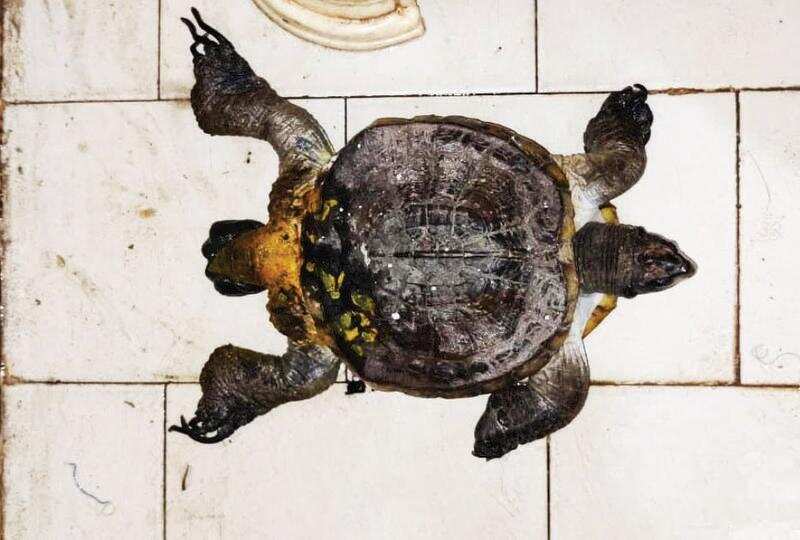
Recently, a two-and-a-half year old Indian black pond turtle with prolapse and metabolic bone disease was rescued from Kurti, Ponda. It was referred to Dr Charmaine Pinto’s clinic, where it underwent a rare penial amputation surgery.
In turtles, any prolapsed tissue represents a potentially life-threatening problem.
“The owner noted that the pet was not eating so he called us. The pet was in a bad condition. It was smelling badly. There was a bone deformity seen in the shell, with some of its organs oozing out of his shells. Earlier, we have rescued three turtle pets that had metabolic bone disease (MBD). But, I have witnessed a prolapse case for the first time,” said Gayatri who has initiated the ‘Homeward Turtles’ project last year to create awareness among people about freshwater turtles.
The pet was kept for years without proper diet, said Dr Pinto. “Normally, when they are in the wild, the turtles get a variety of food. This one was only dependent on the ‘green turtle pellets’ which is not meant for the Indian species. Due to unbalanced diet, his nails are overgrown and shell is deformed turning upwards,” said Dr Pinto.
She said captive pets try to mate, but they are unable to do so, and thus the entire muscle prolapses outside and rots. “Then there is no option but to amputate it, which means remove the entire necrotic muscle tissue. He will not be able to breed in future. But it is a life-saving procedure or else he would have died due to sepsis,” Dr Pinto said.
Dr Pinto, who earlier worked in Mumbai, had handled eight cases of prolapse in turtles in a year.
Gayatri, who has rescued 21 freshwater turtles from May 2020 to July 2021 with the help of other volunteers, said, “This doesn’t occur in the wild, but are seen in captive turtles. When in captivity, freshwater turtles don’t get place for basking. They defecate in the water and if the water is not changed regularly then it leads to infection.”