MANATEE, Fla. _ A rare disease that robs children of their mobility called ataxia-telangiectasia does not have the type of fundraising clout that other child diseases, like cancer, have been able to muster.
So it is mostly the parents of the children themselves who have to fund research for the disease the parents call A-T, thought to occur in one in every 40,000 to 100,000 people worldwide but often misdiagnosed, according to Jennifer Thornton, executive director of the A-T Children's Project (ATCP).
Currently, it is estimated that only 500 to 600 children are diagnosed in the U.S. and often they are siblings, Thornton said.
Two of those parents raising money for A-T are Manatee County residents Nicholas and Samantha Dzembo, whose 10-year-old son Connor, who loves playing video games and riding on the scariest roller coasters he can find, was diagnosed with A-T at age 3.
Ataxia refers to poor coordination and telangiectasia to small, dilated blood vessels, both appearing in those afflicted, the Dzembos said.
Since the number of children impacted is so small, the parents of A-T children across the United States almost all know each other, sharing information and providing support.
The ATCP was started in 1993 by Brad and Vicki Margus, a husband and wife in Boca Raton who have four children, two with A-T.
The ATCP reaches out to newly diagnosed families when they get word, including the Dzembos, Thornton said.
"We would not be where we are today with regard to understanding A-T without the Margus family and the ATCP," Samantha Dzembo said.
In 2009, about four months after their son was diagnosed, the Dzembos started a foundation called Wobbly Feet to raise money for research and to help other families with financial grants for uncovered critical treatment, therapy and equipment they need for their child.
At wobblyfeet.org, the public can learn more or donate. To date, the Wobbly Feet 501 C3 has raised more than $400,000.
WHAT IS A-T AND ITS CAUSE?
A-T is a progressive neurological disease caused by a mutation in the ATM gene.
Since this gene has mutated or is defective, the ATM protein is missing in the cells of people who have A-T, the Dzembos said.
The loss of this ATM protein results in symptoms mirroring various other diseases like Amyotropic Lateral Sclerosis or Lou Gehrig's Disease immune deficiency and Parkinson's, and it leaves those diagnosed 1,000 percent more at risk than their peers for blood cancers, said Samantha Dzembo, who has immersed herself in the study of the disease's cause and treatment.
Children who lack this important protein wobble or sway when they walk and have coordination problems with their arms and hands and involuntary twitching, often leading to the full-time use of a walker or wheelchair by age 10.
Reading is a problem because they have to constantly control their wandering eyes. They can develop respiratory infections and can have a severely weakened immune system, both leaving them susceptible to a threat even from the common cold, Samantha Dzembo said.
Ten to 15 years ago, the life expectancy of A-T children was living into their 20s. But presently, the average life expectancy continues to improve, the Dzembos said.
Parents of A-T children have learned how to better guard their children against chronic lung disease, which claims lives in about one-third of the cases, and now have better treatments against pneumonia blood cancers like leukemia, which also claims about a third of A-T cases.
The chilling fact about A-T is that in order for a child to get it, each parent must be a carrier of the gene, meaning they have one normal copy of the A-T gene and one copy that is mutated.
The odds against that are staggering, since only approximately one percent of the U.S. population is thought to have a genetic mutation for the ATM gene, the Dzembos said.
"We found out that both Nicholas and I are carriers after sequencing Connor's DNA and confirming our own mutations after his diagnosis," Samantha Dzembo added. "We learned we had a one-in-four chance that our child would have A-T."
Since being a carrier of A-T is rare, most people do not know if they have the mutated gene unless a relative finds out they have the gene, the Dzembos said.
A STRONG-LOOKING LAD
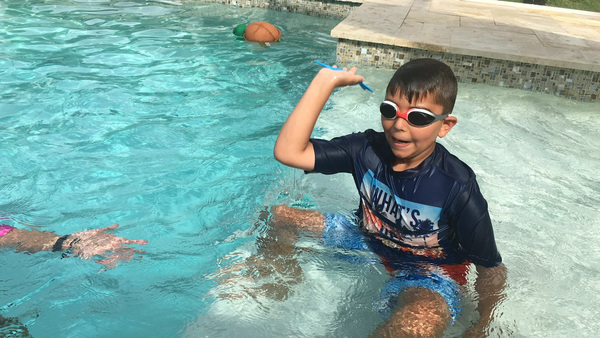
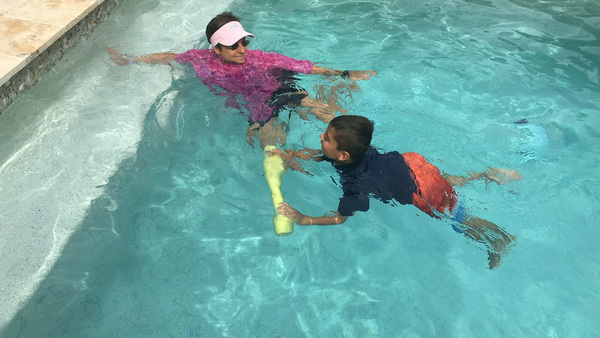
To see Connor in a swimming pool, working with Maria Barringhaus, owner of School of Fish, which provides swimming lessons for all ages, one could be hard pressed to know that he has a serious disease.
"He is so strong and his coordination has improved so much since I started working with him," Barringhaus said from the swimming pool at the Dzembo family home in Mote Ranch.
But getting around out of the water presents a challenge for Connor, whose bedroom features Spider-Man, baseball bats and an Xbox.
"I've ridden Cheetah Hunt at Busch Gardens a lot and I love it," said Connor, who must concentrate hard to get his speech to work the way he wants it to as he has to do with his hands, arms, legs, eyes and even swallowing.
Although his muscles are strong, Connor is progressively losing the brain signals guiding them, so he is a wobbly walker, hence the name of his parents' Wobbly Feet foundation.
At home, if he is rested, he wobbles where he needs to go. If he gets tired, steps become harder and he will use a walker or his power chair.
"He is unstoppable," Nicholas Dzembo said of his son. "He is determined."
"Kids with A-T struggle with everyday activities like walking, talking, reading and eating that other kids take for granted," Thornton said. "Kids like Connor can definitely be determined as they work hard to try to keep up with others."
Connor is the second child in the United States accepted in a drug trial for A-T going on right now at three locations in the country, his parents said.
"The biggest thing going on right now with A-T is this trial," Samantha Dzembo said. "The fact that we could have the first-ever formal treatment to slow the neural degeneration, which is the most debilitating part of the disease, is extremely exciting. This could keep him walking better, walking longer.
"He is going back for his third treatment in mid-June," Dzembo added of her son, who is receiving the trial treatments once a month, for a minimum of one year, at The University of Texas Health Science Center at Houston's McGovern Medical School. "He believes he is walking better and feeling stronger.
"I said to him, 'You are not using your power chair a lot or your walker in the house and you haven't been falling. What's going on?' He said, 'Mom, the trial is working! I feel it.' We don't know if he is getting a placebo or getting one of the two levels of the actual drug. The doctors in Houston don't know what he is getting. Only the company does. But even if he is on a placebo, the placebo affect is real because he fully believes it is working. He is walking straighter and not falling."
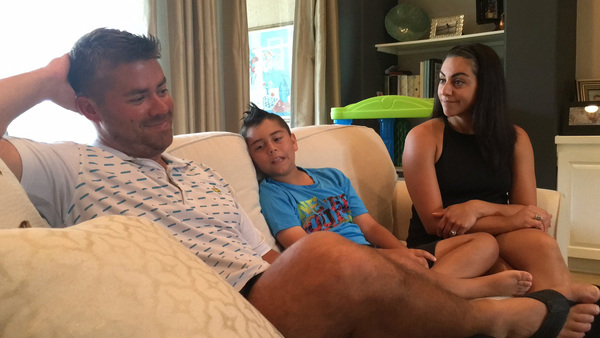
As he sat with his parents on the sofa Connor said, "I feel fine," and smiled broadly.
FOUNDATION FOR A CURE
The Dzembos realized that if money were to be raised locally to find a cure for this disease and to help other A-T families, it would have to be by their own initiative.
The Wobbly Feet Foundation hosts various events in the area, including a golf tournament at the Legacy course in Lakewood Ranch every November. The event raised nearly $30,000 last year, Samantha Dzembo said.
"Because of the efforts of families like the Dzembos, we are closer than ever to finding significant treatments for A-T," Thornton said.
The foundation also will be the beneficiary of Music on Main in Lakewood Ranch on Dec. 1.
"Unraveling how the A-T protein works has shed new light on cancer, metabolic syndrome and HIV/AIDS," Thornton said. "And understanding why brain cells get sick and die in A-T could provide insight as to why brain cells die in other neurodegenerative diseases such as Parkinson's and Alzheimer's disease."
"The thing is," Samantha Dzembo added, "although we may not be doing research to affect you directly because the disease our kids have is so rare, it still may affect a disease you are familiar with. The A-T protein basically controls everything the body does. One way or another, there is a connection to everyone through that A-T protein."