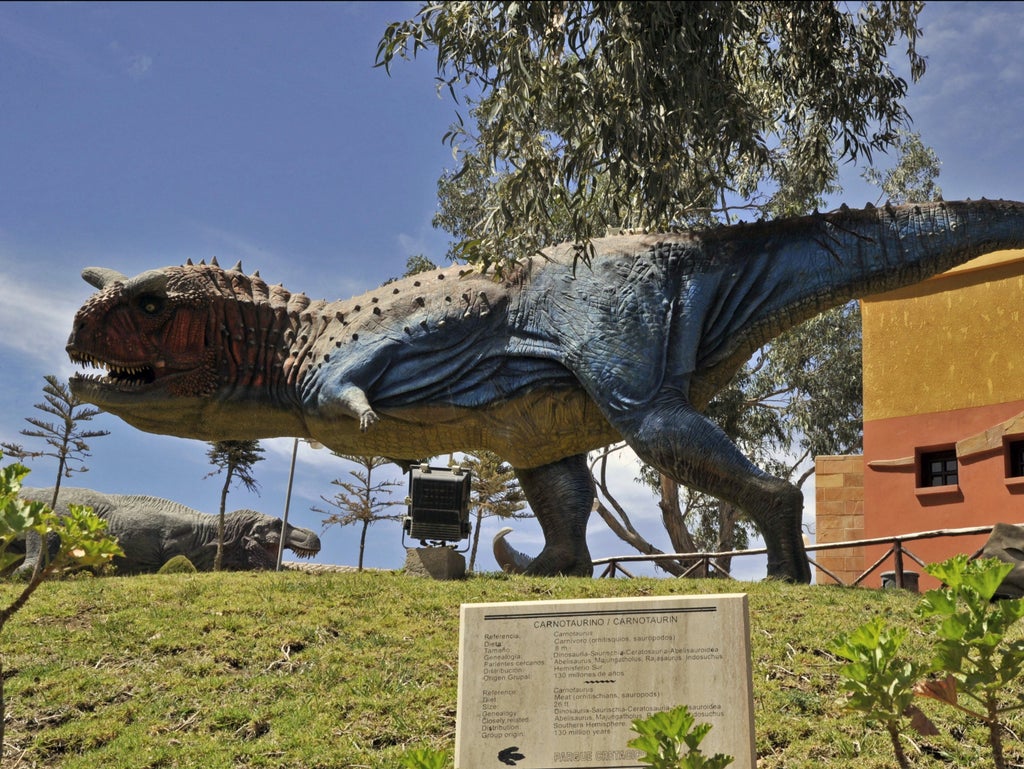
Scientists have analysed the well-preserved skin of one of the “strangest carnivorous dinosaurs ever discovered” in unprecedented detail and found that its complex coat was made up of different patterns of scales and studs.
Since the outer parts of prehistoric animals decompose easily and leave behind very little evidence in the form of fossils, the researchers said the specimen in question, discovered initially in 1984 in the Chubut Province of Patagonia in Argentina, was “remarkable”.
According to the researchers, the scaly skin of this carnivorous dinosaur Carnotaurus sastrei is the most completely preserved of any theropod — a group of hollow-boned, two-legged dinosaurs from which modern birds also evolved.
The study was conducted by researchers from the Unidad Ejecutora Lillo in Argentina and the University of New England in Australia and was published in the journal Cretaceous Research.
The scientists described in detail, for the first time, the features of skin preserved in the shoulder, thoracic, tail and, possibly, neck regions of the fossil skeleton.
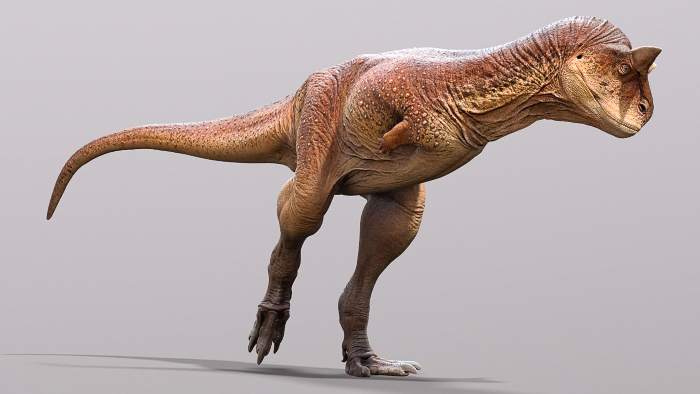
“By looking at the skin from the shoulders, belly and tail regions, we discovered that the skin of this dinosaur was more diverse than previously thought, consisting of large and randomly distributed conical studs surrounded by a network of small elongated, diamond-shaped or subcircular scales,” Christophe Hendrickx from the Unidad Ejecutora Lillo, said in a statement.
The large studs and small scales of Carnotaurus, the scientists said, were similar to those seen in the thorny devil lizard found in Outback Australia.
“Contrary to previous interpretations, the feature scales are randomly distributed and neither form discrete rows nor show progressive variations in their size along parts of the body,” the scientists wrote. “They also show little difference in morphology along the body, although their apices are variously positioned in different body parts.”
The findings, according to the researchers, help give a makeover to Carnotaurus, which translates as “carnivorous bull” in reference to its strange skull with large horns.
Considering the presumed active lifestyle of the horned dinosaur and the need to shed excess heat, the scientists speculate that the complex skin may have played a vital role in regulating body temperature — a role that the skin also plays in modern day mammals and reptiles.