I have to admit that last night’s game between the Dodgers and my Blue Jays was more exhausting than it was disappointing. You can only have one winner in these situations.
Kudos to Freddie Freeman for winning the game in the 18th inning. Sadly, I went to bed at the end of the 14th inning around 2.45 a.m. Atlantic time. There’s not a chance I’m up for a repeat performance from both teams. I doubt they are either. But I digress.
In yesterday’s Top 100 Stocks to Buy, InterGroup (INTG) caught my eye in the 68th spot. Although the small-cap hotel operator and real estate owner moved down 28 spots on the day, its weighted alpha of 191.58 was higher than its 12-month return of 172.79%. That suggests momentum is still the stock’s friend.
I know little about the Los Angeles-based company (how fitting!) other than that it is the successor to the Mutual Real Estate Investment Trust, a REIT that went public nearly 60 years ago.
The Barchart Technical Opinion says it’s a Strong Buy with a 100% likelihood to keep moving higher in the near-term.
While it’s got the momentum, there’s clearly a backstory that has prevented InterGroup from growing beyond its $83 million market cap.
I’ll consider the backstory and what it may or may not mean for INTG stock.
What Are Its Assets?
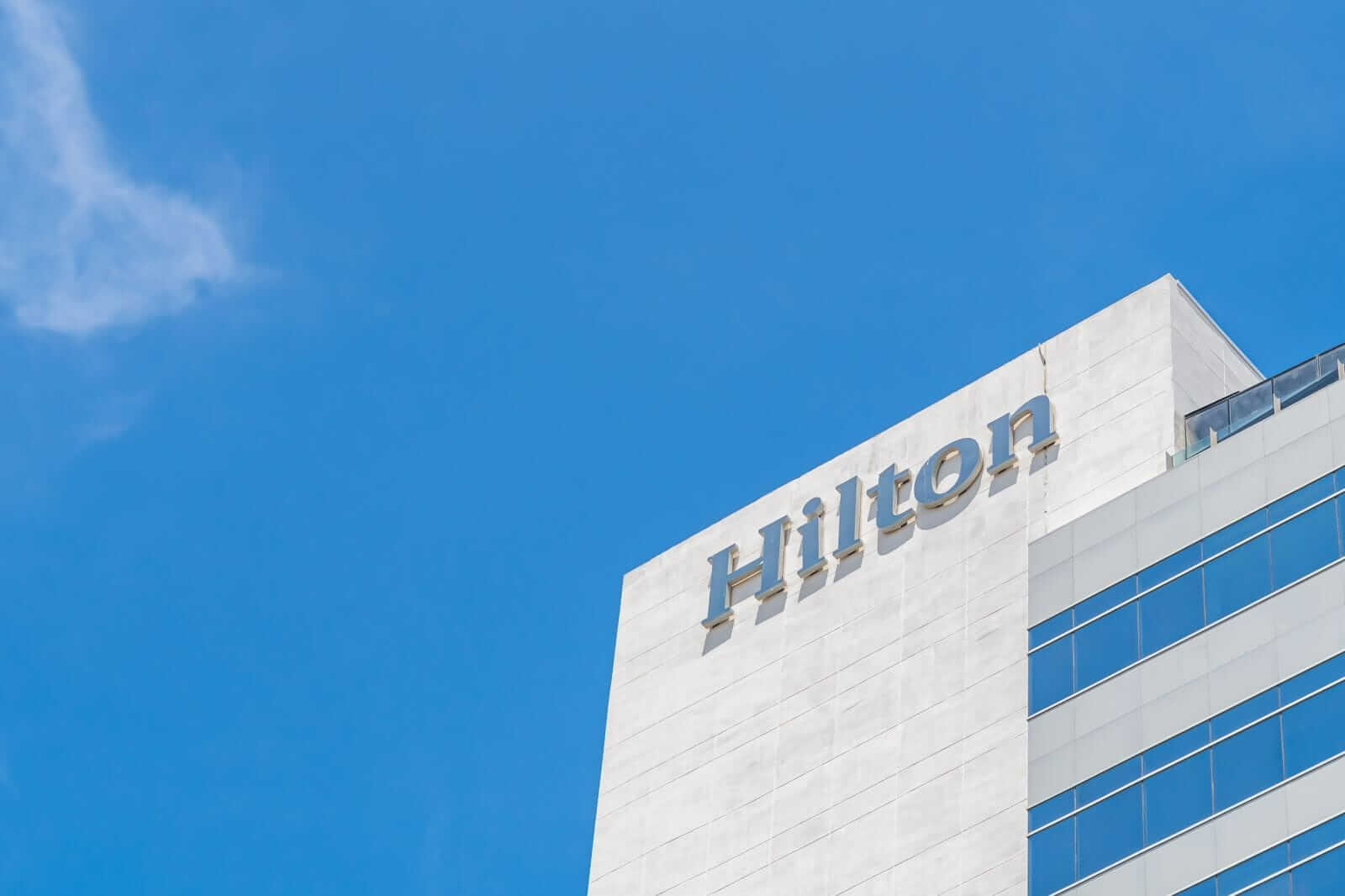
The 2024 10-K states that its assets include a 75.9% controlling interest in Portsmouth Square (PRSI), which, in turn, owns and operates the 558-room Hilton San Francisco Financial District hotel in San Francisco and a five-level underground parking garage. Portsmouth Square was incorporated in July 1967 to acquire the hotel.
For brevity, I won’t go into the details of the limited partnerships involved. Suffice it to say, it initially leased the hotel to Holiday Inn. That lease stayed in place until 1998, when Felcor Lodging Trust, now owned by RLJ Lodging Trust (RLJ), took it over. That ended in June 2004. The hotel was closed for renovations, reopening as a full-service hotel on Jan. 12, 2005. Since February 2017, Aimbridge Hospitality has managed the San Francisco hotel. It operates over 1,500 properties worldwide.
In the 12 months ended June 3o, 2025, its revenues were $46.4 million, 10.7% higher than $41.9 million a year earlier. Its operating profit increased by 51.9% to $8.7 million from $5.7 million in 2024. Its average occupancy in fiscal 2025 was 92%, 10 percentage points higher than in fiscal 2024. Lastly, its RevPAR (revenue per available room) was $200, 13% higher than a year earlier.
If you back out the hotel’s interest expense on the mortgage ($10.7 million) and depreciation and amortization ($3.6 million), its adjusted EBITDA profit in 2025 was $10.1 million, 77.2% higher than $5.7 million in 2024.
That’s good, no?
Now for the rest of the story.
In addition to its majority ownership of Portsmouth Square, InterGroup owns 16 multi-family residential complexes in Texas and Southern California, three single-family houses (random?), one commercial property, and two acres of unimproved land in Maui.
The multi-family properties generated $18.0 million in rental revenue in 2025, 10.8% higher than $16.3 million in 2024. Revenues increased due to higher occupancy rates and rents across the portfolio.
On a GAAP basis, the hotel operations recorded a $4.2 million loss, while the real estate holdings posted a $2.6 million net profit, more than double the $992,000 profit in 2024.
That’s also good.
Lastly, as of June 30, 2024, it had an investment portfolio valued at $7.45 million. Its largest holding, American Realty Investors (ARL), accounted for 28% of it. By the end of June this year, it had sold 54% of the REIT’s stock. The REIT has had a volatile run in the past year, trading between $10 and $18. That explains much of the $1.35 million loss on its marketable securities in 2025, up from $485,000 in 2024.
What’s It All Mean?
Generally, I like businesses that have lots of moving parts that make it tough for investors to value the entire package. It's like searching for a bargain at T.J. Maxx.
In this instance, you really need to look at two things: the valuation of hotel properties and the valuation of multi-family rental properties.
With the former, the Q2 2025 LWHA U.S. Hotel Sales Survey reported an average sale price per room of $225,000. Based on 558 rooms, that would be $125.6 million. As for the five-level garage, Parkedia says there are 400 stalls. Based on $50,000 a stall, you’re looking at $20 million. I suspect that’s low in San Francisco, especially since it generated $3.2 million in revenue in 2025.
The mortgage balance on the hotel as of June 30 was $101.5 million. So, you’re looking at proceeds of $45 -- $50 million after mortgages are paid off or assumed.
As for the latter, there are approximately 1,064 rental units, most of which are in three large complexes in Texas (358), New Jersey (151), Missouri (264), and Kentucky (167). The rest are in California.
According to Multi-Housing News, the average price per unit in the trailing 12 months ended June 30 for U.S. multi-family sales was $213,092. Based on 1,064 units, InterGroup’s properties are valued at $227 million.
The mortgage balances on its real estate, which includes the commercial property and three single-family properties, are $93.5 million. So, after paying off the mortgages, you’re looking at $134 million in unleveraged assets. The balance sheet carries the assets at $45.2 million. That provides about $90 million in additional value.
Between the hotel and real estate, you’re looking at potential net pre-tax proceeds of $184 million, more than double its current market cap of $80 million.
If you’re a risk-averse investor, I don’t think InterGroup is your cup of tea. However, if you’re risk-tolerant, INTG stock remains a value opportunity despite the significant gains over the past 12 months.
On the date of publication, Will Ashworth did not have (either directly or indirectly) positions in any of the securities mentioned in this article. All information and data in this article is solely for informational purposes. For more information please view the Barchart Disclosure Policy here.