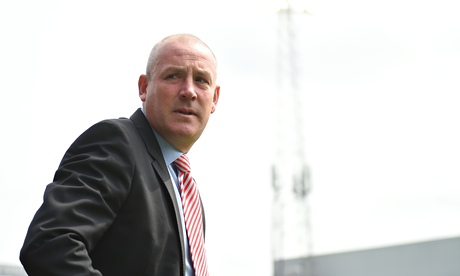
Rangers’ effort to become a very different club under new ownership is a conscious one – illustrated no better than by the appointment of Mark Warburton as their manager on Monday. The 52-year-old probably would not have been considered for the Ibrox job in the past but he is now seen as the embodiment of a new direction for the club. A “modernisation” as director Paul Murray put it at his unveiling.
While Warburton is something of a left-field appointment, his hiring, following a successful spell at Brentford, marks a return to normality for Rangers. Financial meltdown and banishment from the Scottish top flight saw the club start again from the foot of the country’s football pyramid, and yet this feels like the first time a wet cloth has been dragged over the slate.
Ally McCoist, for instance – the manager for three and a half years – was a remnant of Walter Smith’s coaching set-up, with two interim bosses – Kenny McDowall and Stuart McCall – following his departure in December. Even Smith himself, the last truly successful Rangers manager, was a familiar face following his 12-year association with the club over the 1980s and 90s. Warburton’s arrival therefore marks the first fresh Rangers appointment since 2006, when Paul Le Guen was chewed up and spat out within five months.
The appointment of David Weir, a Rangers player for five years, as the assistant manager provides the set-up with a historic connection to the club but Warburton’s background as something of a statistician and a former London city stock trader marks him out as a member of football’s new coaching generation – something Rangers hope to draw on and project across the whole club.
“In the City you’re working in dealing rooms, testosterone-filled rooms, looking to make money – and that’s the same as a football dressing room,” he said. “I like players who dominate the ball and play with possession. It’s not the right way, it’s our way.”
Rangers had been linked with a number of sporting directors, including the former Scottish FA performance director Mark Wotte. With so many players to be brought in before the start of next season, such an appointment to complement the manager may have made sense. It seems Rangers view Warburton as a compromise between the two roles. “Mark has a wider view of the role as manager,” Murray said. “We see Rangers as a modern club going forward.”
Le Guen’s failure at Rangers serves as something of a warning for Warburton. The Frenchman arrived at Ibrox as one of the brightest young coaches in Europe, yet was met with sheer ignorance and his efforts to modernise the club were resisted. Back then, however, Rangers were Scotland’s predominant team, having won three successive league titles. Now Rangers, having missed out on promotion to the Premiership, have been forced to change through failure.
With 11 players leaving at the end of the season Warburton must quickly draw up a list of targets and start piecing together his squad. Essentially, a whole first team must be signed over the next few weeks, with the owner Dave King using buzzwords like “over-investment” and “acceleration” when discussing the club’s transfer window approach. “Our aim is to win the division,” said Warburton, recognising the weight of expectation placed on him.
He is wary of repeating the mistake Rangers have made so crudely in recent years – signing experienced but washed-up players for big money. Instead a man who spent his own money visiting some of Europe’s biggest clubs is placing emphasis on youth. “I think we have to work with the youth system,” he said. “Any club will tell you the academy should be the heartbeat of the club, producing players who are passionate about playing for that club.”
The teenagers Tom Walsh, Ryan Hardie and Andy Murdoch all broke into first-team reckoning during McCall’s short stint, reiterating the importance of youth to a club that has no discernible scouting system. “I’ve got an idea of the squad, and I realise it’s quite lean,” Warburton said.
The average age of Rangers’ squad sat at a lofty 28 last season and lowering that is an objective. “That will be our aim, to make sure we work closely, give the boys the opportunity to progress, give them a pathway, and hope they go from there,” Warburton said. “It’s about long-term foundations. We have to prepare for the longer term here.”