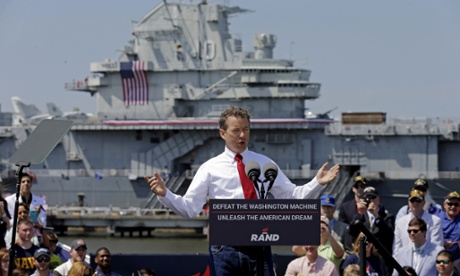
Rand Paul raised more questions than he answered about the foreign policy he would pursue if he became president with a much-anticipated speech in front of the aircraft carrier the USS Yorktown on Thursday.
“I see an America strong, strong enough to deter foreign aggression, yet wise enough to avoid unnecessary intervention,” the Kentucky senator told the audience in South Carolina.
Paul spent only about five of the speech’s 22 minutes discussing foreign policy, relying heavily instead on pledges to constrain the IRS, reject deficit spending and introduce term limits for Congress.
But it positioned Paul as an aggressive advocate of an America that rejects “frivolous” wars, unsubtly if subliminally attacking his rivals – most notably, South Carolina’s own ultra-hawkish senator Lindsey Graham, and likely Democratic candidate Hillary Rodham Clinton – and sounding reminiscent of Barack Obama’s milestone 2002 speech rejecting “dumb wars” like Iraq.
The obligations of commander-in-chief, Paul said, “should never be given to any individual who frivolously or cavalierly calls for war”. Both Graham and Clinton supported the 2003 Iraq war, and the rest of the Republican field has reacted with skepticism to Obama’s diplomatic accord with Iran last week.
The most specific substantive criterion Paul offered for determining when the US must go to war was a negative: a rejection of nation-building. Procedurally, he vowed not to launch a war “without the constitutional approval of Congress”, a frequently-flouted principle, most recently by Obama for the US’s newest war in Iraq.
As Obama did in 2002 and later on the 2008 campaign trail, Paul offered reassurances that he is no pacifist. He reiterated his opposition to the “barbarous aberration” he termed “radical Islam” and said that as commander-in-chief, the world would not be able to mistake a US desire for peace with “passivity”.
Wars fought by Paul, if elected, would feature “unrelenting force and we shall not relent until victory is ours”, he said.
Though Paul did not explicitly reference it, he tapped into a tradition associated with Ronald Reagan’s defense secretary Caspar Weinberger, who advocated the use of overwhelming force in wars limited to an overriding national interest. (“Unless we are certain that force is essential, we run the risk of inadequate national will to apply the resources needed,” Weinberger warned in a 1984 speech of his own.)
Paul preferred, as do most GOP candidates, to cite Weinberger’s boss.
“In 1964, Ronald Reagan warned of the dangers of ceding our freedom to a little intellectual elite in a far-distant Capitol who think they can plan our lives for us better than we can plan our lives for ourselves,” he said, before a long disquisition about his domestic policy preferences for lower taxes, an end to deficit spending and more.
Paul appeared unconcerned with fleshing out his campaign foreign policy or clarifying his shifting positions. His criteria for determining the national interest, the stated linchpin of his decision-making about launching a war, went unarticulated. “Radical Islam” is a vague term that has been used in the years since 9/11 to encompass everything from Hamas to Iran to the Islamic State to Nato ally Turkey and non-Nato ally Saudi Arabia. Paul had nothing at all to say about any of the non-martial aspects of US foreign policy, save for a line rejecting foreign aid predicated on borrowed money.
On surveillance, a signature issue for Paul, the candidate repeated his pledge to end “on day one” of his administration the bulk collection of US phone and internet data. Along the way, he misattributed the architecture of the US surveillance apparatus to an Obama “executive order”, though its real legal foundations are a 1978 law and a 1981 executive order issued by Reagan. (Obama signed a January 2014 order trimming the sails of his ongoing bulk domestic phone data collection; and an earlier policy directive authorizing cyber-attacks.)
Paul was on firmer footing taking a shot at his hawkish rivals for the Republican nomination, who frequently attack Paul as a naive, unserious dove.
“War is not a game and should not be used for political advantage. Too many lawmakers in Washington haven’t learned that lesson,” Paul said.